When Plans Fall Apart: Willem Verbeeck Finds Beauty in the Unpredictable on the Outer Banks

When inclement weather disrupts a scheduled public event, the standard protocol for photographers and spectators alike is immediate evacuation, complete with camera equipment safely stowed in protective cases. Yet, contemporary photographic lore frequently suggests that the most compelling visual narratives emerge precisely when itineraries disintegrate. On analog trips especially, where the temporal distance between capture and development breeds a unique kind of suspense, the frames resulting from logistical failures often prove to be the most enduring.
Over the course of a nearly two-week expedition across the remote, storm-prone landscape of North Carolina’s Outer Banks, analog photographer and educator Willem Verbeeck systematically tested this premise. Encountering a continuous sequence of meteorological interruptions and deviated plans, Verbeeck relied on traditional film techniques to document an environment defined by shifting sands, maritime isolation, and volatile coastal weather patterns. The resulting body of work underscores a fundamental truth of documentary photography: rigid planning yields predictable archives, whereas adaptation yields discovery.
The Rained-Out Speedway: Capturing Chaos in the Mud
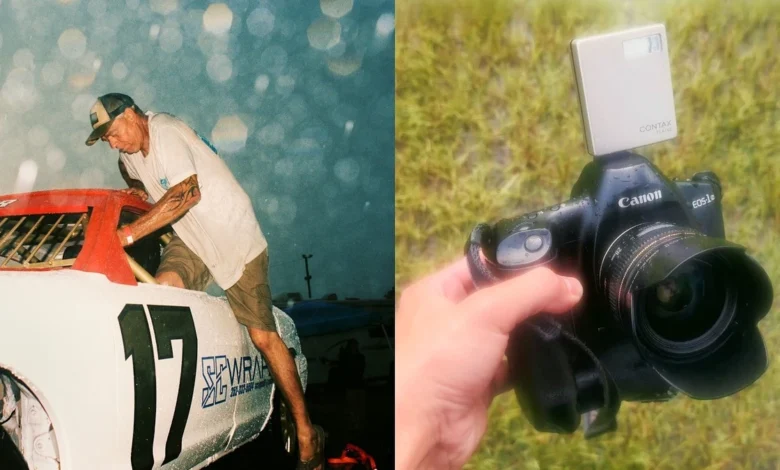
The most pronounced disruption of Verbeeck’s itinerary occurred approximately an hour inland from the barrier islands, at a localized dirt speedway that the photographer had sought to visit for years. Upon arrival, local race teams had already meticulously prepared their vehicles, tuning engines and adjusting tire pressures in anticipation of the evening’s heats. However, a sudden, high-intensity tropical downpour swiftly saturated the clay oval, forcing track officials to officially cancel the event.
As pit crews and mechanics immediately pivoted from racing preparations to frantically loading competitive machines back onto transport trailers, Verbeeck made a calculated technical risk. He deployed a Canon EOS-1N—a robust, professional-grade 35mm single-lens reflex camera that possesses no factory-certified weather sealing—directly into the driving rain.
The operational dynamic of regional dirt track racing in the American Southeast contrasts sharply with more heavily regulated motorsports venues in regions like Southern California, where events are routinely canceled at the earliest meteorological threat. By contrast, southern dirt tracks operate on resilient community schedules, and the sudden abandonment of a race produces a distinct human and mechanical landscape.
Shooting in the downpour yielded frames impossible to capture during standard racing conditions: mechanics soaked to the skin, drivers scrambling to secure expensive equipment under temporary tarps, vehicle headlights cutting through dense sheets of torrential rain, and subjects entirely too preoccupied with the elements to register the presence of a camera lens. These raw, candid documents illustrate the friction between human ambition and unforgiving atmospheric forces.
Maritime Transit and the Ocracoke Ferry
Reaching the more isolated stretches of the Outer Banks required utilizing the North Carolina Department of Transportation ferry system, specifically the free vehicular route to Ocracoke Island. These marine vessels function as essential infrastructure for both permanent residents and regional tourists, creating a compressed, highly accessible sociological cross-section on the open deck. For a street and documentary photographer, the ferry deck serves as a dynamic, floating stage.
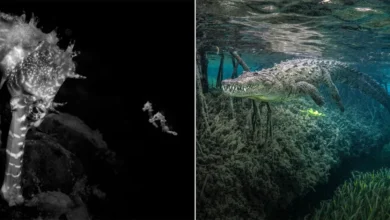
The transit assumed an unexpected visual dimension after nightfall, when the vessel’s powerful overhead navigation and safety lights engaged. The artificial illumination acted as a potent attractant for hundreds of migratory seabirds, drawing gulls into a tight, chaotic vortex that trailed the moving ferry.
Accompanied by a fellow creative, Verbeeck utilized portable flash units to document the avian activity as the gulls swept past the superstructure. Operating manual flash on fast-moving subjects under low-light conditions on analog film introduces an exceptionally high failure rate. Photographers lose the instant feedback loop of digital review screens, rendering focus, exposure timing, and light diffusion variables entirely speculative until the exposed rolls are processed in a darkroom. The technical gamble, however, successfully yielded high-contrast imagery that captured the kinetic energy of the maritime crossing.
Technical Evolutions: Amphibious Systems and Underwater Optics
Equipment durability formed a central theme of the expedition, underscored by a mid-trip transition to specialized underwater photographic hardware. During a localized surf lesson, a companion handed Verbeeck an amphibious camera, offering a distinct mechanical contrast to the Minolta Weathermatic models Verbeeck had previously deployed during coastal work in Hawaii.
The lineage of dedicated underwater cameras traces directly back to the introduction of the Nikon Nikonos in 1963, a system developed from foundational French amphibious camera engineering. Nikon maintained and evolved the Nikonos product cycle until the discontinuation of the Nikonos V model in 2001. These mechanical, interchangeable-lens bodies were engineered for professional SCUBA diving, capable of operating at hydrostatic pressures far exceeding the demands of recreational beach use or shallow surf photography.
Conversely, cameras such as the Minolta Weathermatic represent a simplified consumer philosophy: fixed-angle lenses, minimalist external controls, and exterior chassis sealing rated strictly for surface splashes and shallow immersion. For practitioners whose aquatic work is confined to surfboards or waist-deep ocean margins, simplified weather-resistant compacts provide sufficient utility, eliminating the operational anxiety of delicate mechanics.
However, professional amphibious systems justify their fiscal and physical weight when a photographer requires precise manual exposure control or exceptional optical sharpness beneath the surface. For contemporary practitioners acquiring used Nikonos bodies on the secondary market, industry technicians consistently emphasize a critical maintenance caveat: the rubber O-rings and internal sealing gaskets of vintage housings degrade over time. Without comprehensive inspection and preventative replacement by qualified service technicians, decades-old seals are prone to catastrophic failure upon submersion.
Meteorological Frustrations: The Elusive Lightning Strike
Not all experimental captures yielded successful exposures. During a week marked by frequent atmospheric instability near Jennette’s Pier, Verbeeck expended an entire roll of 35mm film attempting to document coastal lightning storms, ultimately failing to secure a single definitive bolt on emulsion.
Photographic analysis suggests that the specific meteorological conditions—characterized by relatively dry air masses—accelerated the atmospheric discharge speed, rendering individual lightning bolts significantly faster and less visually persistent than the lingering, high-humidity electrical displays common to tropical environments. Compounding the challenge, the Canon EOS-1N lacks automated lightning-triggering sensors or intervalometer capabilities linked to optical flashes. Consequently, Verbeeck was forced to rely entirely on manual human reflexes, attempting to anticipate and shutter-click individual strikes in real-time. The exercise highlighted a universally understood trial within traditional analog practice: human visual reaction times are fundamentally ill-suited to capture sub-second atmospheric phenomena.
Historic Reenactments and Unexplained Skies
The expedition also incorporated structured historical documentation, including a Coast Guard operational reenactment staged at one of the original historic life-saving stations peppering the Outer Banks. Conducted under intense afternoon heat, the event featured participants outfitted in authentic period uniforms.
For Verbeeck, the assignment marked an initial foray into historic reenactment photography. The juxtaposition of period-accurate costumes against late-19th and early-20th-century architectural infrastructure produced frames imbued with a distinct temporal ambiguity, evoking documentary aesthetics from a century prior.
Following the aborted speedway shoot, atmospheric conditions continued to generate anomalies. As the tropical squall line cleared the mainland highway, a remarkably long, well-defined band of cloud formations stretched uninterrupted across the entirety of the evening sky. Spotting the rare meteorological formation, the crew diverted to the nearest location offering an unobstructed horizon line—a local commercial gas station. Verbeeck noted the singularity of the cloud structure, stating that he had never encountered a comparable atmospheric phenomenon, and subsequently appealed to meteorological observers for formal identification of the cloud formation.
Broader Implications for Analog Documentary Work
The documentation gathered across the Outer Banks highlights the resilience required in modern film-based media creation. In an era dominated by instantaneous digital validation, algorithmic optimization, and hyper-controlled studio environments, expeditions relying on manual chemical processes embrace uncertainty as a core creative driver.
By refusing to capitulate to rained-out schedules, equipment limitations, or technical failures, practitioners like Verbeeck demonstrate that the periphery of an event—the unscripted chaos of a parking lot evacuation, the erratic flight of seabirds under strobe light, or the accidental geometry of storm clouds over industrial infrastructure—frequently carries greater narrative weight than the primary event itself. As the physical rolls return from commercial laboratories, the resulting visual archive serves as a testament to the enduring value of patience, mechanical adaptation, and unplanned exploration in visual journalism.
Related posts: