

The global landscape of expatriate relocation has undergone a structural transformation, driven by shifting economic pressures, tightening visa requirements, and evolving digital nomad policies across the international community. Originally compiled in 2018, the definitive ranking of overseas relocation destinations by expatriate expert Kathleen Peddicord has been comprehensively re-evaluated for 2026. This updated analysis reflects critical legislative shifts, such as the discontinuation of major European golden visa real estate avenues, fluctuating cost-of-living metrics, and updated U.S. State Department travel advisories.

For American citizens considering a departure from the domestic market, maintaining a foundational connection to the United States remains a logistical necessity. Managing domestic financial accounts, tax obligations, and physical mail handling typically requires a verified U.S. residential address. Specialized logistics services, such as SavvyNomad, continue to facilitate these domestic requirements for long-term expatriates residing abroad. Below is the updated, exhaustive assessment of the top ten international destinations for Americans seeking an alternative lifestyle overseas in 2026.
1. Lisbon, Portugal: Old World Elegance Meets Modern Visa Realities
Steeped in a maritime history that traces back to Phoenician trade routes and flourished during the 15th-century Age of Discovery, Lisbon remains a premier destination for urban expatriates in Europe. Characterized by pastel-colored stone facades, jacaranda trees, and intricate mosaic sidewalks, the Portuguese capital offers a refined European lifestyle. However, the regulatory framework governing foreign residency in Portugal has experienced sweeping changes heading into 2026.

Legislative and Economic Shifts
The golden visa landscape changed fundamentally when Portugal officially terminated the real estate acquisition pathway for residency. While the €500,000 investment fund route remains available, the widely utilized Non-Habitual Resident (NHR) tax regime was simultaneously phased out for general applicants, narrowing tax incentives primarily to highly qualified scientific researchers and professionals.
The primary pathway for American retirees is now the D7 passive-income visa, which requires verified monthly earnings of approximately €920 for a single applicant and €1,380 for a couple, alongside liquid savings equivalent to an annual income. For remote professionals, the D8 digital nomad visa mandates a minimum monthly income threshold of €3,680. Furthermore, legislative adjustments extended the path to naturalization for non-EU nationals to 10 years of legal residence, though permanent residency remains accessible after five years. Economically, rapid gentrification has caused property prices and new lease rents to nearly double compared to 2018 metrics, pushing a couple’s monthly budget in Lisbon to a range of €2,300 to €4,200. The U.S. State Department currently maintains a Level 1 travel advisory for Portugal, advising normal precautions.

2. Cali, Colombia: The Valle del Cauca Salsa Capital
Positioned south of Medellín at an altitude of approximately 3,300 feet, Cali presents a geographically strategic and economically accessible urban environment. Often overshadowed by historical safety concerns and negative media framing, Colombia’s third-largest city—housing a metropolitan population of roughly 2.5 million—offers a temperate year-round climate, expansive green spaces, and a cost of living significantly lower than competing South American hubs.
Practical Realities and Security
Colombia’s pro-U.S. diplomatic stance underpins its appeal to American expatriates. Retirees utilizing the pensionado visa must demonstrate a lifetime pension equivalent to at least three times the national monthly minimum wage, totaling approximately 5,252,715 Colombian Pesos (COP) per month in 2026, or roughly $1,400 to $1,650 USD depending on exchange rate fluctuations. A typical expatriate couple can maintain a comfortable lifestyle in Cali on a monthly budget ranging from $1,200 to $1,825.

Impartial risk assessment requires acknowledging the U.S. State Department’s Level 3 travel advisory ("Reconsider Travel") issued for parts of Colombia. While Cali is carved out from the severe Level 4 designations affecting wider sections of the Valle del Cauca department, localized crime and elevated homicide rates relative to Bogotá or Medellín require careful neighborhood selection and integration into local safety networks.
3. Santo Domingo, Dominican Republic: The Historic Cradle of the Americas
Established in 1496 by Bartholomew Columbus, Santo Domingo holds the distinction of being the oldest continuously inhabited European city in the Americas. Featuring classic Spanish colonial architecture, Calle Las Damas, and the historic residence of Diego Columbus, the capital city offers a dignified and culturally rich Caribbean environment paired with one of the most streamlined residency processes in the region.

Immigration and Cost Dynamics
The Dominican Republic facilitates long-term settlement through well-defined pensionado and rentista visa programs, requiring monthly certified incomes of roughly $1,500 and $2,000, respectively. While promotional literature frequently highlights fast-track citizenship, legal frameworks dictate that immediate permanent residency and accelerated citizenship eligibility are primarily secured through the investor route, requiring a minimum capital investment of $200,000. For standard retirees, statutory timelines to naturalization generally range from two to seven years. Daily living expenses for a couple in Santo Domingo average $2,200 to $2,800 per month. The U.S. State Department maintains a Level 2 travel advisory ("Exercise Increased Caution") for the nation.
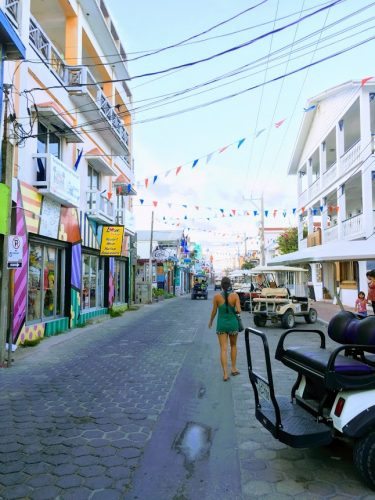
4. Ambergris Caye, Belize: Caribbean Island Living in San Pedro
Transitioning from an isolated fishing village accessible primarily by boat or unpaved airstrips into a mature island community, Ambergris Caye centers around the coastal town of San Pedro. While modern infrastructure now supports multi-story resorts, golf cart transit networks, and professional service hubs, the island retains a distinct, English-speaking community atmosphere that attracts expatriates from across the globe.
Residency and Financial Planning
Belize continues to attract retirees through its Qualified Retired Persons (QRP) program. Eligibility requires applicants to be at least 40 years of age and able to document a minimum monthly income of $2,000 sourced from outside Belizean borders. In exchange, participants receive duty-free exemptions on household goods and vehicle imports. However, inflation and coastal development mean Ambergris Caye is no longer an ultra-budget destination; a retiring couple should anticipate monthly expenditures between $2,500 and $3,500. The U.S. State Department maintains a Level 2 travel advisory for Belize.
5. Saint-Chinian, France: Affordable French Countryside Living
Located in the Languedoc region of southern France—now officially consolidated within the Occitanie administrative zone—Saint-Chinian offers an authentic rural French lifestyle at a fraction of the real estate and operational costs associated with neighboring Provence or the Côte d’Azur. Boasting a population centered around 1,800 inhabitants alongside a prolific winemaking economy specializing in AOC-certified red wines, the village provides traditional European charm coupled with high-speed rail connectivity via nearby Béziers.

Immigration Regulations and Remote Work Restrictions
France does not feature a dedicated retirement visa category. Consequently, Americans typically apply for the long-stay visitor visa (VLS-TS visiteur), which mandates proof of financial resources equivalent to the French minimum wage (roughly €1,800 gross monthly in 2025) and explicitly prohibits engaging in local professional employment. Furthermore, French authorities clarified that this visitor status does not extend authorization to remote work conducted for foreign employers, presenting a legal hurdle for digital professionals. Real estate values in the region remain roughly half those of Provence, allowing a couple to live comfortably on a budget of €2,000 to €2,500 monthly. The U.S. State Department maintains a Level 2 travel advisory for France.
6. Città Sant’Angelo, Italy: The Undiscovered Abruzzo Region
Nestled between the Apennine Mountains and the Adriatic coastline, the Abruzzo region offers dramatic geographic diversity, ranging from alpine ski resorts to Mediterranean beaches. Historically recognized as one of Italy’s economically disadvantaged zones, Abruzzo has experienced steady infrastructure development and GDP convergence with northern Italian standards. Within this landscape, the historic hilltop town of Città Sant’Angelo serves as an emerging alternative to saturated Tuscan tourist destinations.

Economic and Financial Frameworks
Italy’s Elective Residence Visa requires applicants to demonstrate independent, passive annual income of approximately €31,000, while strictly prohibiting domestic labor. Additionally, Italy hosts a targeted digital nomad visa for remote professionals meeting a higher earnings threshold of roughly €28,000 annually. Due to inflationary pressures and currency adjustments, an expatriate couple should budget between €1,800 and €2,400 monthly for living expenses in Abruzzo. The U.S. State Department maintains a Level 2 travel advisory for Italy.
7. Ljubljana, Slovenia: Central European Stability and Rural Access
Serving as the political, cultural, and economic capital of Slovenia, Ljubljana merges Central European architectural heritage with extensive green spaces and proximity to both the Julian Alps and the Adriatic coast. As the most economically advanced Slavic nation by GDP per capita, Slovenia offers a first-world infrastructure embedded within a tranquil, heavily forested landscape.

Visa Structures and Cost Metrics
While Slovenia lacks a traditional retirement visa, the nation introduced a dedicated digital nomad permit allowing one-year stays for remote employees earning at least twice the average net national salary (approximately €3,400 monthly in 2026). Retirees generally utilize standard temporary residence permits contingent on proving adequate financial self-sufficiency and comprehensive health insurance. Ljubljana has transitioned into a moderately priced European capital, with monthly expenditures for a couple averaging approximately $3,000 USD. The U.S. State Department maintains a Level 1 travel advisory ("Exercise Normal Precautions") for Slovenia.
8. Playa del Carmen, Mexico: Proximity and Infrastructure on the Riviera Maya
Situated along the Caribbean coastline of the Yucatán Peninsula, Playa del Carmen has evolved from a transit hub for Cozumel ferries into a major international expatriate enclave. Characterized by the pedestrian-only Quinta Avenida, robust English-language integration, and extensive commercial infrastructure, the city accommodates a diverse demographic ranging from young families to retirees.

Immigration Policies and Cost Adjustments
Mexico’s temporary resident visa framework experienced adjustments tied to the Unidad de Medida y Actualización (UMA) index. Consular offices generally require proof of monthly income ranging from $4,400 to $4,650 USD, or equivalent liquid savings between $74,000 and $78,000 USD. Driven by sustained regional growth and tourism demand, real estate and rental markets have climbed, setting a couple’s operational budget between $2,100 and $2,800 USD monthly. The U.S. State Department maintains a Level 2 travel advisory for the state of Quintana Roo.
9. Bali, Indonesia: Tropical Biodiversity and Long-Term Stays
Renowned globally for its volcanic topography, terraced agricultural landscapes, and Hindu temple culture, Bali remains a premier tropical destination. Within the island, the coastal suburb of Sanur provides a quieter, unpretentious residential alternative to the heavily touristed southern beaches, offering a balanced environment for expatriates seeking community integration.

Regulatory and Financial Updates
Indonesia expanded its long-term residency options beyond traditional tourist visas. The Second Home Visa offers multi-year residency (five or ten years) for individuals maintaining a minimum deposit of IDR 2 billion (approximately $111,000 USD) in a designated state bank account. Furthermore, the E33G remote-worker KITAS accommodates digital professionals earning a minimum annual income of $60,000 USD. A couple residing in Sanur can expect monthly living costs to range between $1,500 and $2,200 USD. The U.S. State Department maintains a Level 2 travel advisory for Indonesia.
10. Da Nang, Vietnam: Economic Dynamism and Regional Growth
As Vietnam’s third-largest urban center, Da Nang combines modern infrastructure, strategic municipal master planning, and coastal geography with a traditional, family-run business culture. Registering record tourism arrivals exceeding 21 million foreign visitors nationally, Vietnam represents one of Southeast Asia’s most economically dynamic environments.
Visas and Expatriate Living Costs
Vietnam extended its electronic tourist visa duration to 90 days with multiple-entry privileges. However, the nation still lacks dedicated retirement or standalone digital nomad visa programs. Long-term expatriate residency typically requires sponsorship through local employment, qualifying corporate investments starting at VND 3 billion, or familial ties. Da Nang remains highly economical, with a couple’s monthly budget averaging $1,400 to $2,500 USD, inclusive of housing. The U.S. State Department maintains a Level 1 travel advisory for Vietnam.