Orient Express Venezia Defines the New Era of Venetian Hospitality Through Historic Maximalism

The opening of the Orient Express Venezia marks a transformative milestone in the luxury hospitality sector of Italy, signaling a shift toward the "reimagining" of historic assets rather than the mere renovation of existing hotel stock. Situated within the Palazzo Donà Giovannelli in the Cannaregio district, the property is the result of an exhaustive eight-year restoration project. By blending 15th-century Venetian architecture with high-concept contemporary design, the hotel serves as a focal point for the broader strategic expansion of the Orient Express brand, now under the stewardship of the Accor group.
A Chronology of the Palazzo Donà Giovannelli
The history of the Palazzo Donà Giovannelli is inextricably linked to the narrative of Venetian nobility. Built in the 1400s, the palazzo served for centuries as a private residence for the city’s elite, most notably the Donà family, who held significant sway in the Venetian Republic. Throughout the 19th century, the building underwent various modifications, reflecting the evolving aesthetic tastes of its successive owners.
The site’s recent history began in earnest in 2016, when the Accor group—in partnership with the investment firm Arsenale S.p.A.—initiated a massive development plan to convert the landmark into a flagship luxury hotel. The project required meticulous coordination with Italian heritage authorities to preserve the palazzo’s structural integrity, including its rare double-canal frontage. For nearly a decade, artisans, conservators, and structural engineers worked to stabilize the foundation and restore the building’s 15th-century architectural bones, culminating in the 47-room hotel that opened to the public this year.
Architectural Philosophy and Design Curation
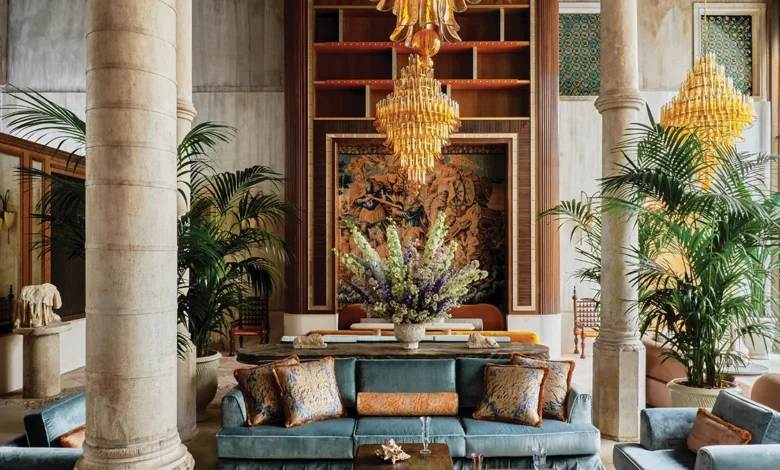
The design direction was spearheaded by architect Aline Asmar d’Amman, whose previous work on the Hôtel de Crillon in Paris informed her approach to balancing historical gravity with modern opulence. The property is designed as a "maximalist fever dream," a deliberate departure from the minimalist trends that dominated the hotel industry in the 2010s.

The common areas function as an immersive environment. The hotel features an extensive collection of custom-commissioned textiles from Bevilacqua, a historic Venetian weaving house, and hundreds of custom-blown Murano glass chandeliers. The spatial layout is anchored by an octagonal staircase—a signature architectural feature intended to serve as a dramatic transition point for guests.
The six signature suites, located on the piano nobile, represent the pinnacle of the property’s design ambition. These rooms range up to 1,560 square feet and serve as galleries for historical preservation. For example, the Cherubini Suite features an original 18th-century frescoed frieze by Sebastiano Santi, which has been integrated into a layout that includes a rare 1950s chandelier designed by Carlo Scarpa. This juxtaposition of Renaissance-era art and mid-century Italian design serves as a case study in curatorial hospitality.
Culinary Program and Brand Synergy
The hotel’s food and beverage operations are designed to anchor the property as a destination for international travelers. The dining program is led by Heinz Beck, a chef widely recognized for his three-Michelin-starred work in Rome. His presence at the hotel’s flagship restaurant underscores the brand’s commitment to high-level culinary standards.
Complementing this is La Casati, an all-day dining venue named in tribute to Luisa Casati, the eccentric patron of the arts who previously occupied the palazzo and whose legacy is closely tied to the history of the Peggy Guggenheim Collection. The incorporation of the "Wagon Bar," which utilizes Art Deco aesthetics, provides a thematic link to the Orient Express brand’s historical identity as a pioneer of luxury rail travel.
Strategic Context and Market Implications
The launch of the Orient Express Venezia is not an isolated development but a critical node in a larger infrastructure project. The hotel is positioned to serve as a primary transit hub for the forthcoming Orient Express "La Dolce Vita" luxury train service. This service, which will traverse Italy, aims to revive the golden age of European rail travel by connecting major cultural hubs via a fleet of newly designed, period-inspired carriages.

From a market perspective, the location in Cannaregio is strategic. Unlike the crowded areas surrounding the Piazza San Marco or the remote isolation of Giudecca, Cannaregio offers proximity to the city’s transport hubs—specifically the Venice Santa Lucia train station—while maintaining an air of residential exclusivity. This positioning mitigates the "overtourism" fatigue that has plagued other luxury properties in Venice, providing guests with a logistical advantage that is increasingly valuable in a post-pandemic travel economy.
Economic and Cultural Impact
The restoration of a landmark like the Palazzo Donà Giovannelli represents a significant capital investment in Venice’s preservation. By repurposing the site, the developers have prevented the potential degradation of a historic monument, instead integrating it into the city’s active economic ecosystem.
Industry analysts note that the trend of "branded luxury residences and hotels" in historic European cities is a response to the growing demand for "experiential travel." Travelers are no longer seeking standardized luxury; they are seeking properties that offer a narrative connection to the city’s history. The Orient Express Venezia addresses this by synthesizing the city’s artistic heritage with the operational precision of a global hospitality conglomerate.
Looking Ahead
The implication of the Orient Express Venezia for the wider hospitality market is clear: the future of high-end lodging lies in the ability to bridge the gap between museum-quality preservation and modern guest expectations. As Accor continues to scale the Orient Express brand, the Venice property will likely serve as the benchmark for future developments in Rome, Riyadh, and beyond.
For the city of Venice, the property’s opening serves as a reminder of the palazzo’s enduring role as a venue for high culture. Whether through the curated art programs, the preservation of the freschi, or the integration of historic Murano glasswork, the hotel functions as both a business entity and a custodian of Venetian heritage. As the new fleet of Orient Express trains begins its routes across the Italian landscape, the palazzo in Cannaregio stands ready to function as the ultimate gateway for the next generation of luxury travelers, successfully harmonizing the storied past of the 15th century with the sophisticated, mobile future of 21st-century travel.