Intrepid Travel Secures B Corp Recertification Under New Rigorous Global Standards


Global adventure travel pioneer Intrepid Travel has successfully achieved its latest B Corp recertification, navigating a newly overhauled framework introduced by B Lab designed to enforce stricter, more comprehensive sustainability and operational standards. First earning its B Corp status in 2018 and maintaining it through successive reviews, Intrepid’s latest credential reflects a fundamental shift in how third-party auditors measure corporate accountability, transforming the certification process from a flexible points-based system into a rigid matrix of mandatory performance metrics.
The transition to these heightened standards marks a significant evolutionary step for the global certification body, B Lab. Historically, companies could offset shortcomings in one operational pillar—such as environmental footprint—with high scores in another, such as employee relations, provided they crossed a cumulative numerical threshold. The updated framework eliminates this flexibility, establishing rigorous, mandatory requirements across seven distinct impact categories that encompass governance, workers, community, environment, and customers. Independent third-party audits now evaluate every facet of a certified enterprise, ensuring that organizations maintain top-tier standards across all operational vectors rather than cherry-picking areas of excellence.
Background Context and the Evolution of B Lab Standards
The B Corp movement, initiated in 2006 by the non-profit organization B Lab, was established to verify companies that meet high standards of social and environmental performance, public transparency, and legal accountability to balance profit and purpose. Over nearly two decades, the designation has evolved from a niche badge of honor for social enterprises into a gold standard for corporate responsibility.
As consumer demand for authentic sustainability grew, critics argued that older certification models allowed larger corporations to leverage historical points systems without fundamentally transforming entrenched, systemic practices. In response, B Lab spent years developing a revamped framework. This updated system shifts the emphasis from a voluntary scorecard to absolute performance thresholds. For multinational tourism companies like Intrepid, which manages complex supply chains, localized operations, and global networks, the revised standards represent an immense regulatory and logistical challenge.
Scope of the Assessment Across Global Operations
Unlike localized businesses evaluated under streamlined parameters, Intrepid’s recertification audit required a microscopic examination of its sprawling global infrastructure. B Lab’s evaluators scrutinized not only the corporate headquarters but also its 93 localized operational offices worldwide, proprietary accommodations, subbrands, and external supplier agreements.

This expansive review process highlights the multifaceted nature of modern sustainable tourism. In the context of Intrepid’s ecosystem, the audit spanned human resources policies in developing nations, wage equity, carbon tracking across transport networks, and the economic impact of tourism dollars on local micro-enterprises. According to industry analysts, this level of comprehensive scrutiny sets a new benchmark for the travel sector, where supply chain transparency has traditionally been difficult to enforce due to fragmented local partnerships and third-party vendors.
Chronology of Intrepid’s Sustainability Journey
Intrepid’s institutional commitment to responsible travel spans over three decades, marked by strategic milestones that culminated in its initial B Corp achievement and subsequent evolution:
- 1989: Intrepid Travel is founded in Melbourne, Australia, with a core mission to operate trips that benefit both travelers and host communities.
- 2018: The company achieves its inaugural B Corp certification, officially codifying its triple-bottom-line philosophy—people, planet, and profit—into its corporate charter.
- 2020–2022: Intrepid undergoes its first recertification cycle, adapting its operations to survive the COVID-19 pandemic while maintaining strict environmental and social protocols.
- 2024: B Lab introduces its new, rigorous performance-requirement standards, prompting a comprehensive internal audit across Intrepid’s global subsidiaries.
- Late 2026: Intrepid officially secures recertification under the new B Lab standards, validating its cross-border compliance with the updated mandatory impact topics.
Operational Realities: Translating Policy into Practice

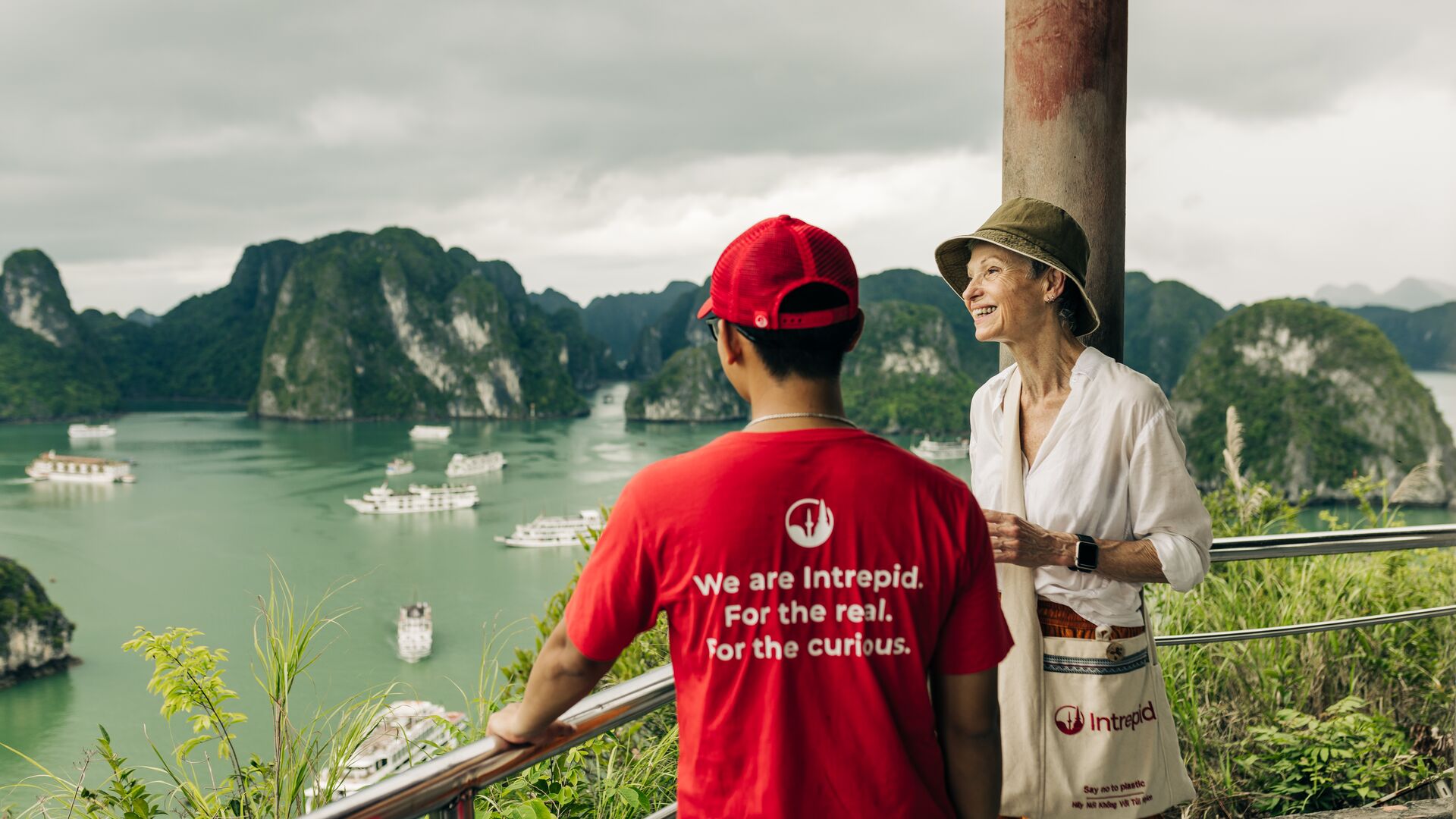
While corporate paperwork, independent auditing, and compliance matrices dominate the administrative phase of B Corp recertification, the ultimate test of these policies occurs on the ground during active itineraries. To illustrate how high-level corporate governance materializes in everyday travel scenarios, industry observers frequently examine standard small-group excursions, such as the company’s popular routes through Southeast Asia.
Consider a standard 15-day itinerary traversing Vietnam from Hanoi to Ho Chi Minh City. Far removed from corporate boardrooms, the effects of B Corp standards manifest in routine traveler experiences. Accommodations are deliberately selected to prioritize locally owned boutique hotels or community-led stays that circulate tourism revenue directly back into local neighborhoods rather than foreign conglomerates. Transport logistics emphasize low-carbon alternatives, such as expanding rail networks and sleeper trains, which simultaneously reduce the carbon intensity of the journey and offer authentic cultural immersion.
Furthermore, dining choices integrated into the itineraries intentionally support social enterprises, family-run street food vendors, and vocational training restaurants that uplift marginalized youth. These localized economic integrations are not accidental; they are the direct result of strict supply-chain vetting mandated by B Lab’s community impact metrics. Local tour leaders, hired directly from the destinations visited, serve as cultural bridges while receiving fair wages, comprehensive training, and health benefits that align with B Corp labor standards.
Statements and Industry Implications

While specific executive commentary regarding this recent recertification cycle highlights the arduous nature of the new audit, industry leaders have consistently emphasized that accountability must match the scale of the climate and social crises facing the tourism sector.
"Achieving recertification under B Lab’s new, uncompromising framework is a testament to the fact that sustainability is not a marketing strategy for us, but the core engine of our business model," noted a representative familiar with Intrepid’s corporate governance structure. "The travel industry must move past superficial greenwashing. When standards become stricter, companies must adapt or be left behind."
Economic and Environmental Analysts point out that Intrepid’s successful recertification establishes a precedent for the broader travel and leisure industry. As regulatory bodies in Europe and other regions crack down on unsubstantiated environmental claims—often referred to as greenwashing—voluntary certifications backed by rigorous third-party verification provide a credible differentiator for conscious consumers.
Fact-Based Analysis of Broader Industry Implications

The tightening of B Corp standards arrives at a critical juncture for global tourism. With international travel rebounding to pre-pandemic volumes, destinations worldwide are grappling with the pressures of overtourism, carbon emissions, and economic leakage—a phenomenon where the vast majority of tourist expenditures leave the host country.
By demanding mandatory performance requirements across all impact topics, B Lab’s updated framework directly targets economic leakage and labor exploitation. For companies aspiring to maintain B Corp status, passive compliance is no longer viable. Enterprises must actively demonstrate measurable, positive externalities in every market they operate within.
For Intrepid, maintaining this status under heightened scrutiny reinforces its market positioning as a leader in responsible tourism. However, it also raises the operational bar for competitors. As consumers become increasingly discerning, demanding transparent proof of sustainability claims, certifications like the revised B Corp credential will likely transition from a niche corporate differentiator to an essential license for operating responsibly in the global marketplace.
Ultimately, the successful recertification signals that while the paperwork behind sustainable travel is voluminous and the auditing process increasingly unforgiving, the intersection of rigorous corporate accountability and authentic on-the-ground travel experiences remains both achievable and vital for the future of global tourism.
Related posts: