The enduring legacy of ancient Greek sculpture continues to captivate historians, archaeologists, and global travelers alike. Renowned for their unprecedented realism, balanced proportions, and profound technical mastery, these works have defined the aesthetic trajectory of Western art for more than two millennia. From the idealized depictions of Olympic athletes and powerful mythological gods to dramatic scenes of triumph and despair, ancient Greek statuary offers an irreplaceable window into the cultural, religious, and political values of antiquity. However, a common misconception among modern travelers is that these masterpieces can only be viewed within the borders of Greece. Due to centuries of historical excavations, geopolitical shifts, museum acquisitions, and the widespread Roman practice of copying Greek originals, many of the world’s most significant surviving classical sculptures are now distributed across premier cultural institutions spanning Europe and the United States.
Understanding the distinction between original Greek bronzes or marbles and later Roman copies is critical for travelers and art enthusiasts planning cultural itineraries. Many original freestanding bronze statues cast during the Classical and Hellenistic periods were melted down for weaponry or currency in antiquity, leaving posterity reliant on marble replicas commissioned by Roman elites during the Republic and Empire. Furthermore, major archaeological discoveries continue to refine our understanding of these artifacts, highlighting the necessity of consulting up-to-date institutional catalogs before embarking on museum tours. Below is a comprehensive geographic and historical inventory detailing where key ancient Greek sculptures and statue-groups are housed today, along with essential context regarding their creation, preservation, and current display status.

The Louvre Museum, Paris, France
France’s national museum houses several of the most universally recognized Hellenistic masterpieces, serving as a primary destination for enthusiasts of classical antiquity.
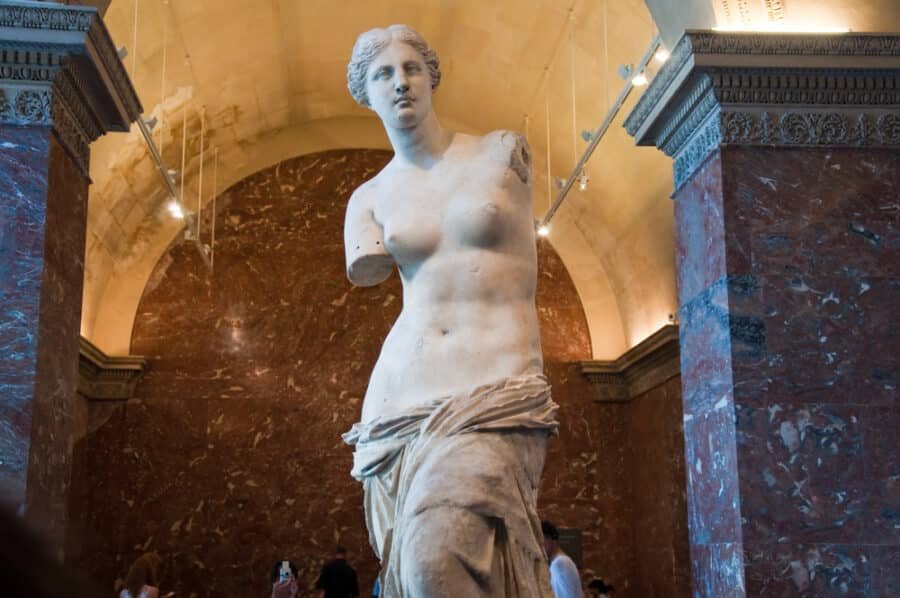
The Aphrodite of Milos, commonly known as the Venus de Milo, stands as one of the definitive icons of ancient Greek art. Generally dated to the second century BC, approximately between 160 and 110 BC, the sculpture is carved from Parian marble and measures 203 centimeters in height. Discovered on the Aegean island of Milos in 1820, its creation is occasionally attributed by fragmentary inscription evidence to Alexandros of Antioch on the Maeander, though this attribution remains a subject of ongoing scholarly debate. The figure’s missing arms and the precise narrative intent behind her pose have puzzled art historians for generations.

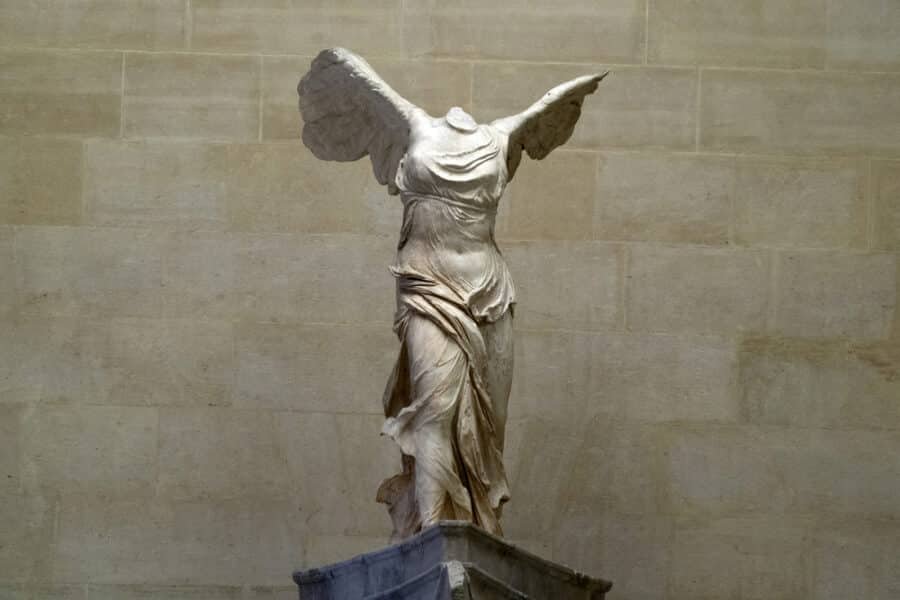
The Winged Victory of Samothrace, or the Nike of Samothrace, is a monumental Hellenistic sculpture dating to approximately 190 BC. Unearthed in fragments on the Greek island of Samothrace in 1863 by French archaeologist and diplomat Charles Champoiseau, the statue was meticulously reconstructed and now commands a dramatic focal point atop the Daru staircase within the Louvre. Depicting the goddess of victory descending upon the prow of a warship while facing a maritime gale, the sculpture showcases dynamic movement and masterful drapery. While often associated stylistically with the Rhodian sculptor Pythokritos, the creator’s exact identity remains unconfirmed.
The Lady of Auxerre, a considerably older limestone kore dating from 650 to 625 BC, is also maintained within the Parisian collections. Discovered in storage at the Auxerre Museum in 1907 with an unknown provenance, this Daedalic-style sculpture exemplifies the early archaic period, though its original religious or funerary function remains undetermined.
The National Archaeological Museum and Acropolis Museum, Athens, Greece
Athens remains the epicenter for indigenous classical heritage, housing an unmatched repository of archaic and classical masterpieces recovered directly from local sanctuaries and cemeteries.
The National Archaeological Museum in Athens hosts foundational works such as the Dipylon Kouros, also known as the Sacred Gate Kouros. Crafted from Naxian marble around 600 BC and standing approximately 2.1 meters tall, it was excavated in 2002 from the Kerameikos archaeological site and is attributed to the anonymous workshop of the "Dipylon Master." The same museum displays the Artemision Bronze—a magnificent original bronze dating to roughly 460 BC, recovered from a shipwreck off Cape Artemision, depicting either Zeus or Poseidon poised to hurl a weapon—alongside the Varvakeion Athena, a Roman-era marble statuette serving as the most faithful surviving scale copy of Phidias’s lost chryselephantine cult statue, the Athena Parthenos.
Nearby, the Acropolis Museum preserves works directly associated with the Athenian citadel. The Peplos Kore, carved around 530 BC from Parian marble, retains microscopic traces of the vivid polychrome pigments that originally decorated archaic sculptures, challenging the modern misconception that ancient Greek art was exclusively monochromatic. The Moschophoros, or Calf Bearer, dating to approximately 560 BC, depicts a bearded citizen carrying a sacrificial calf, accompanied by a base inscription identifying the dedicator. Additionally, the Kritios Boy, sculpted around 480 BC, marks a revolutionary stylistic departure into the severe style by introducing contrapposto—the natural weight-shift of the human pelvis—for the first time in Western art history.
Delphi and Olympia Archaeological Museums, Greece
For travelers seeking to view masterpieces in their original geographical and religious contexts, the archaeological museums of central and western Greece offer unparalleled insights.
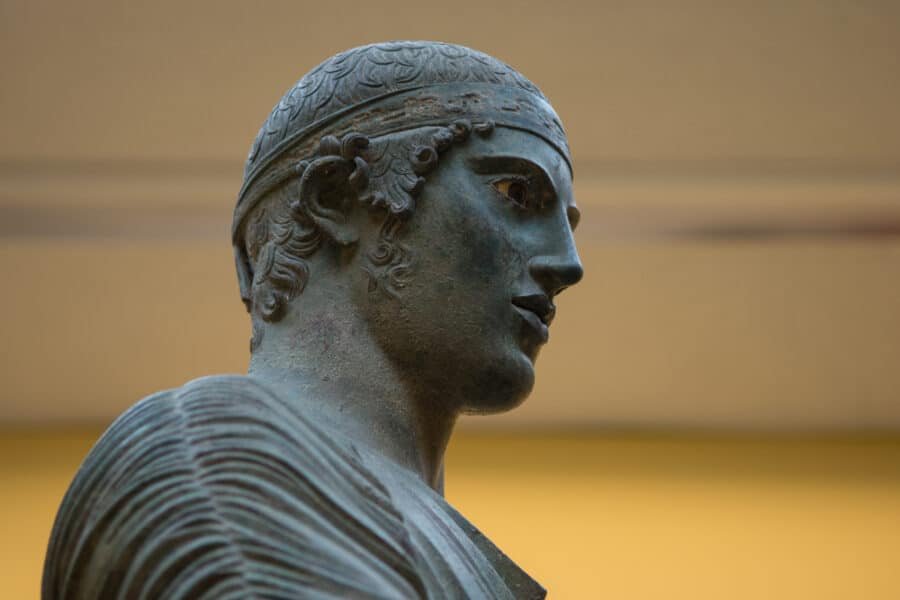
The Delphi Archaeological Museum features the Charioteer of Delphi, or Heniokhos, discovered in the Sanctuary of Apollo in 1896 and dated between 478 and 474 BC. Cast in bronze using the lost-wax technique, it is one of the rare surviving large-scale bronzes from the early classical period, commemorating a chariot victory at the Pythian Games. The same museum houses the archaic marble statues of Kleobis and Biton, dated to approximately 580 BC and signed by the sculptor Polymedes of Argos, illustrating the mythological tale recounted by Herodotus regarding filial piety.
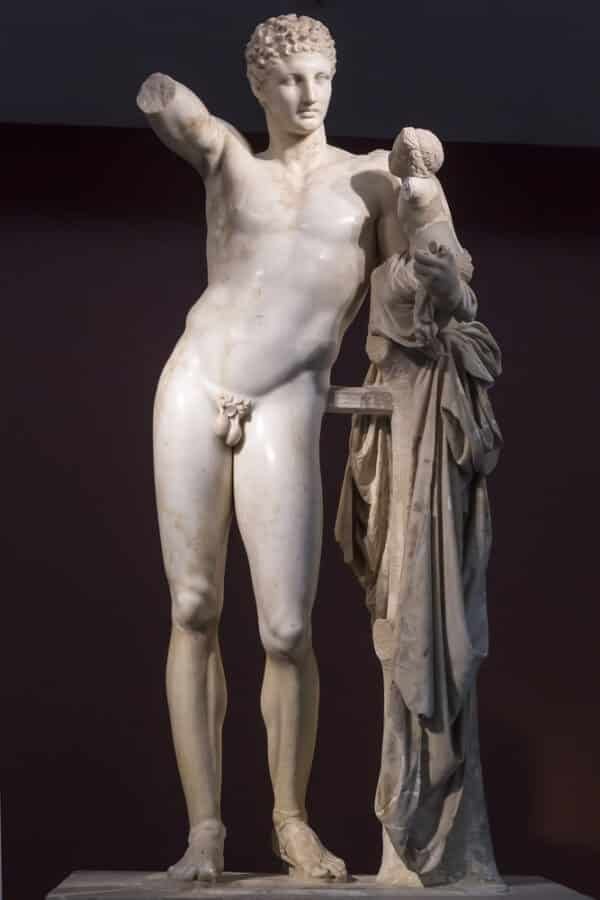
At the Archaeological Museum of Olympia, visitors encounter the Hermes of Praxiteles, unearthed within the Temple of Hera in 1877. Traditionally attributed to the renowned 4th-century BC sculptor Praxiteles, the Parian marble statue depicts the messenger god playing with the infant Dionysus. Olympia is also home to the terracotta group of Zeus and Ganymede, dating to around 470 BC, which demonstrates remarkable large-scale modeling from the early classical era.
National Roman Museum and Vatican Museums, Italy
Italy’s extensive collections reflect both the historical looting of Greek territories and the prolific Roman demand for high-quality copies of Hellenistic originals.
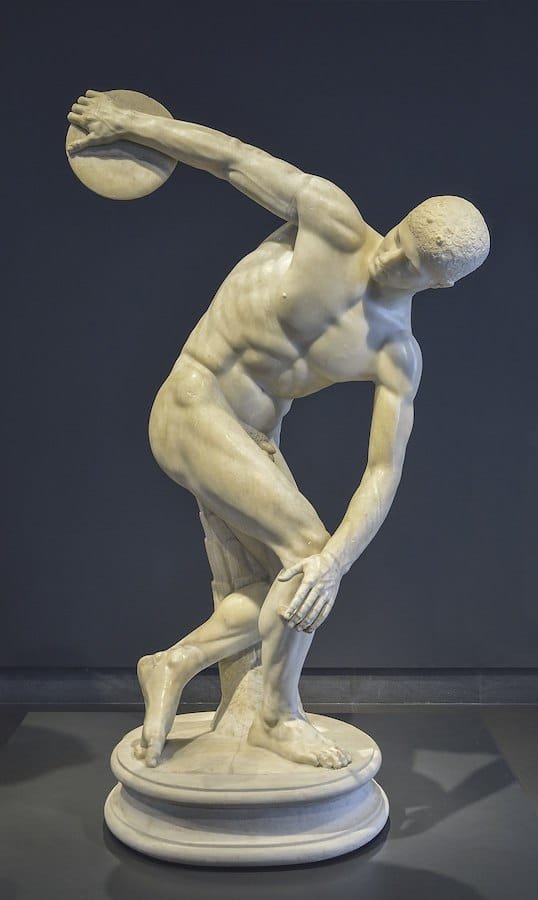
The National Roman Museum operates across multiple venues in Rome, most notably Palazzo Massimo alle Terme, which houses the Boxer at Rest. This Hellenistic bronze sculpture, created between 100 and 50 BC, portrays an exhausted pugilist seated after a brutal match, rendered with astonishing realism through copper inlay depicting wounds, cauliflower ears, and blood. The museum also displays one of the finest surviving marble copies of Myron’s 5th-century BC bronze original, the Discobolus (Discus Thrower). Furthermore, Italy preserves the Riace Bronzes in Reggio Calabria—two full-scale, highly detailed warrior statues recovered from the Ionian seabed in 1972—and the Farnese Hercules in Naples, a colossal Roman marble signed by Glykon, adapted from an original design by Lysippos.
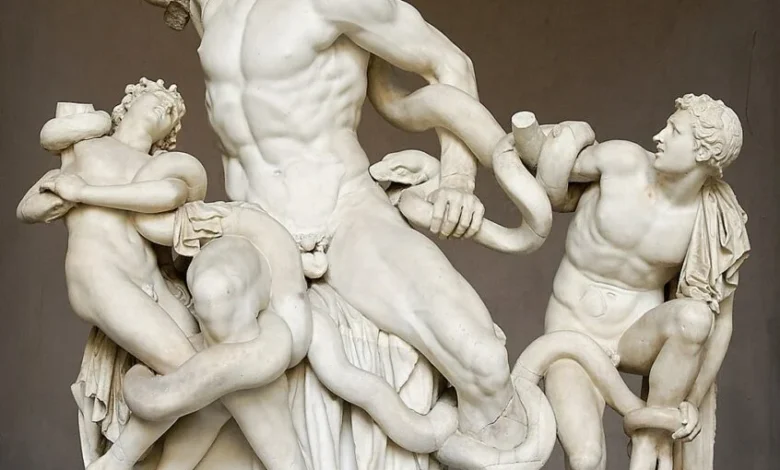
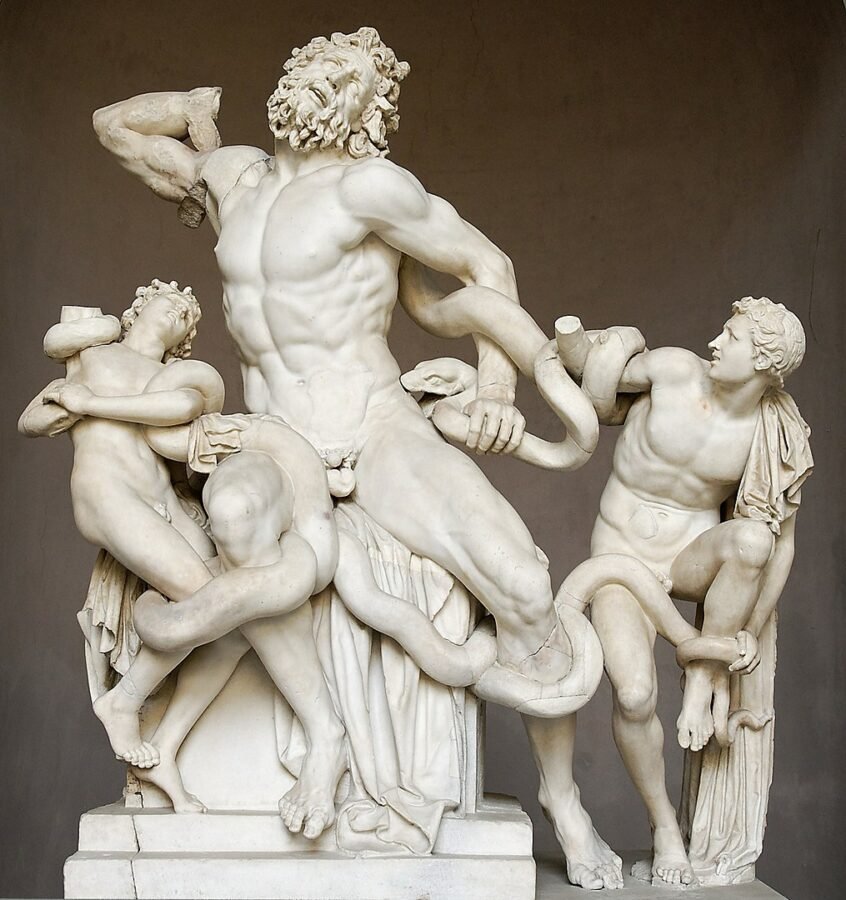
Within Vatican City, the Pio-Clementine Museum houses the legendary sculptural group of Laocoön and His Sons. Generally dated to the early 1st century AD and attributed by Pliny the Elder to the Rhodian sculptors Agesander, Athenodoros, and Polydorus, the work depicts the Trojan priest Laocoön and his sons being consumed by sea serpents. Discovered near Rome in 1506, its theatricality and emotional intensity profoundly influenced Renaissance masters such as Michelangelo.
Museums in Munich, London, and Los Angeles
Important collections outside the Mediterranean continue to preserve critical chapters of Greek artistic evolution.
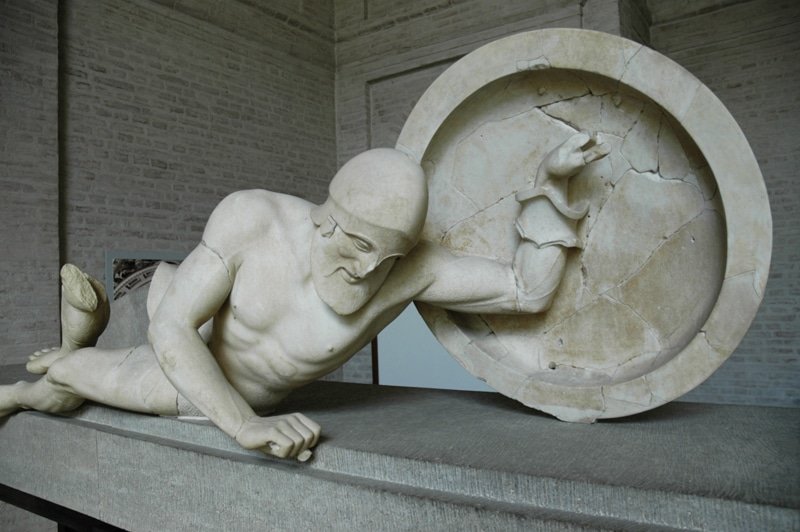
In Munich, the Glyptothek museum houses the Dying Warrior pedimental sculptures from the Temple of Aphaia on the island of Aegina, dating to circa 505–500 BC, alongside the Hellenistic Barberini Faun, a masterwork depicting a sleeping satyr in a state of relaxed muscular abandon.
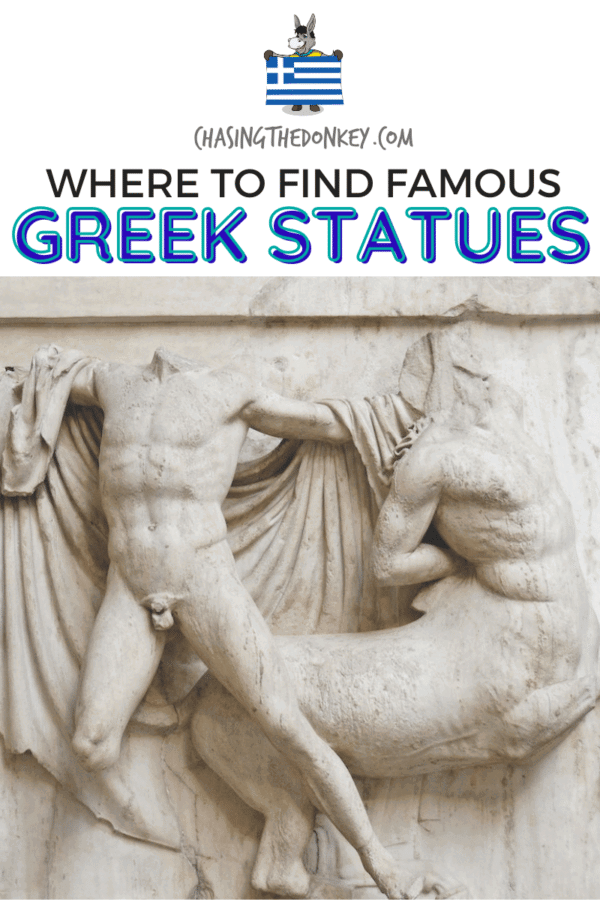
In London, the British Museum displays the Parthenon Marbles, including the carved marble metopes executed between 447 and 438 BC under the direction of Phidias. These architectural relief panels depict mythological battles, such as the Centauromachy, forming a contentious focal point in modern debates concerning cultural property repatriation.
In the United States, the J. Paul Getty Museum in Los Angeles preserves key antiquities, including a notable 1st-century AD Roman interpretation of Leda and the Swan, tracing its conceptual lineage back to 4th-century BC Greek prototypes associated with sculptors such as Timotheos.
Chronology and Evolution of Ancient Greek Art
To contextualize these masterpieces, art historians divide ancient Greek sculpture into distinct stylistic periods, each reflecting broader historical developments:
Archaic Period (c. 600–480 BC): Characterized by rigid frontal postures, formalized hairstyles, and the characteristic "archaic smile," exemplified by works like the Dipylon Kouros, the Peplos Kore, and Kleobis and Biton. Statues served primarily as grave markers (kouroi and korai) or votive offerings at sanctuaries.
Classical Period (c. 480–323 BC): Marked by a transition toward anatomical accuracy, naturalism, and emotional restraint. Divided into the Severe Style (e.g., Charioteer of Delphi, Artemision Bronze), the High Classical Period (e.g., Parthenon sculptures, Polykleitos’s canon of proportions), and the Late Classical Period (e.g., works by Praxiteles and Lysippos). This era prioritized idealized beauty, balance, and harmony.
Hellenistic Period (c. 323–31 BC): Beginning with the death of Alexander the Great, this era favored dramatic movement, intense psychological expression, theatricality, and realistic portrayals of diverse human experiences, ranging from the divine majesty of the Winged Victory of Samothrace to the stark realism of the Boxer at Rest and the Barberini Faun.
Implications and Practical Travel Considerations
The geographical dispersion of ancient Greek statuary necessitates careful research for cultural travelers. Because institutions frequently rotate objects for conservation, loan exhibitions, or structural reorganization within gallery spaces, visitors should independently verify current display inventories before finalizing international travel arrangements. Additionally, understanding the distinction between lost originals and surviving Roman copies deepens the educational value of visiting sites in Athens, Rome, Paris, and beyond. As ongoing archaeological excavations continue to unearth fragmentary evidence across the Mediterranean, our comprehension of these foundational works of human creativity remains dynamic, ensuring that the legacy of ancient Greek sculptors endures for future generations.