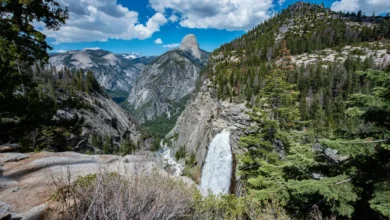
In the autumn of 2025, beneath clear, banner-blue skies, a group of ten backpackers and five dogs journeyed deep into a remote Utah canyon to celebrate a milestone birthday. The destination was chosen for its striking geological features, centered around a hundred-foot natural sandstone arch where the gulch widened. This expansive footprint allowed the group to distribute their sleeping arrangements across a wide radius—affording sweeping views of the ancient stone formation while maintaining enough physical distance to insulate light sleepers from nighttime disturbances.
The spatial distribution of the camp was spontaneous yet remarkably structured. Participants instinctively selected positions that mirrored historical human settlement patterns: three members pitched their tents within the protective shadow of a natural rock alcove; another participant and his canine companion established a vantage point atop a raised knoll backed by protective stone outcrops; and a professional photographer in the party selected an elevated perch sheltered by hackberry and maple trees, arranging his gear meticulously against the backdrop of a sheer orange cliff.
While ostensibly a casual wilderness celebration, this intuitive exercise in campsite organization reflects deep-seated evolutionary behaviors. Anthropologists, environmental psychologists, and behavioral scientists note that the meticulous process of establishing a temporary wilderness camp is not merely a logistical necessity of outdoor recreation. Rather, it represents a modern manifestation of survival instincts hardwired into the human brain over millennia of evolutionary history.
The Evolutionary Drivers of Wilderness Settlement
To understand why humans meticulously arrange gear, select specific vantage points, and establish perimeters in the backcountry, researchers look to environmental psychology and the concept of prospect-refuge theory. First proposed by British geographer Jay Appleton in 1975, the theory posits that human aesthetic pleasure and feelings of safety in natural environments are directly related to the presence of "prospect" (an unobstructed view of the surrounding area) and "refuge" (a safe place from which to view without being seen).
In the context of modern backpacking, these primal drivers dictate every decision made during the final hours of daylight before camp is established. The choice to pitch a tent beneath an overhang, against a rock face, or beneath a dense canopy satisfies an innate subconscious need for shelter and defensive positioning.
Behavioral data collected by outdoor recreation researchers indicate that backpackers, when left to their own devices in unfamiliar terrain, exhibit consistent spatial allocation patterns. These include:
- Elevation Advantage: A preference for elevated ground, knolls, or benches that provide drainage and a visual command of approaches.
- Back-Protection: Positioning sleeping quarters with a solid, impassable barrier—such as a cliff face, dense boulder field, or thick timber—at the rear to minimize perceived vulnerability from behind.
- Resource Proximity: Organizing utilitarian zones (cooking, gear staging, sleeping) in concentric circles relative to water sources or central gathering points, mirroring ancestral campsite layouts.
Chronology of an Expedition: From Trailhead to Tentsite
The journey into the Utah backcountry followed a standard protocol typical of remote wilderness expeditions, balancing physical endurance with logistical foresight.
Day One: Approach and Assessment
The expedition commenced at dawn from a designated Bureau of Land Management (BLM) trailhead. Traversing approximately eight miles of rugged terrain, the party carried self-contained supplies, including water filtration systems, freeze-dried and fresh rations, and heavy-duty shelter materials. Throughout the trek, expedition members continuously scanned the topography, subconsciously evaluating micro-climates, windbreaks, and geological stability.
Late Afternoon: The Selection Phase
Upon arriving at the natural arch site approximately two hours before sunset, the group engaged in a rapid, non-verbal assessment of the terrain. According to expedition logs, spatial segregation occurred within twelve minutes of arrival. Participants naturally drifted toward zones matching their psychological profiles and physical needs. The selection of the alcove, the knoll, and the elevated tree-line perch occurred without explicit coordination, highlighting the automatic nature of these environmental assessments.
Dusk: Organization and Habitat Stabilization
The final phase of camp setup involved the micro-organization of personal gear. Cameras, cooking stoves, and apparel were systematically arranged on flat sandstone slabs or hung from stable branches. This ritualized placement of personal belongings serves a dual purpose: it maximizes efficiency in low-light conditions and establishes a psychological boundary, signaling to the individual and the group that a temporary domain has been successfully claimed.
Supporting Data and Wilderness Demographics
The behavior observed in the Utah canyon reflects broader national trends in outdoor recreation. According to the Outdoor Industry Association’s (OIA) annual participation reports, backpacking and primitive camping have experienced a steady upward trajectory, driven by demographic shifts toward wellness-oriented travel and outdoor escapism.
Data from land management agencies, including the National Park Service (NPS) and the U.S. Forest Service (USFS), indicate that millions of Americans engage in overnight backcountry trips annually. Psychological studies conducted in conjunction with these agencies reveal several key findings regarding human behavior in remote environments:
- Anxiety Reduction: Over 78% of surveyed backpackers report a significant reduction in cortisol levels within 24 hours of establishing a wilderness camp, largely attributed to the removal of urban stimuli and the resolution of immediate shelter needs.
- Territorial Instincts: Controlled behavioral experiments demonstrate that campers exhibit strong territorial markers (such as arranging rocks, setting up perimeter gear lines, and maintaining clear pathways between tents) within minutes of entering a new site, mirroring mammalian territorial establishment.
- Social Distancing in Nature: Group dynamics studies show that while backpackers seek communal experiences, they maintain strict spatial boundaries during rest periods—typically preserving a radius of 15 to 30 feet between individual sleeping zones to balance social cohesion with personal autonomy.
Expert Analysis: The Intersection of Biology and Recreation
Environmental psychologists emphasize that the pleasure derived from organizing a campsite is deeply rooted in neurobiology. When individuals successfully establish a secure camp—securing water, erecting shelter, and organizing tools—the brain releases dopamine, a neurotransmitter associated with reward, motivation, and satisfaction.
"What we are seeing in the backcountry is the expression of an evolutionary toolkit," explains Dr. Elena Vance, a professor of environmental behavioral science at the University of Utah. "For 99% of human history, selecting the wrong campsite meant vulnerability to predators, weather events, or resource scarcity. Modern backpackers may be engaging in a leisure activity, but the software running in their brains is ancient. The satisfaction of a well-pitched tent and an organized kit is the echo of ancestral survival success."
Furthermore, modern ergonomic and gear design has evolved to complement these innate behaviors. The proliferation of lightweight, modular backpacking equipment allows modern recreationists to externalize their cognitive maps. The careful placement of a digital camera on a sandstone slab or the hanging of an instant camera from a maple branch represents a modern adaptation of tool-staging behaviors observed in early human toolmakers.
Implications for Land Management and Conservation
Understanding the psychological and behavioral drivers of backcountry camping carries practical implications for wilderness preservation and Leave No Trace (LNT) principles. Because human instincts often drive campers toward specific landscape features—such as fragile alcoves, riparian zones beneath natural arches, and elevated knolls with panoramic views—concentrated impact zones frequently form in ecologically sensitive areas.
Land managers utilize this behavioral data to design better trail systems, designate campsites, and implement educational campaigns that redirect intuitive human impulses away from vulnerable terrain. By recognizing that campers are acting on primal instincts rather than malicious intent, conservation authorities can better manage high-use corridors without alienating the recreation community.
As outdoor participation continues to grow, the intersection of evolutionary psychology and modern adventure provides a compelling framework for understanding why humanity’s oldest impulses remain vividly alive beneath the quiet expanse of a remote canyon sky.
Related posts: