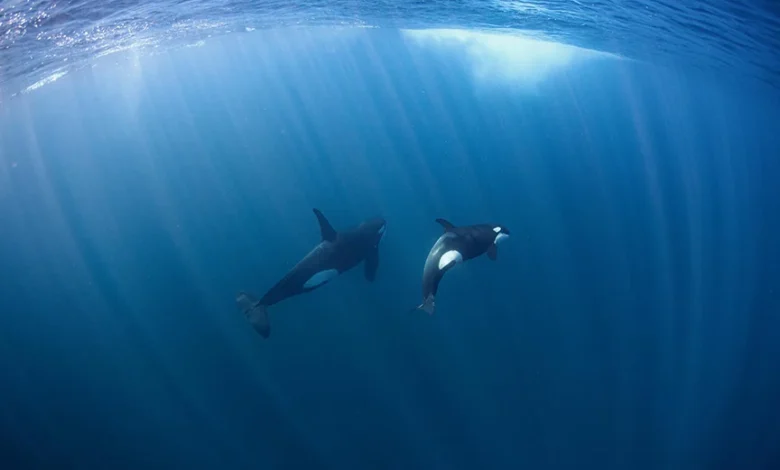
The extraordinary incident, which unfolded in 2024, was meticulously observed and recorded by diver and marine scientist Kathryn Ayres. Her findings were subsequently detailed in a paper published in 2026 in the esteemed journal Frontiers in Ethology, bringing this unprecedented observation to the attention of the scientific community. Ayres’ footage shows one orca holding the deceased sharptail sunfish by its tail, while a second, larger orca positioned itself and then accelerated, ramming the colossal fish at high speed. The impact was so powerful that the sunfish, one of the ocean’s heaviest bony fish, exploded into a cloud of consumable pieces, which were then readily grazed upon by the juvenile members of the orca pod.
Unprecedented Predatory Tactics in the Sea of Cortez
The Gulf of California, often referred to as the Sea of Cortez, served as the backdrop for this unique interaction. This slender body of water, nestled between Mexico’s Baja California peninsula and the mainland, is renowned globally for its exceptional biodiversity and rich marine ecosystems. It is a vital habitat for numerous marine species, including various whales, dolphins, seals, and a vast array of fish, making it a prime location for observing complex predator-prey relationships.
Kathryn Ayres, whose extensive experience as a marine scientist includes numerous underwater observations, noted that while cooperative ramming behavior among orcas was not entirely novel to her, the outcome in this particular instance was unprecedented. "The cooperative ramming behavior wasn’t entirely new to me, as I had previously observed similar coordinated ramming during a hunt involving a whale shark," Ayres explained in an interview with CNN following the publication of her research. However, the complete disintegration of the sunfish upon impact marked a significant departure from previously documented hunting techniques. This observation underscores the adaptability and potential for innovation within orca hunting strategies, even for species as robust and challenging as a whale shark or a massive sunfish.
Scientific Hypotheses: Play, Social Bonding, or Calculated Efficiency?
Ayres’ paper in Frontiers in Ethology delves into several potential explanations for this remarkable behavior, acknowledging the multifaceted nature of orca interactions with their environment and prey. The proposed hypotheses offer a spectrum of motivations, from mere playful engagement to a highly calculated feeding strategy.
One prominent theory suggests the behavior could be a vigorous form of play. Orcas are well-documented for their intelligent and often playful interactions, sometimes involving their food. Instances of orcas tossing seals, manipulating objects, or engaging in complex games are not uncommon, leading researchers to consider if this violent sunfish interaction might also fall under the umbrella of elaborate play. Such behaviors, while appearing aggressive, can serve various purposes within a pod, including skill development for younger individuals.
A second hypothesis centers on the strengthening of social bonds within the pod. Cooperative activities, especially those involving complex coordination and shared outcomes, are known to reinforce social cohesion among highly intelligent and social animals. The synchronized effort required for one orca to hold the sunfish while another delivered the fatal blow demonstrates a high level of teamwork and communication. Such cooperative endeavors could play a crucial role in maintaining the intricate social structure and hierarchy of an orca pod, fostering trust and mutual reliance among its members.
Perhaps the most compelling explanation, particularly given the immediate aftermath, is that the ramming was a deliberate and efficient method of processing a large prey item for consumption, especially by younger, less experienced hunters. The sharptail sunfish, or mola, is an enormous fish, capable of growing up to three meters in length and weighing over 2,000 kilograms. Its sheer size and tough, leathery skin would present a considerable challenge for a single orca or even a pod to tear into efficiently, particularly for juveniles. By causing the fish to explode, the orcas effectively created a cloud of readily digestible "chum" – smaller, bite-sized pieces that were easily consumed by the young whales. This method would minimize the energy expenditure typically required for dismembering such a large carcass, turning a formidable meal into an accessible feast.
The Uniqueness of the Sharptail Sunfish and its Vulnerability
The choice of prey and its subsequent disintegration are also critical aspects of this observation. The sharptail sunfish (Mola alexandrini), a close relative of the more commonly known ocean sunfish (Mola mola), is one of the largest bony fish in the world. Its distinctive flattened, disc-like body, which lacks a true caudal fin and relies on its dorsal and anal fins for propulsion, is highly unusual among large marine species. This unique morphology, Ayres suggested in her paper, could be a key factor in its susceptibility to exploding upon a high-speed impact. Unlike fish with more streamlined, cylindrical bodies, the sunfish’s broad, relatively thin structure might not be able to withstand the immense kinetic energy transferred from a ramming orca, leading to its dramatic fragmentation.
Sunfish are typically slow-moving and often observed basking near the surface, making them potentially vulnerable targets for apex predators like orcas, sharks, and sea lions. Despite their immense size, their primary defense mechanisms are their thick, tough skin and ability to dive to considerable depths. Their diet consists mainly of jellyfish, small fish, and squid, placing them in a different trophic level than many of the orcas’ typical large prey. The nutritional value of a sunfish, while substantial due to its size, is often debated, as much of its mass can be cartilage and a jelly-like substance rather than dense muscle. However, for a hungry orca pod, especially one with growing juveniles, any large, accessible biomass represents a valuable energy source.
Orca Intelligence and Adaptability: A Broader Context
This observation contributes significantly to our understanding of Orcinus orca as one of the ocean’s most intelligent and adaptable predators. Orcas are renowned for their diverse hunting techniques, which vary widely across different ecotypes and geographical regions. Transient or Bigg’s orcas, for example, specialize in marine mammals, employing sophisticated strategies to hunt seals, sea lions, porpoises, and even large whales. Resident orcas, primarily found in the Pacific Northwest, specialize in fish, often using cooperative herding techniques like "carousel feeding" to corral schools of salmon. Offshore orcas, less studied, are thought to prey on sharks and other large fish in the open ocean.
The sunfish incident highlights several key aspects of orca intelligence:
- Cooperative Hunting: The coordinated effort of two orcas points to advanced communication and teamwork, a hallmark of their social structure.
- Problem-Solving: Faced with a large, potentially difficult-to-dismember prey item, the orcas seemingly devised a novel and highly effective method for processing it. This demonstrates a capacity for innovative problem-solving.
- Learning and Cultural Transmission: Such complex behaviors are often learned within a pod and passed down through generations. The fact that younger orcas benefited from the "pre-processed" meal suggests this could be a learned feeding strategy aimed at facilitating the training and nourishment of juveniles.
- Behavioral Plasticity: Orcas exhibit remarkable behavioral plasticity, adapting their hunting methods to the specific prey available and environmental conditions. This ability to innovate and modify strategies is crucial for their success as apex predators in diverse marine environments.
The observation of similar ramming behavior used against a whale shark further supports the idea that this isn’t an isolated fluke but potentially a developed technique for dealing with unusually large or challenging prey. While a whale shark’s primary defense is its immense size, and it is not typically considered a prey item for orcas, the application of coordinated ramming suggests a method for either subduing or disorienting very large marine animals, perhaps for investigative purposes or opportunistic feeding if the animal is already weakened.
The Gulf of California: A Hotbed for Marine Discoveries
The Gulf of California, declared a UNESCO World Heritage Site, is a critical area for marine research and conservation. Its unique oceanography, characterized by strong upwellings and a semi-enclosed nature, creates an exceptionally productive ecosystem. This productivity supports a vast food web, from microscopic plankton to large marine mammals. Jacques Cousteau famously dubbed it "the world’s aquarium" due to its incredible biodiversity and clarity of water, which facilitates underwater observation and photography, much like Ayres’ groundbreaking footage.
The consistent presence of diverse marine life, including various orca ecotypes that frequent these waters, makes the Gulf an ideal natural laboratory for studying complex ecological interactions. Discoveries like the exploding sunfish incident emphasize the ongoing need for research and conservation efforts in such biodiverse regions, as they continue to reveal previously unknown facets of marine life and behavior.
Broader Implications and Future Research Directions
The documentation of orcas intentionally causing a large prey item to explode has significant implications for marine ethology and our understanding of predator-prey dynamics. It challenges existing notions of how large predators process difficult prey and highlights the extreme adaptability of orcas.
From an ethological perspective, this event underscores the sophisticated cognitive abilities of orcas. Their capacity for cooperative hunting, strategic planning, and potentially teaching or demonstrating new techniques to younger pod members speaks volumes about their intelligence and social complexity. Further research could explore how widespread this behavior is, whether it is specific to certain pods or ecotypes, and what environmental factors might trigger its adoption. Long-term studies, possibly involving acoustic monitoring and satellite tagging of orcas in the Gulf of California, could help determine the frequency and context of such predatory actions.
The discovery also prompts a re-evaluation of the role of sunfish in the marine food web. While often considered a somewhat passive inhabitant of the open ocean, this incident demonstrates that they can be significant, albeit challenging, prey items for apex predators. Understanding the full spectrum of predator-prey interactions is vital for accurate ecological modeling and conservation strategies.
Ultimately, Kathryn Ayres’ remarkable footage and subsequent scientific publication serve as a powerful reminder of the vast mysteries that still lie beneath the ocean’s surface. Even in well-studied species like the orca, nature continues to surprise scientists with novel behaviors, pushing the boundaries of our understanding of marine life and the intricate dance of survival in the deep blue. This incident is not merely a curious anomaly but a compelling piece of evidence that deepens our appreciation for the intelligence, adaptability, and complex social lives of killer whales.