Summit Fever Grips Himalayas: Annapurna and Dhaulagiri See Simultaneous High-Stakes Pushes Amidst No-Oxygen Attempts and Record Chases


The perilous peaks of Annapurna I and Dhaulagiri I, two of the world’s most formidable 8,000-meter mountains, are currently experiencing intense summit pushes, marking a critical juncture in the early Himalayan climbing season. Climbers on Annapurna, including a notable contingent attempting the ascent without supplemental oxygen, have departed Camp 4 for their final push towards the summit. Concurrently, on Dhaulagiri, a Sherpa rope-fixing team is paving the way for a wave of climbers expected to follow, with the first summits anticipated around 7 AM local time tomorrow, Saturday, extending into Sunday. This period also features a compelling race for a historic mountaineering record between two legendary Nepali climbers, Sanu Sherpa and Nirmal Purja, both vying to be the first to complete a third ascent of all fourteen 8,000-meter peaks.
Annapurna: The "Killer Mountain" Beckons No-O2 Challengers
Annapurna I, standing at 8,091 meters (26,545 feet), holds a fearsome reputation as one of the most dangerous of the 8,000-meter peaks, often referred to as the "Killer Mountain" due to its historically high fatality rate. Its steep, avalanche-prone slopes and extreme weather conditions present an unparalleled challenge, even for seasoned mountaineers. This season, a determined group of climbers has chosen to confront these formidable odds without the aid of supplemental oxygen, significantly increasing the physiological demands and inherent risks of their ascent.
The no-O2 contingent includes Stefi Troguet of Andorra, a prominent figure known for her strong high-altitude performances; Charles Page of Canada; Israfil Ashurli of Azerbaijan; Marie Saame of Estonia, whose Instagram updates provided real-time glimpses into their preparations; Andreas Frydensberg of Denmark; and a strong Russian team comprising Valery Babanov, Anton Pugovkin, and Vitali Shipilov. These climbers embarked from Camp 4, typically located around 7,000 to 7,200 meters, after a brief respite. Their departure, confirmed by tracker data around 9:30 PM Nepal time, signaled the initiation of an arduous, hours-long climb through the "Death Zone," where oxygen levels are critically low, and the human body rapidly deteriorates.
Climbing without supplemental oxygen is an extraordinary feat of endurance and acclimatization. It demands impeccable physical conditioning, meticulous planning, and an exceptional tolerance for extreme cold, fatigue, and the debilitating effects of hypoxia. Every movement becomes a monumental effort, and the risk of frostbite, cerebral edema, and pulmonary edema escalates dramatically. The prestige associated with such an ascent is immense, placing these climbers among the elite few who attempt to conquer the world’s highest peaks in the purest style. The mountaineering community eagerly awaits news from Annapurna, recognizing the monumental effort and courage displayed by these individuals.
Dhaulagiri: The White Mountain’s Early Season Push
Meanwhile, on Dhaulagiri I, the seventh-highest mountain in the world at 8,167 meters (26,795 feet), another significant summit push is underway. Dhaulagiri, often translated as "White Mountain," is renowned for its immense ice walls and complex route-finding challenges. Climbers reached Camp 3 today, positioned strategically for the final assault. A day ahead of the main group, a dedicated Sherpa rope-fixing team has been meticulously working to establish a safe and navigable path, securing ropes across the exposed and technical sections leading to the summit area. This critical work involves carrying heavy loads of rope, ice screws, and anchors, often in treacherous conditions, to mitigate hazards for the climbers following behind.
The strategy of deploying a vanguard Sherpa team is a standard practice in modern commercial Himalayan expeditions. It significantly enhances safety and efficiency, allowing clients and other independent climbers to conserve energy by ascending fixed lines rather than having to forge their own path. While the Sherpa team is expected to be the first to reach the summit, an unspecified number of clients and independent climbers are poised to follow closely, aiming to capitalize on the fixed ropes and improved route conditions.
Among the climbers on Dhaulagiri are Ukrainians Irina Galay and Valentyn Sypavin, alongside clients from Pioneer Expedition and a second group outfitted by Imagine Nepal. Unlike the Annapurna team, there are no reported attempts without supplemental oxygen on Dhaulagiri, indicating a different strategic approach to managing the inherent risks of an 8,000-meter ascent. The use of oxygen significantly improves a climber’s chances of success and survival by reducing the physiological strain at extreme altitudes. Expedition organizers, such as Pioneer Adventure and Imagine Nepal, are responsible for coordinating logistics, ensuring the safety of their clients, and managing the intricate dynamics of a large-scale high-altitude operation. Their primary focus remains on successful summits while prioritizing the well-being of all team members.
The Epic Duel for a Triple Crown: Sanu Sherpa vs. Nirmal Purja
Adding a captivating layer of competition and historical significance to this season is the ongoing race between two titans of Nepali mountaineering: Sanu Sherpa and Nirmal "Nimsdai" Purja. Both are striving to become the first individuals in history to complete a triple ascent of all fourteen of the world’s 8,000-meter peaks. This extraordinary achievement, if realized, would solidify their places in mountaineering legend.
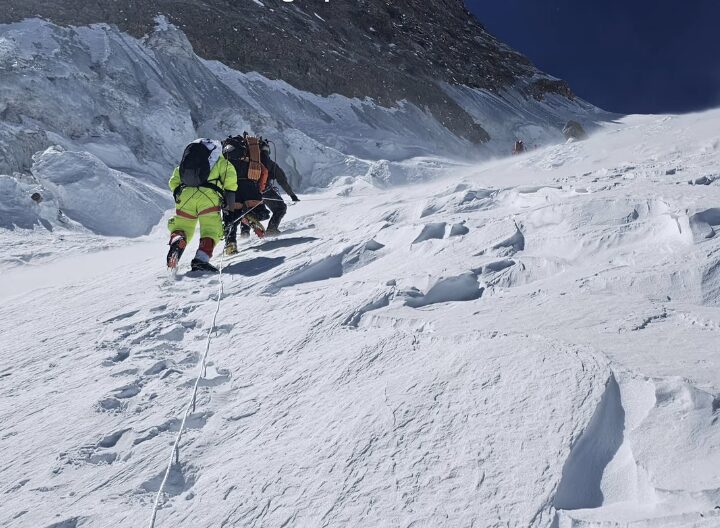
Nirmal Purja, currently heading for the summit of Annapurna with a client, is widely recognized for his groundbreaking "Project Possible 14/7" in 2019, where he summited all fourteen 8,000-meter peaks in a record-breaking six months and six days. Purja holds a Guinness World Record certificate acknowledging 49 "true" 8,000-meter summits, a figure that includes repeated ascents as a guide. He clarifies that his total 8,000-meter ascents stand at 52, with the discrepancy arising from earlier climbs where he, like many others at the time, unknowingly stopped at "foresummits" rather than the absolute highest point. This distinction became a significant point of discussion in the mountaineering community following detailed research by figures like Eberhard Jurgalski of 8000ers.com, who works with Guinness World Records to define "true summits." Purja has since made efforts to re-summit the true peaks where he previously only reached a foresummit, demonstrating his commitment to the highest standards of mountaineering record-keeping. His career is characterized by audacious goals, remarkable speed, and an unwavering drive to push the boundaries of human endurance.
Sanu Sherpa, leading the Pioneer Adventure team on Dhaulagiri, represents a different, yet equally formidable, climbing philosophy. Known for his consistent, often understated, achievements, Sanu has already completed two full circuits of the 14x8000ers. His Instagram profile currently claims 40 8,000-meter summits, a number that likely requires an update given his recent activity. In 2025 alone, he added five more 8,000-meter peaks to his tally, and notably summited Makalu in January of this year, albeit with supplemental oxygen. This winter success, however, was tragically overshadowed by the deaths of his client and a fellow Sherpa guide during the descent, an incident that also left Sanu with a leg injury during an attempted rescue. Sanu’s strength lies in his deep experience, resilience, and quiet determination, making him a formidable contender in this historic race. His ability to consistently guide clients to the summit while maintaining a remarkable personal climbing record speaks volumes about his skill and dedication.
The "true summit" debate, ignited by rigorous verification efforts, has brought a new layer of scrutiny to historical mountaineering records. It emphasizes the importance of precise topographical understanding and GPS verification in an era where distinctions of a few meters can redefine a climb’s historical status. Both Purja and Sherpa navigate this evolving landscape, committed to achieving their records under the most stringent contemporary criteria. The outcome of their parallel efforts this season, and potentially later in the year, will be closely watched by mountaineers and enthusiasts worldwide.
Chronology of the Summit Pushes
The current summit pushes are the culmination of weeks of meticulous planning, arduous trekking, and critical acclimatization rotations.
- Early April: Expedition teams arrived at their respective Base Camps (BC) on Annapurna and Dhaulagiri. Establishing BC involves significant logistical effort, including setting up tents, medical facilities, and communication hubs.
- Mid-April: Climbers began their acclimatization rotations, making several trips to higher camps (Camp 1, Camp 2, Camp 3) to allow their bodies to adapt to the progressively thinner air. This process is vital for preventing acute mountain sickness (AMS) and preparing for the extreme conditions of the Death Zone.
- Late April: Weather windows were carefully monitored. High-altitude meteorologists provide crucial forecasts, advising expedition leaders on optimal periods for summit attempts, considering factors like wind speed, snowfall, and temperature.
- Today (Summit Push Initiation):
- Annapurna: The no-O2 climbers, after reaching Camp 4 and taking a short break, commenced their final summit push. Their departure from Camp 4, typically around evening, is timed to allow them to reach the summit in the early morning hours, when weather conditions are often most stable, and they have daylight for the descent.
- Dhaulagiri: The Sherpa rope-fixing team advanced from Camp 3, beginning the critical task of fixing ropes across the traverse to the summit. This sets the stage for the main climbing group to follow, potentially a few hours behind or in the early hours of tomorrow.
- Tomorrow (Projected Summit Day): The first summits on both Annapurna and Dhaulagiri are expected around 7 AM local time (8:45 PM EDT this evening). This early morning timing is crucial for safety, providing maximum daylight for the descent, which is often more hazardous than the ascent due to fatigue and deteriorating conditions.
- Sunday: Follow-up summits are anticipated, as different groups of climbers, or those who chose a slightly later departure, continue their ascents.
The Perils and Logistics of 8,000-Meter Climbing
High-altitude mountaineering is an endeavor fraught with extreme risks. Beyond the obvious dangers of falls, avalanches, and crevasses, climbers face a relentless assault from the environment. Temperatures can plummet to -40°C (-40°F) or lower, wind chills are brutal, and the constant exposure to solar radiation at extreme altitudes can cause severe sunburn and eye damage. The physical toll is immense, with climbers often losing significant body weight and muscle mass during an expedition.
Logistically, these expeditions are complex undertakings. They involve hundreds of porters and yaks to transport gear to Base Camp, elaborate communication networks, sophisticated weather forecasting, and a robust support team. Medical personnel are on standby, and contingency plans for rescues, often involving helicopters, are essential. The role of Sherpa guides is paramount, not only in fixing ropes and establishing camps but also in leading clients, carrying supplies, and often performing critical rescues. Their expertise and dedication are the backbone of commercial climbing in the Himalayas.
Broader Impact and Implications for the Climbing Season
The success or failure of these early-season pushes on Annapurna and Dhaulagiri will set a precedent for the rest of the Himalayan climbing season. Successful summits will boost morale and confidence, potentially encouraging more climbers to attempt these challenging peaks. Conversely, any incidents or tragedies would cast a somber shadow, prompting re-evaluations of safety protocols and strategies.
The pursuit of records, particularly the triple circuit of the 14x8000ers, injects a competitive dynamic into an already high-stakes environment. While healthy competition can drive innovation and performance, it also underscores the delicate balance between ambition and safety. The ongoing debate around "true summits" reflects a maturing of the sport, where historical accuracy and precise verification are increasingly valued. This push for accuracy helps to standardize records and ensures that future generations of climbers have a clear understanding of the achievements of their predecessors.
As the world watches these dramatic events unfold in the heart of the Himalayas, the stories of these climbers serve as a powerful testament to the enduring human spirit of exploration, endurance, and the relentless pursuit of the world’s highest peaks. The coming hours and days will determine the fate of these summit pushes and potentially etch new chapters into the annals of mountaineering history.
Related posts: