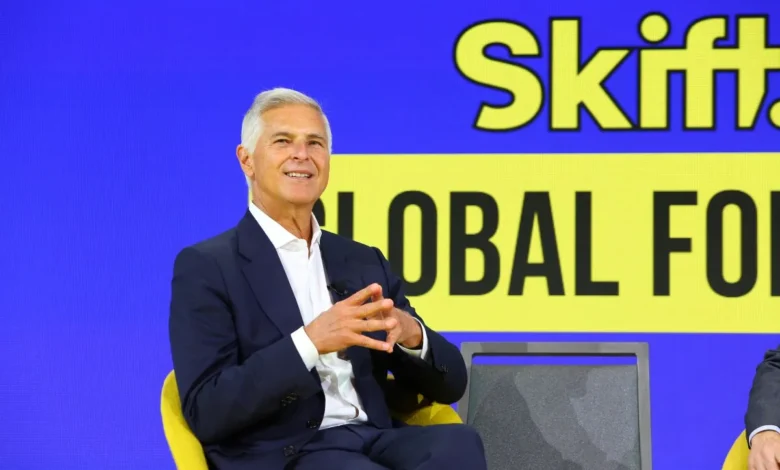
Christopher Nassetta has a new way of describing Hilton: “people-led, tech-powered.” This concise tagline, articulated by the President and CEO during the company’s third-quarter earnings call on October 27, 2026, marks a pivotal shift in the strategic narrative of one of the world’s most established hospitality conglomerates. For a company that has spent over a century defining the traditional hotel experience, the pivot toward a technology-centric identity is not merely a marketing exercise—it is an aggressive repositioning aimed at aligning Hilton with the giants of Silicon Valley.
This transformation is anchored by three major strategic developments over the past month: the high-profile appointment of a new chief technology officer from Uber, the impending migration of its stock listing to the Nasdaq, and a commitment to integrating Hilton’s vast booking infrastructure into the emerging ecosystem of AI-driven travel agents.
The Nasdaq Move: A Symbolic and Strategic Pivot
When Hilton announced last week that it would transition its stock listing from the New York Stock Exchange to the Nasdaq, the move was initially perceived by market analysts as a procedural change. However, during the earnings call, Nassetta made it clear that the move is deeply symbolic. By listing on the Nasdaq, Hilton joins the ranks of Apple, Microsoft, and Nvidia—companies that are universally recognized as the engines of global innovation.
Nassetta’s rhetoric serves a dual purpose: it signals to investors that Hilton no longer wishes to be viewed as a traditional real estate or hospitality firm, but rather as a technology-enabled services company. By distancing itself from the "bricks and mortar" perception, Hilton is positioning its valuation to benefit from the higher multiples typically reserved for software and tech-infrastructure entities.
The switch to Nasdaq is expected to be completed in the coming weeks. While the operational mechanics of the business will remain unchanged, the psychological shift for institutional investors is profound. Hilton is effectively betting that its future growth will be driven as much by its digital guest-experience platform as by its ability to open new physical properties.
Giving Tech More Oxygen: The Jeff Moore Appointment
A centerpiece of this strategy is the recruitment of Jeff Moore as the company’s new chief technology officer. Moore arrives at Hilton with a resume heavily weighted toward high-scale digital operations. Previously, Moore served as a key leader within Uber’s engineering organization, where he managed a team of 2,500 people responsible for the core logistics and algorithmic matching that power the ride-hailing giant.
The hiring of a tech executive from a mobility platform, rather than a traditional hospitality background, highlights the specific challenges Hilton is looking to solve. In the modern travel landscape, "hospitality" is increasingly defined by friction-free digital interaction—from mobile check-in and digital key integration to hyper-personalized loyalty rewards. Moore’s mandate is expected to be focused on scaling these systems to accommodate Hilton’s massive global footprint, which spans thousands of properties across dozens of brands.
Integrating the AI Agent Revolution
Beyond personnel changes, Hilton has publicly committed to a "plug-and-play" strategy regarding artificial intelligence. As the travel industry grapples with the rise of AI-powered travel agents—automated systems capable of planning, booking, and managing complex itineraries—Hilton is ensuring that its inventory is fully compatible with these platforms.

Nassetta noted during the earnings call that Hilton is already integrated into “each and every one” of the AI agents currently emerging in the travel sector. This is a crucial defensive and offensive maneuver. If AI agents become the primary interface for travelers to book their trips, Hilton’s ability to remain front-and-center in those search results is non-negotiable. By optimizing its API infrastructure to serve AI agents, Hilton is attempting to bypass the traditional reliance on third-party online travel agencies (OTAs) that have historically squeezed hotel margins.
Chronology of Recent Strategic Moves
- September 23, 2026: Christopher Nassetta speaks at the Skift Global Forum in New York, hinting at a fundamental shift in how Hilton views its digital future.
- Early October 2026: Hilton officially appoints Jeff Moore, formerly of Uber, as the new CTO to spearhead the company’s digital transformation.
- Mid-October 2026: The company announces its intent to move its stock listing to the Nasdaq, citing a desire to be associated with the world’s most innovative tech companies.
- October 27, 2026: During the third-quarter earnings call, Hilton formally unveils the "people-led, tech-powered" mantra and clarifies its integration strategy for AI-driven travel agents.
Data-Driven Hospitality: The Rationale
The impetus for this pivot is rooted in shifting consumer behavior and the necessity of operational efficiency. Recent industry data indicates that digital-first travelers now prioritize the speed of check-in, the quality of Wi-Fi, and the seamlessness of loyalty app integration over traditional amenities.
Hilton’s push into technology also serves to protect its profit margins. By investing in proprietary tech stacks, the company reduces its dependency on external booking platforms, which can command commission fees of 15% to 25%. If Hilton can convert more guests to direct bookings via its mobile app or through direct integration with AI agents, the bottom-line impact on RevPAR (Revenue Per Available Room) could be significant.
Furthermore, the data collected from these digital touchpoints provides Hilton with a competitive advantage in "predictive hospitality." By analyzing patterns in guest behavior across its global portfolio, Hilton can optimize room pricing, staff scheduling, and personalized marketing in real-time, effectively creating a feedback loop that benefits both the guest experience and shareholder value.
Industry Implications and Market Reaction
The broader implications of Hilton’s strategy are substantial. If a legacy hotel giant can successfully re-brand as a tech-powered entity, it puts significant pressure on competitors like Marriott, Hyatt, and Accor to justify their own digital investments. The "platformization" of hotels is no longer a niche trend; it is the new standard for survival in the global hospitality market.
Market analysts have generally responded with cautious optimism. While some warn that the transition carries the risk of "tech fatigue"—where the focus on digital systems might inadvertently dilute the human-centric service for which Hilton is known—most agree that the pivot is necessary. The emphasis on "people-led" suggests that Hilton is aware of this balance, aiming to use technology to remove friction so that staff can focus on the high-touch, personalized service that differentiates a luxury or upscale hotel stay.
Conclusion
As Hilton moves into the final months of 2026, the company’s trajectory is clear. The decision to list on the Nasdaq and the recruitment of top-tier engineering talent are not just corporate housekeeping; they are the markers of a company preparing for a future where the distinction between a hotel company and a technology company becomes increasingly blurred.
Whether Hilton can successfully execute this transition remains to be seen. However, by embracing the AI-agent ecosystem and aligning its corporate identity with the most innovative sectors of the market, Hilton is clearly aiming to lead the industry into a new, tech-defined era. The "people-led, tech-powered" strategy is more than a slogan—it is a comprehensive blueprint for maintaining dominance in an increasingly digitized global travel landscape.