Guiding the Ancient Nomads: Conservationists Race to Protect the Migratory Corridors of Kazakhstan’s Saiga Antelope

The modern transformation of the Eurasian steppe presents a critical test for one of the planet’s most resilient and ancient ungulates: the saiga antelope (Saiga tatarica). Navigating a landscape of shifting mud paths and howling Siberian winds, field researchers with the Association for the Conservation of Biodiversity of Kazakhstan (ACBK) conduct vital monitoring operations during the species’ annual rutting season. This fieldwork underscores an urgent global conservation challenge: how to preserve migratory megafauna corridors amid accelerating industrial development, expanding infrastructure, and geopolitical fragmentation across Central Asia.
Main Facts and Ecological Significance
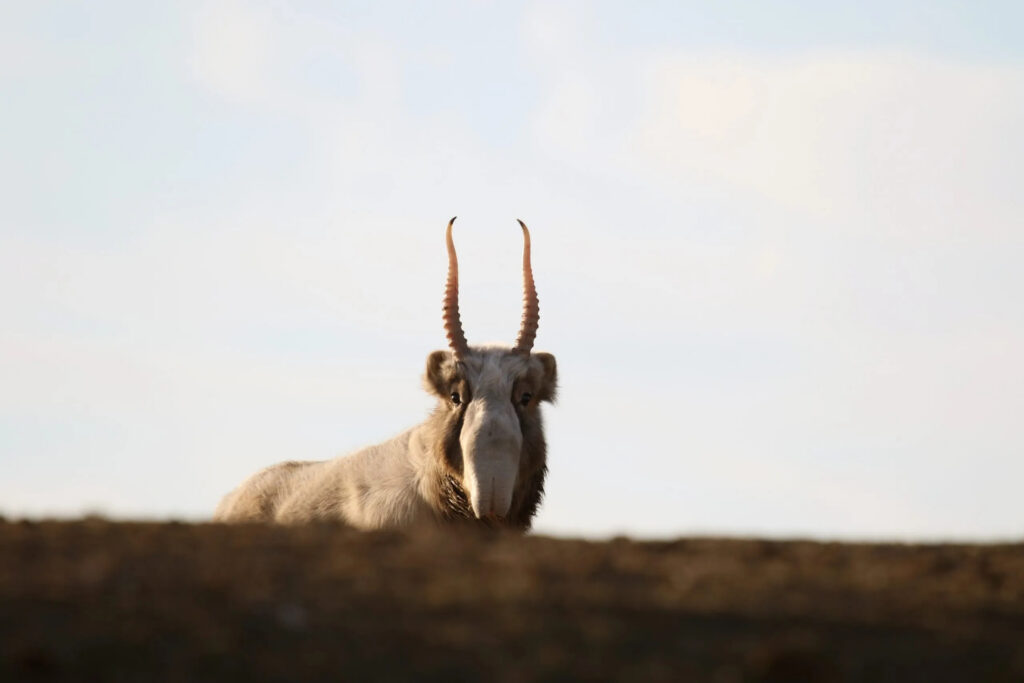
The saiga antelope is a survivor of the Late Pleistocene epoch, having coexisted with woolly mammoths, saber-toothed cats, and giant deer. Unlike many of its prehistoric contemporaries, the saiga endured climatic shifts, glacial retreats, and millennia of human expansion. Characterized by their distinctively bulbous, ringed noses—evolutionary adaptations designed to filter dust and warm freezing winter air before it reaches their lungs—these nomads travel across the treeless plains of Central Asia in massive herds.
During the late-autumn rutting season, massive single-file columns converge for competitive displays and mating rituals. Males engage in intense physical combat, utilizing their ringed horns to assert dominance, often driven to extreme physical exhaustion. Females, meanwhile, assess potential mates based on physical vitality and the size of their nasal passages, which signify virility and respiratory efficiency. Historically, these expansive seasonal migrations spanned thousands of miles, stretching from the foothills of the Caucasus Mountains to the semi-arid expanses of Mongolia.
Chronology of Human and Animal Displacement
The shared history of human and animal movement across the Eurasian steppe dates back to the Early Iron Age. The term Kazakh itself derives from the Turkic root qaz, meaning "wanderer" or "vagabond." For centuries, human nomadic communities mirrored the seasonal patterns of wildlife, migrating to higher elevations during the summer and returning to sheltered valleys for the winter. These established transit corridors formed the foundational network of the historic Great Silk Road, where the fertile banks of the Ural River served as a vital transcontinental crossroads linking Europe and Asia.
The traditional lifestyle of continuous movement experienced a decisive disruption in the 20th century. During the Soviet era, mandatory sedentarization policies forced nomadic populations into permanent agricultural settlements, effectively halting traditional seasonal migrations across the steppe. While framed as modernization, these policies proved ecologically problematic, as large portions of the steppe soil were fundamentally unsuitable for intensive crop cultivation. Following the dissolution of the Soviet Union, further demographic shifts occurred as local populations largely transitioned to sedentary urban lifestyles.
For the saiga antelope, however, the pressures of modern infrastructure intensified significantly in the late 20th and early 21st centuries. The rapid expansion of railways, paved highways, and border fencing fragmented the once-continuous habitat into isolated regional pockets.
Supporting Data and Infrastructure Impacts
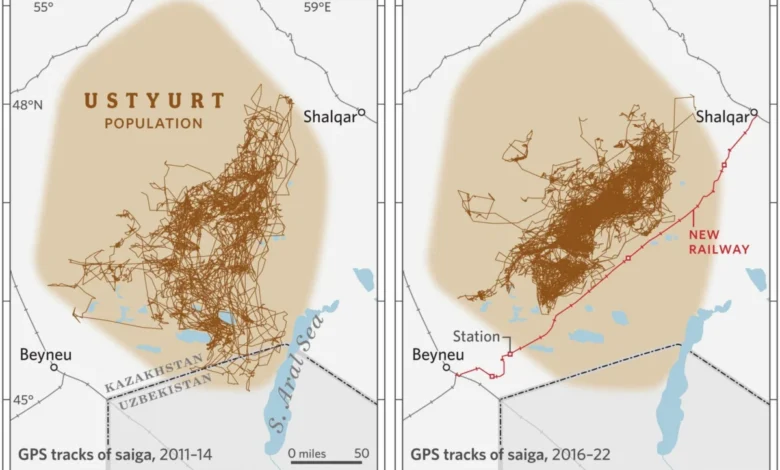
Modern conservation science has increasingly relied on telemetry and GPS-collaring technologies to track the shifting ranges of migratory herds. Historically, conservationists faced immense challenges locating nomadic saiga populations across boundless, roadless steppes. Today, satellite tracking data provides high-resolution maps of animal movement, revealing the immediate impacts of anthropogenic barriers.
Data collected by ACBK researchers illustrates the severe consequences of linear infrastructure. For instance, tracking data from a population of saigas that routinely migrated deep into Uzbekistan revealed a sharp behavioral shift following the construction of a major rail line in 2014. Prior to construction, telemetry data showed consistent, seasonal crossings across the border. Post-construction, tracking data indicated that herds became disoriented, milling about on the northern side of the tracks while traditional grazing and watering zones to the south remained inaccessible. Such disruptions risk the collapse of spatial knowledge—a generational transfer of migratory routes that wildlife experts compare to the erasure of language.
Official Responses and Conservation Frameworks
To mitigate the fragmentation of saiga habitats, the ACBK has partnered closely with the government of Kazakhstan and international conservation entities to implement targeted structural interventions.
Among the primary initiatives is the construction of specialized saiga-friendly crossings along major railway lines. These engineering solutions feature gently sloping dirt ramps designed to match the elevation of the tracks, creating the visual illusion of a natural land bridge. To prevent catastrophic collisions, cattle-guard fencing is installed at safe distances from the actual crossing points, preserving the animals’ natural transit paths while ensuring operational safety for rail transport.
Furthermore, conservationists have collaborated with neighboring authorities, such as the government of Uzbekistan, to modify existing border security infrastructure. Traditional barbed-wire fencing has been systematically replaced with X-shaped barricades. These redesigned structures effectively restrict unauthorized vehicular traffic while leaving sufficient ground clearance for saigas to move freely across international boundaries. These measures coincide with the establishment of new protected wildlife sanctuaries, whose boundaries are directly informed by empirical GPS tracking data collected during field audits.
Broader Impact and Implications
The ongoing efforts to protect the saiga antelope carry profound implications for regional biodiversity and landscape-scale conservation in Central Asia. As linear infrastructure continues to expand globally, the preservation of transboundary ecological corridors remains vital for the survival of migratory species.
The integration of advanced telemetry, cross-border governmental cooperation, and localized engineering solutions provides a replicable framework for balancing industrial development with wildlife preservation. Ultimately, safeguarding the migratory pathways of the saiga ensures the survival of a living link to the Pleistocene epoch, maintaining the ecological integrity of one of the world’s last great temperate grasslands.