Mastering Macro Insect Photography in the Field: How Photographer Ben Harvey Uses Vintage Gear and Fill Flash to Capture Crisp Details

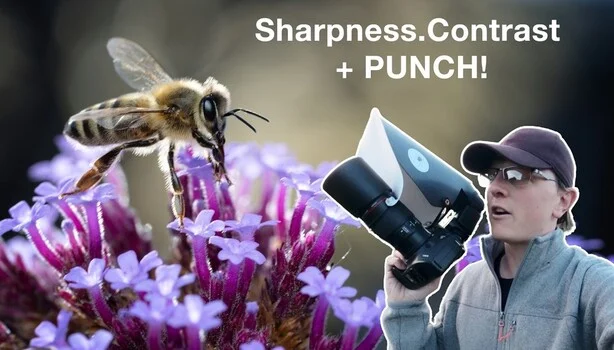
Capturing crisp, detailed macro photographs of fast-moving insects like bees and butterflies remains one of the most technically demanding disciplines in photography. Subjects featuring pitch-black eyes, dark exoskeletons, and erratic flight patterns present extreme challenges, particularly when working outdoors in variable daylight. While many photographers turn to complex focus-stacking techniques or expensive, modern lighting systems, professional nature photographer Ben Harvey demonstrates that exceptional results can be achieved using surprisingly accessible equipment. Operating along the Brighton seafront and the nearby Benfield Nature Reserve, Harvey relies on a vintage speedlight, a manual-focus macro lens, and a carefully positioned diffuser to transform unpredictable natural light into professional-grade macro imagery.
The core mechanics of this approach shift the traditional burden of exposure away from the camera body and place it firmly onto a diffused, low-power auxiliary flash unit. Rather than investing in modern, high-cost E-TTL automated lighting systems, Harvey employs an older Canon Speedlite 430EX II—a model now nearly 15 years old—paired with a Sony a7 III and a manual-focus 100mm macro lens capable of 2:1 magnification. By bypassing automated TTL communication and utilizing the flash exclusively in manual mode, the camera is required only to signal the flash when to fire. This method allows photographers to utilize inexpensive or legacy hardware without sacrificing technical precision or image quality. According to Harvey, artificial fill flash ranks as the single most effective alternative to focus stacking for achieving sharp macro detail, offering a faster workflow that avoids the rigorous post-processing and editing hours demanded by stacked focus techniques.
The Physics of Speedlight Performance and Motion Freezing
Understanding how speedlights function at a micro-level is essential for mastering high-magnification insect photography. Unlike continuous lighting sources, speedlights regulate their luminous output by modulating the physical duration of the light burst. As the power output is reduced—such as dialing the unit down to 1/16 or 1/32 power—the duration of the flash burst shortens drastically, often lasting mere microseconds.
At these low power settings, the duration of the flash burst is significantly faster than a typical mechanical camera shutter operating at 1/200 of a second. Consequently, it is the flash duration, rather than the shutter speed, that effectively freezes rapid environmental movements, such as a swaying plant stem, a twitching insect antenna, or the delicate motion of compound wings. This phenomenon provides an immense advantage when shooting handheld in natural, breezy outdoor environments.
Distance also plays a critical technical role in modifying light quality. A diffuser that appears relatively modest when mounted directly to a hot shoe becomes a broad, exceptionally soft light source when positioned just a few inches away from a subject like a foraging bee. This occurs because the apparent, relative size of a light source is determined by its proximity to the subject.
Harvey’s methodology mirrors the classic fill-flash techniques long utilized by wedding and commercial event photographers working outdoors. The primary objective is to establish an accurate ambient exposure for the background environment, and then introduce a measured, subtle burst of artificial light to lift deep shadows, illuminate obscured details, and introduce a natural catchlight into the insect’s eyes. Without this fill light, the eyes of dark-bodied subjects often register as underexposed, lifeless voids. However, photographers transitioning to this technique must account for the reality that high-magnification macro photography exponentially exaggerates even the slightest amount of camera shake, making disciplined handholding or stabilization techniques mandatory.
Field Chronology and Workflow Strategies
To evaluate the practical application of this lighting philosophy, Harvey documented field sessions across two distinct coastal and urban-adjacent wildlife locations in the United Kingdom. The first session commenced at 5:30 a.m. along a public stretch of freshly planted wildflowers on the Brighton seafront. This urban-adjacent location was deliberately selected to demonstrate that high-quality macro subjects do not require remote wilderness access; local municipal parks, urban green spaces, and residential gardens can host thriving insect populations.
Operating in the early morning hours provided crucial environmental advantages. The low-angle morning sun combined with overcast coastal skies yielded soft, diffused ambient light. Furthermore, lower ambient temperatures reduced the metabolic activity of cold-blooded insects, rendering bees and butterflies more cooperative subjects than they would be during the heat of midday.
Despite these favorable conditions, field challenges immediately emerged. Behavioral inconsistencies across different plant species required continuous technical adjustments. Settings meticulously calibrated for a bee foraging on purple lavender frequently produced overexposed or underexposed results the moment the insect transitioned to a white floral surface. Harvey observed that resting insects generally offered the most stable opportunities for precise focusing, whereas actively foraging specimens demanded swift, anticipatory framing.
During a secondary field session conducted at the Benfield Nature Reserve situated on the outskirts of Brighton, Harvey altered his equipment configuration. He transitioned to an autofocus 100mm macro lens mounted on a traditional digital single-lens reflex (DSLR) camera body. This session focused on capturing a backlit butterfly under harsh, direct sunlight. To prevent the subject from collapsing into an unwanted silhouette against the bright background, Harvey deployed his fill flash at a specialized exposure triangle: a shutter speed of 1/200 s, an aperture of f/5.6, and an ISO setting of 200.
Throughout both field operations, behavioral observations revealed that insects exhibited remarkable tolerance toward photographic equipment. Neither the brief discharge of the off-camera flash nor the presence of the lens caused immediate flight responses. Instead, empirical tracking suggested that sudden shifts in ambient lighting—such as a photographer’s large shadow sweeping across the subject—or physical intrusion beyond the insect’s proximate comfort zone were the primary catalysts for flight.
Technical Parameters and Camera Settings
Maintaining a rigorous, repeatable baseline of camera settings is vital when balancing natural ambient illumination with artificial flash output. Harvey’s standard operational template begins with the following configuration:
- Shutter Speed: 1/200 s (synchronized to the camera’s maximum flash sync speed)
- Aperture: f/8 (providing an optimal balance between diffraction limits and adequate depth of field)
- ISO: 400 (adjusted dynamically upward or downward depending on fluctuations in ambient sunlight)
- Flash Power: 1/16 to 1/32 power output
The strategic objective of this specific parameter combination is to achieve a properly exposed photographic frame driven primarily by ambient environmental light, with the speedlight serving strictly as a secondary enhancement tool. The flash is calibrated solely to lift shadow density and sharpen fine structural details on the insect’s exoskeleton.
If a photographer intentionally underexposes the ambient background scene and relies entirely on the flash to illuminate the subject, the resulting image acquires an unnatural, heavily flashed aesthetic—effectively replicating the look of shooting in total darkness. Beyond aesthetic considerations, operating the speedlight at lower power fractions (1/16 or 1/32) yields a secondary practical benefit: drastically reduced recycling times. This rapid recharge cycle enables the photographer to fire consecutive bursts during handheld tracking sequences in windy conditions, maximizing the statistical probability that at least one frame in a burst achieves critical focus on the subject’s compound eyes.
Working under bright midday sun introduces strict optical constraints. Because focal plane shutters cannot exceed their designated flash synchronization speed (typically between 1/200 s and 1/250 s), shutter speed ceases to function as an effective tool for controlling ambient exposure in harsh sunlight. When confronted with direct, unyielding solar illumination, Harvey bypasses mechanical limitations by physically repositioning his body or utilizing the physical span of his light diffuser to cast a temporary shadow across the subject, effectively engineering a controlled micro-environment for the shot.
Industry Implications and Broader Impact
The techniques demonstrated by Harvey carry significant implications for both amateur naturalists and professional macro photographers. In an era dominated by high-cost optical innovations, automated focus-stacking rails, and sophisticated computational photography algorithms, the reliance on vintage hardware highlights the enduring value of foundational photographic principles.
By utilizing legacy speedlights and basic manual diffusers, photographers can achieve publication-quality macro imagery without incurring prohibitive financial costs. This accessibility democratizes nature photography, encouraging hobbyists to explore local urban ecosystems rather than investing in specialized expedition gear. Furthermore, the emphasis on fieldcraft—understanding insect behavior, circadian rhythms, micro-weather patterns, and the physical properties of light diffusion—underscores that technical mastery remains superior to mere equipment acquisition in modern wildlife documentation.