The dramatic landscapes of Iceland, characterized by cascading waterfalls, sweeping volcanic fields, and rugged coastlines, draw millions of international visitors annually. While the paved Ring Road (Route 1) encircles the island and offers access to many popular destinations, a vast majority of the country’s most isolated and visually striking interiors remain untouched by modern asphalt. For travelers seeking to venture off the beaten path, navigating gravel and unpaved roads is an unavoidable reality. However, this vehicular exploration comes with unique hazards that frequently catch foreign tourists unawares, prompting safety officials, car rental agencies, and tourism boards to ramp up education efforts surrounding road safety and mandatory insurance policies.
The Geography of Isolation and the Reality of Iceland’s Infrastructure
To understand why gravel roads dominate much of Iceland’s driving network, one must look at the nation’s geography and population distribution. The vast majority of Iceland’s roughly 380,000 residents live in or around the capital city of Reykjavík and various coastal settlements. The interior highland plateau—known as the Highlands—is a desolate, high-altitude desert featuring volcanic ash fields, glaciers, and braided rivers.

Constructing and maintaining paved roads across this harsh terrain is financially and logistically prohibitive. Consequently, the national road network relies heavily on unpaved gravel tracks to connect remote communities, geothermal areas, hiking trailheads, and interior valleys. According to the Icelandic Road and Coastal Administration (Vegagerðin), gravel roads account for a substantial percentage of the country’s total public road length. While essential for connectivity, these routes were originally engineered for local traffic, farming, and light utility use, making them fundamentally different from the multi-lane highways familiar to most international tourists.
Shifting Surfaces and Environmental Hazards
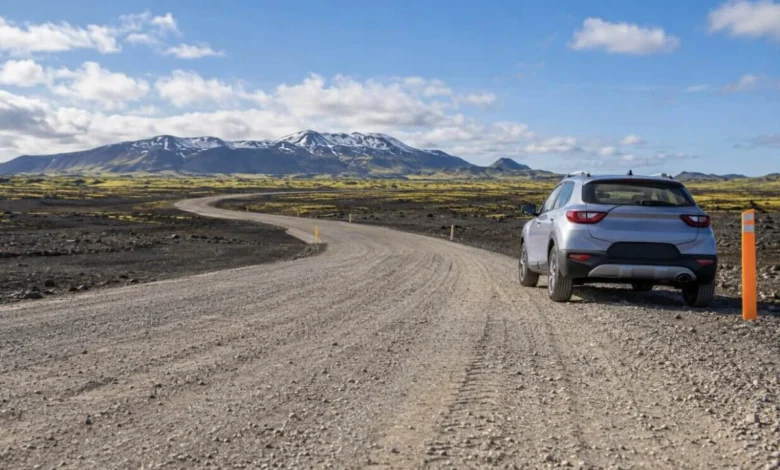
Driving on Icelandic gravel requires a distinct set of operational skills compared to navigating standard asphalt. Unlike uniform paved surfaces, gravel roads undergo rapid physical transformation driven by weather, traffic volume, and maintenance schedules.
Surfaces can transition abruptly from hard-packed, smooth earth to deep ruts, loose stone accumulations, and treacherous washboard ridges—a series of parallel ripples caused by vehicle tires shifting loose material at speed. These conditions severely compromise vehicular traction. Furthermore, road shoulders are frequently narrow or entirely absent, leaving drivers with little margin for error should they drift toward a ditch or steep embankment.

Environmental factors compound these physical challenges. Precipitation quickly transforms dry gravel into a slick, muddy slurry, while dry, windy conditions kick up dense plumes of dust. These dust clouds can severely restrict visibility, particularly around blind corners and undulating hill crests. Wind is another formidable adversary in Iceland; coastal plains and open highland valleys frequently experience severe gusts capable of pushing vehicles sideways or wrenching steering wheels from drivers’ hands. Large commercial vehicles or tour buses traveling in the opposite direction can also create sudden air turbulence when passing, surprising unprepared motorists.
Core Driving Techniques and Safety Protocols
Traffic safety authorities and local rental agencies emphasize that speed management is the single most critical factor in preventing accidents on gravel roads. Stopping distances on loose stone are significantly longer than on dry pavement, and panic-braking almost invariably leads to a loss of directional control.
Experts advise drivers to reduce their speed well below posted limits when approaching curves, intersections, and blind rises, maintaining a conservative velocity that allows for sudden reactions. Smooth inputs—avoiding abrupt steering corrections, heavy acceleration, or sudden braking—are vital for keeping all four tires engaged with the loose surface. Keeping both hands firmly on the steering wheel ensures better leverage if the vehicle begins to slip.

Visibility management is equally crucial. Drivers are instructed to increase their following distance behind other vehicles to stay clear of flying stones and blinding dust clouds. Under Icelandic law and safety recommendations, turning on headlights—even during broad daylight—is mandatory to ensure oncoming traffic can spot vehicles through dust or fog. On narrow roads, standard etiquette dictates yielding the right-of-way by carefully pulling toward the edge of the road when safe, giving priority to larger vehicles or traffic navigating uphill grades.
Vehicle Preparation and Rental Agency Requirements
Before embarking on a journey beyond the Ring Road, vehicular readiness can mean the difference between a minor inconvenience and a dangerous rescue operation in a remote region. Rental car companies routinely inspect tires, suspension systems, and undercarriages, but drivers must ensure they know the exact locations of spare tires, jacks, and lug wrenches. Punctures caused by sharp volcanic rock are among the most common mechanical issues reported by tourists.
Fuel management also requires careful planning. Gas stations can be separated by vast distances in the interior and rural fjords, and the resistance offered by gravel surfaces naturally increases fuel consumption. Carrying emergency provisions, including potable water, warm clothing, and communication devices, is strongly encouraged for any remote itinerary.

Furthermore, motorists must navigate the complex landscape of Icelandic car rental insurance. Standard collision damage waiver (CDW) policies frequently exclude damage caused by loose gravel flung up by tires—commonly referred to as "gravel protection" (GP)—as well as sand and ash damage caused by high winds stripping paint from the vehicle body. Rental agencies and tourism officials strongly advise travelers to review their insurance coverage carefully and purchase specialized riders covering gravel, ash, and sandstorms, which can cost thousands of dollars in out-of-pocket repairs if omitted.
Specialized F-Roads and River Crossings
For travelers venturing deeper into the interior highlands, standard passenger cars are entirely inadequate. These routes, officially designated as "F-roads," are legally restricted to four-wheel-drive (4×4) vehicles due to their extreme terrain, steep inclines, and unbridled natural hazards.
Entering F-roads with a two-wheel-drive vehicle is illegal under most rental agreements and can result in severe financial penalties and voided insurance. Moreover, many F-roads require crossing unbridled glacial rivers. These water levels fluctuate unpredictably throughout the day based on glacial melt rates, solar radiation, and rainfall. Crossing a river requires specialized knowledge of vehicle wading depths, water currents, and proper crossing techniques. Inexperienced drivers frequently flood engines or get swept downstream, resulting in costly recoveries managed by Icelandic search and rescue teams (Landsbjörg).

Economic and Tourism Implications
The rise in self-drive tourism in Iceland has correlated with a notable increase in single-vehicle run-off-road accidents and property damage claims. According to traffic safety analysts, foreign tourists unfamiliar with gravel dynamics account for a disproportionate share of these incidents.
In response, government bodies and tourism coalitions, including Visit Iceland and rental car operators, have launched extensive educational campaigns. These initiatives include mandatory safety videos at rental counters, real-time road condition mapping via the Icelandic Road and Coastal Administration website (umferdin.is), and weather warning systems managed by the Icelandic Meteorological Office (vedur.is).
Tourism economists note that while these safety measures add friction to the visitor experience, they are vital for protecting both tourists and Iceland’s emergency infrastructure. Search and rescue operations in remote interior regions are largely volunteer-driven and heavily taxed by avoidable driving mishaps. By fostering a culture of preparation, respect for local conditions, and proper insurance coverage, authorities aim to reduce accident rates while preserving access to Iceland’s spectacular wilderness.

Conclusion
Navigating Iceland’s gravel roads is an essential gateway to experiencing the nation’s most pristine and dramatic environments. While these unpaved arteries present distinct challenges—ranging from shifting stone surfaces and blinding dust to unpredictable weather and mechanical wear—they are entirely manageable with the right mindset and preparation. By exercising patience, driving conservatively, respecting vehicle limitations, and securing comprehensive insurance coverage, travelers can transform what might otherwise be a stressful journey into an unforgettable component of their Icelandic adventure.