Conquering the Cardrona Alpine High Country: A Comprehensive Guide to New Zealand’s Premier Quad Bike Experience

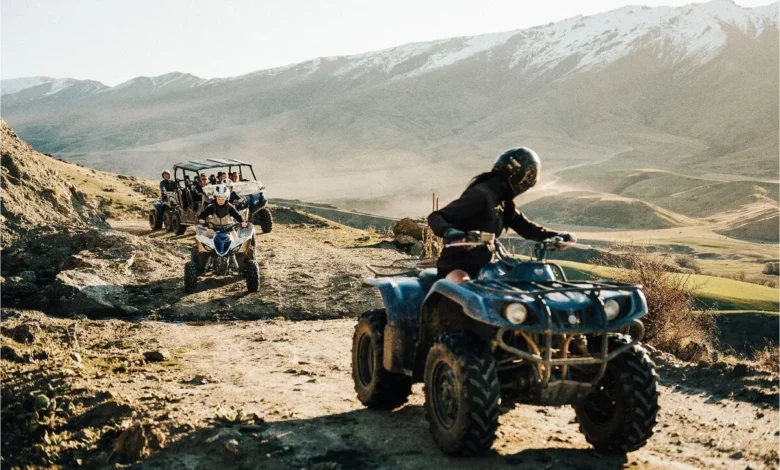
While the vast majority of international and domestic travelers experience New Zealand’s iconic Cardrona Valley through the framed perspective of a car window, a growing sector of adventure tourists is choosing a much more visceral vantage point. Situated high above the valley floor in the rugged expanse of Otago, specialized all-terrain vehicle tours offer an unfiltered encounter with the Southern Alps. With engines rumbling and the landscape shifting from pastoral farmland to raw, glaciated alpine terrain, these excursions redefine how visitors interact with the high country. Operated by seasoned local guides who have spent decades navigating these peaks, the Cardrona quad bike tour delivers an immersive physical and geographical transition that static viewpoints simply cannot replicate.
Background and Evolution of Cardrona Adventure Tourism
The Cardrona Valley holds a storied place in the historical fabric of New Zealand’s South Island. Renowned globally for its pivotal role in the 1860s Otago Gold Rush, the valley transformed overnight from a quiet river basin into a bustling frontier of prospectors, tent settlements, and rudimentary mining infrastructure. Today, while the gold miners are long gone, the imprint of human history remains visible across the tussock-covered hillsides.
Capitalizing on this rich heritage, local tourism operators have spent decades developing low-impact ways for travelers to access the remote backcountry. Founded 13 years ago by veteran operator Kel, The Cardrona Horse Treks & ATV Adventures has evolved into a cornerstone of the region’s soft-adventure economy. Over more than a decade of continuous operation, the business has refined its approach to balancing high-altitude recreation with environmental stewardship, granting visitors exclusive access to vast tracts of private high-country land that would otherwise remain entirely closed to the public.
Anatomy of the Mountain Experience: What to Expect Upon Arrival
The operational hub of the tour is established at a rustic, purpose-built base facility in the heart of the Cardrona Valley, situated approximately 20 minutes from Wānaka and 45 minutes from Queenstown. Upon arrival, participants are greeted not only by professional expedition guides but also by the operation’s resident barn cats—local fixtures that have achieved informal legendary status among returning guests. The reception area, anchored by a traditional stone fireplace, offers a warm, welcoming environment designed to mentally prepare visitors for the cooler climes awaiting them at higher elevations.
Once administrative check-in and liability documentation are completed, safety protocols take center stage. Guides meticulously fit each participant with Department of Conservation-approved safety helmets, heavy-duty weatherproof outerwear, high-grade gloves, and robust gumboots. Following the gear fitting, a comprehensive mandatory safety briefing and vehicle orientation are conducted. Given the demanding nature of alpine terrain, operators place a heavy emphasis on this preparatory phase, ensuring that both novices and experienced handlers possess a clear understanding of throttle control, weight distribution, and trail etiquette.
The Ascent: From Flat Paddocks to High-Altitude Tussock
The two-hour Mountain Experience tour is structurally engineered to build rider confidence progressively. The journey begins across flat, expansive paddocks and well-maintained gravel access roads. Traveling in a disciplined single-file formation led by an experienced front guide, participants use this initial low-stress environment to master the handling characteristics of their machinery.
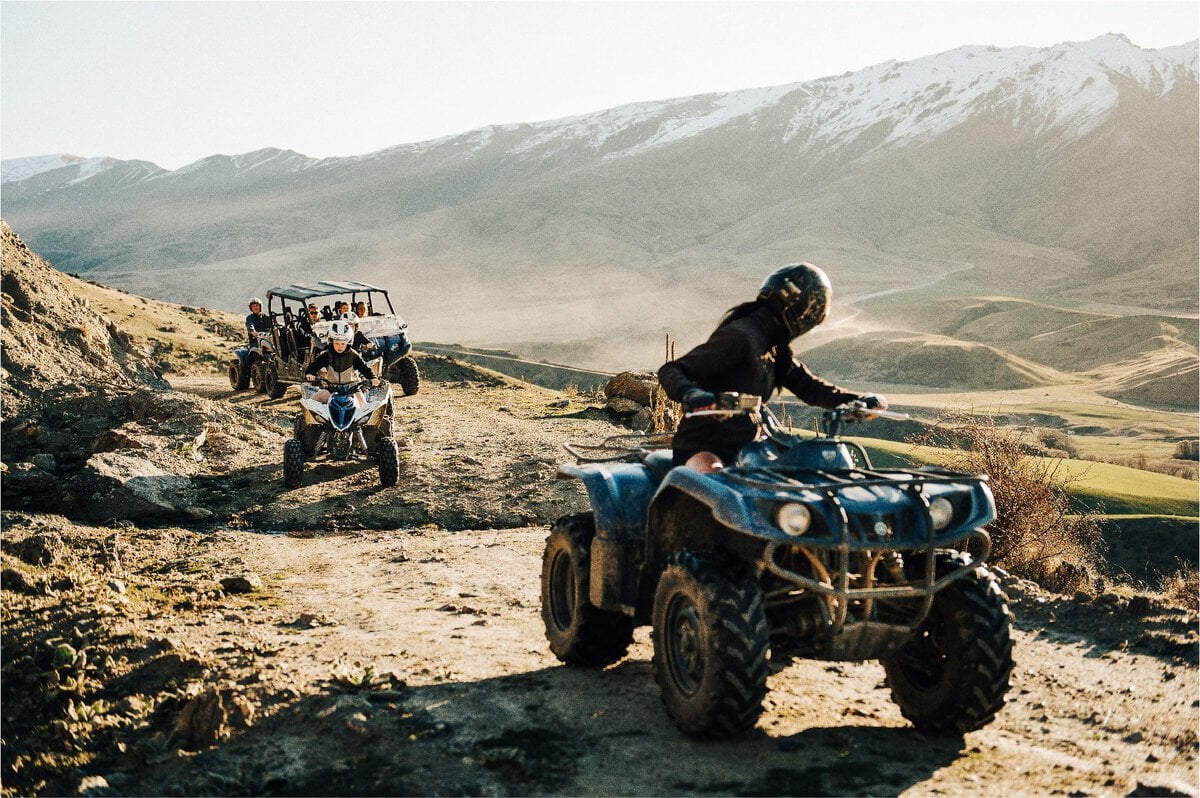
The fleet comprises Yamaha Kodiak 450cc four-wheel-drive quad bikes. These machines are celebrated in the utility and recreational vehicle sectors for their mechanical resilience, robust suspension systems, and user-friendly ergonomics. Crucially for the alpine environment, the quads are equipped with heated handle grips, a feature that becomes indispensable as the convoy ascends into lower-temperature microclimates. Regular stops are integrated into this initial phase, allowing guides to check in individually with participants, monitor skill progression, and offer contextual commentary regarding the surrounding geography.
Transitioning Through Working Farmland
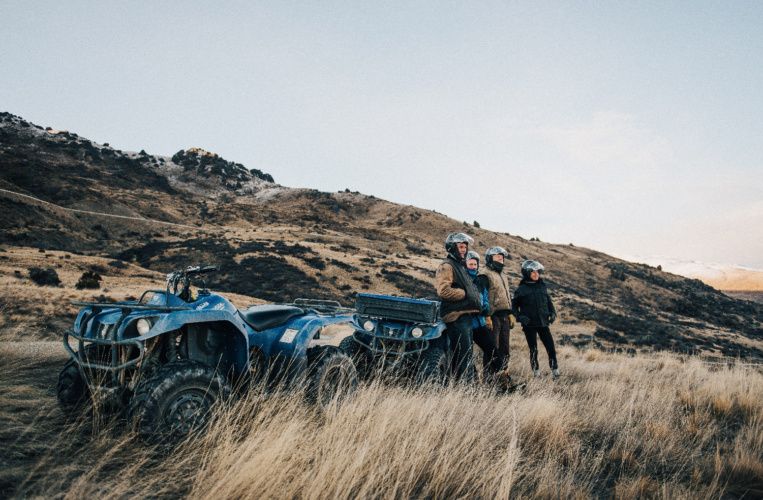
As the route progresses, the trail leaves the valley floor and enters a sprawling 15,000-acre expanse of private high-country farmland. This section underscores the working reality of New Zealand’s agricultural sector. Unlike sterile commercial tourism parks, this is an active pastoral lease. Participants frequently encounter flocks of merino sheep, herds of beef cattle, and darting populations of wild rabbits. In peak seasons, working shepherds and their highly trained working dogs can often be observed managing stock across the steep slopes.
During these transitional halts, guides enrich the journey with historical and ecological insights. Narratives detailing the trials and triumphs of 1860s gold prospectors are paired with botanical identifications of indigenous flora, such as native tussock grasses, speargrass, and alpine herbs. This interpretive framework transforms what could otherwise be a purely mechanical thrill ride into an educational exploration of Central Otago’s unique ecosystem.
Entering the Raw Alpine Zone
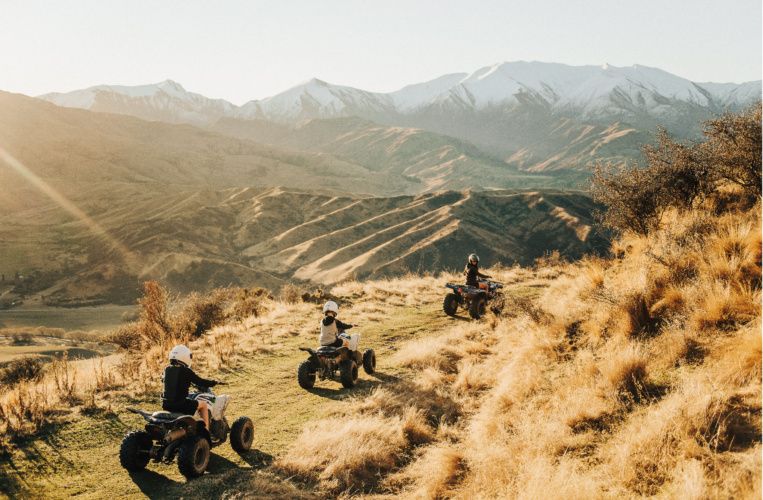
Upon pushing past the timberline and the upper limits of the working farm, the character of the environment shifts dramatically. Grass and gravel give way to an uncompromising landscape of weathered rock, jagged schist formations, and sprawling alpine tussock. The acoustic profile of the environment alters simultaneously; engines echo off stone faces, but once parked, a profound, near-absolute stillness settles over the peaks.
Depending on the seasonal timing and prevailing meteorological patterns, the alpine zone frequently features patches of residual snow underfoot or dusting the distant jagged ridges of the surrounding mountain ranges. While snow accumulation cannot be guaranteed on any given summer day, its unpredictable appearance fundamentally alters the visual scale of the landscape. At these elevations, air temperatures can plummet close to 0°C, even during peak summer months, largely driven by biting wind chills. Guides utilize these strategic viewpoints to grant participants a moment to catch their breath, rehydrate, and capture panoramic photographs overlooking Lake Wanaka and the sprawling alpine ranges.
Descent, Debrief, and Inclusive Options
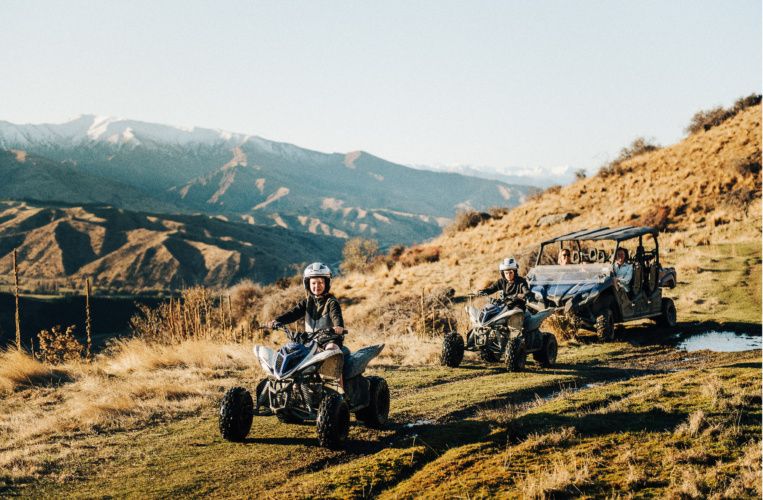
The return journey traces a descending gravel access road, offering a smoother, less technical ride that allows participants to relax and fully absorb the scale of the valley opening up beneath them. Upon returning to the base facility, the tour concludes with a communal debrief. Operators feature a large-screen digital photo recap, projecting high-resolution images captured by guides along the trail. Recognizing the logistical impossibility of self-photographing while navigating technical mountain trails, the operation makes these professional digital image packages available for purchase.
Crucially, tour operators have engineered the experience to be inclusive of non-drivers—a logistical consideration frequently overlooked in standard adventure travel literature. Individuals who feel hesitant about operating a motorized quad bike independently are not required to sit out the excursion. Instead, they can travel comfortably as passengers within Yamaha Viking off-road buggies, steered by professional guides. Alternatively, self-drive options for the multi-passenger buggies are available. This structural flexibility allows multi-generational families or mixed-preference travel groups to ascend the mountain together, with some members operating quad bikes, others riding in buggies, and specialized arrangements available for those wishing to combine elements of the tour with traditional high-country horse trekking.
Logistics, Pricing, and Practical Considerations
The Cardrona Mountain Experience operates year-round across all standard weather conditions, reflecting the changeable nature of New Zealand’s southern alpine climate. Standard pricing for adult solo quad bike drivers begins at NZ$349.00 per person. Drivers must be a minimum of 16 years of age to operate a quad bike independently; younger travelers are welcomed aboard as passengers within the guided off-road buggies.
From a logistical standpoint, participants are strongly advised to dress in flexible thermal layers, regardless of ambient temperatures recorded at the base building. While foundational weatherproof gear, gloves, and footwear are provided on-site, personal thermal underlayers significantly enhance comfort against high-altitude wind chill. Furthermore, during dry summer months, the trailing dust kicked up along gravel tracks makes the inclusion of a personal balaclava or face covering highly recommended.
Located centrally in the Cardrona Valley, the base is easily accessible via a 20-minute drive from Wānaka or a 45-minute journey over the Crown Range Road from Queenstown. Travelers navigating the region during winter months are legally required to carry snow chains and check regional highway advisories before departure, as sudden alpine snowfalls can temporarily affect mountain passes.
Economic and Regional Implications
The sustained success of operations like Kel’s Cardrona quad bike tours highlights a broader structural shift within New Zealand’s tourism economy toward low-density, high-value experiential travel. By partnering with private landowners to secure exclusive access to extensive tracts of high-country wilderness, adventure tourism operators help diversify rural revenue streams while alleviating visitor congestion in traditional national parks.
As regional tourism boards across Otago continue to promote shoulder-season and year-round visitation, all-weather alpine excursions play a vital role in maintaining local employment stability and hospitality demand outside the traditional peak summer window. By offering a balanced synthesis of historical education, agricultural integration, and controlled motorized exploration, the Cardrona quad bike experience sets a high benchmark for sustainable, inclusive adventure tourism in the Southern Hemisphere.