Chasing Ghosts of the Eurasian Steppe: Conservationists Fight to Preserve the Ancient Migration Routes of Kazakhstan’s Endangered Saiga Antelope


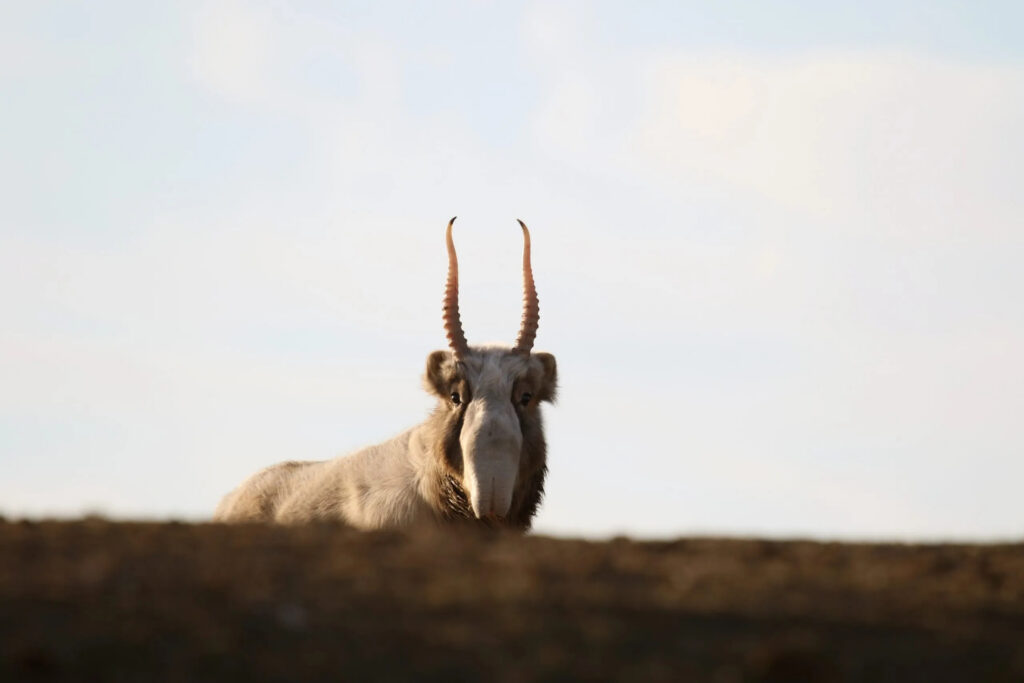
The modern landscape of the Eurasian steppe is a fractured mosaic of asphalt highways, electrified rail lines, and agricultural fencing that cuts across one of the Earth’s oldest remaining wildernesses. Yet, amid this sprawling industrial development, an ancient survivor continues to defy the constraints of modern borders. The saiga antelope (Saiga tatarica), an unmistakable ungulate characterized by its bulbous, trunk-like snout, represents a living link to the Pleistocene epoch. Having outlived woolly mammoths, saber-toothed cats, and giant deer, these nomadic travelers now face their greatest existential threat not from prehistoric predators, but from the relentless march of human infrastructure.
Recent field audits conducted by conservationists in western Kazakhstan illuminate the precarious reality facing these herds. Braving extreme weather and volatile terrain, researchers from the Association for the Conservation of Biodiversity of Kazakhstan (ACBK) continue to monitor the western saiga population during their critical annual rutting season. Their findings, combined with cutting-edge tracking data, offer both a stark warning regarding habitat fragmentation and a beacon of hope through targeted transnational conservation strategies.
Anatomy of an Ancient Migration and the Rutting Season
The biological rhythms of the saiga antelope are inextricably linked to the harsh, open expanses of Central Asia. Unlike sedentary species, saigas are perpetual wanderers, traversing hundreds of miles across treeless plains in response to seasonal shifts in weather and forage availability.
The fieldwork detailed by ACBK researchers coincided directly with the saiga rut, a biologically intensive period that dictates the population’s future generation. During this window, herds converge in massive, single-file processions across the semidesert steppe before fracturing into competitive mating groups.
The physiology of the saiga is uniquely adapted to these extremes. Their enlarged, floppy snouts serve a dual evolutionary purpose: filtering out choking dust during dry summer months and warming sub-zero winter air before it reaches their lungs. During the rut, males utilize these distinct features as visual indicators of dominance and vitality, engaging in fierce headbutting contests that often result in extreme physical exhaustion.
Historically, this nomadic lifestyle spanned a vast geographic arc stretching from the Caucasus Mountains to Mongolia. However, twentieth-century geopolitical shifts, rapid agricultural expansion, and linear infrastructure projects have severely compressed this historic range, isolating distinct populations into increasingly vulnerable sub-groups.
Infrastructure and the Erasure of Spatial Memory
The primary driver of saiga population decline and habitat fragmentation in the post-Soviet era has been the rapid proliferation of linear infrastructure. While GPS telemetry has revolutionized how conservationists track these elusive ungulates—allowing researchers to map migration corridors with pinpoint accuracy—it has also laid bare the devastating impact of human barriers.
Data compiled by ACBK highlights a stark turning point in 2014, when the construction of a major railway line in western Kazakhstan effectively severed traditional migratory pathways. Prior to the installation of the tracks, telemetry data revealed fluid, seasonal movements of saiga herds crossing freely into neighboring Uzbekistan in search of vital forage and water resources. Following construction, spatial tracking showed herds milling despondently on the northern side of the physical barrier, unable to access traditional winter ranges while southern pastures withered away.
This disruption triggers what scientists term a loss of spatial knowledge—a phenomenon as thorough as the erasure of a language. Saiga calves acquire navigational routes, water sources, and hazard avoidance not through genetic instinct alone, but through active participation and observation within the herd. When railways and border fences cleave these pathways, the collective cultural memory of the migration is fractured, leaving entire generations stranded.
This ecological bottleneck mirrors the historical displacement of human populations in the region. For millennia, indigenous Kazakh nomads—whose ethnonym derives from Turkic roots signifying wanderers and vagabonds—practiced seasonal transhumance across these same river valleys and plateaus. The institutional sedentarization policies enforced during the Soviet era fundamentally altered human mobility, forcing pastoralists into agricultural settlements and permanently altering the demographic fabric of the Eurasian steppe.
Transnational Conservation and Engineering Solutions
Recognizing the severity of the crisis, conservation organizations and government agencies have initiated targeted remediation efforts to restore permeability to the landscape. In partnership with the Kazakh government, ACBK has spearheaded the design and construction of specialized, saiga-friendly crossing points along newly developed rail corridors.
These interventions utilize slightly sloping dirt ramps engineered to match the elevation of train tracks, creating the optical illusion of a natural gap in the barrier. Coupled with cattle-guard fences positioned at safe distances to prevent direct collisions, these structures are intended to re-establish historical connectivity without compromising rail safety.
International cooperation has proven equally vital. ACBK has collaborated with authorities in Uzbekistan to modify rigid border security infrastructure. By replacing traditional, solid barbed-wire walls with X-shaped barricades that successfully deter unauthorized vehicular traffic while leaving adequate clearance for saigas to pass underneath, cross-border migrations are slowly beginning to find a path forward.
Furthermore, the establishment of new wildlife sanctuaries—delineated using rigorous, empirical data harvested from GPS-collared specimens—provides legally protected strongholds for the herds during their most vulnerable biological cycles.
Broader Implications for Steppe Ecosystems
The plight of the saiga antelope serves as an essential case study in modern conservation biology: the realization that protected areas alone are insufficient to safeguard wide-ranging migratory species. As industrial development continues to accelerate across Central Asia, the long-term viability of the saiga depends entirely on the maintenance of functional ecological corridors.
The conservation framework established in Kazakhstan offers a replicable model for other arid and semi-arid ecosystems worldwide, demonstrating that economic development and ecological preservation are not mutually exclusive. By integrating empirical tracking data with responsive infrastructure engineering, conservationists are working to ensure that the ancient thunder of saiga hooves continues to echo across the Eurasian steppe for generations to come, preserving a living monument to an irreplaceable Pleistocene heritage.