GSI Outdoors Glacier Canister Top Stove: A Comprehensive Review of Simplicity and Performance

As the backpacking community continuously seeks a balance between efficiency, weight, and cost, the GSI Outdoors Glacier Canister Top Stove emerges as a notable contender, particularly for those who prioritize minimalist utility over complex integrated systems. Recently redesigned for improved lightness and compactness, this stove reinforces the enduring appeal of a straightforward cooking setup: a reliable canister stove, a fuel source, and a pot. This article provides an in-depth analysis of the Glacier Canister Top Stove, examining its design, performance metrics, user experience, durability considerations, and market positioning within the broader landscape of backpacking cooking solutions.
Product Overview and Design Philosophy
The GSI Outdoors Glacier Canister Top Stove is positioned as an accessible and functional option for backpackers, priced at an economical $65. In an era where many essential pieces of outdoor gear often exceed the $100 mark, its affordability is a significant selling point. GSI Outdoors, a brand known for its practical and durable outdoor cooking and dining equipment, has focused on streamlining this flagship stove. The redesign aimed to reduce both its weight and packed volume, making it more appealing to hikers who meticulously manage their pack contents.
The core philosophy behind the Glacier Canister Top Stove is uncompromised simplicity. It eschews the integrated heat exchangers and specialized pots found in more expensive systems, opting instead for a direct, high-efficiency burner that attaches directly to a standard threaded isobutane/propane fuel canister. This design choice caters to backpackers whose primary cooking need is boiling water for rehydrated meals or beverages, rather than elaborate trailside gourmet preparations. The stove’s effectiveness was put to the test across various environments, including multiple spring camping excursions and a week-long backpacking journey along the often-windy Oregon coast, providing robust real-world data on its capabilities.
Key Specifications and Initial Impressions
The GSI Glacier Canister Top Stove offers the following core specifications:
- Burn Time: Approximately 60 minutes per 8 oz. (227g) fuel canister.
- Verified Boil Time (1L): 4 minutes, 0 seconds (at sea level with room temperature water).
- Weight: 3.1 ounces (87.9 grams).
- Price: $65.
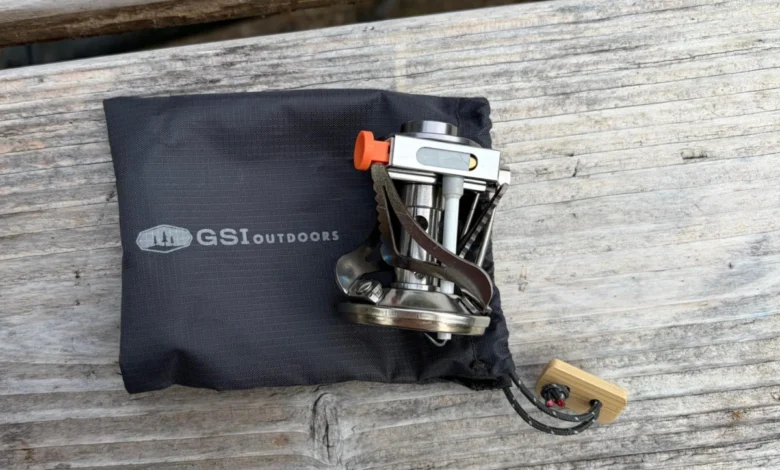
Upon initial inspection, the stove presents a robust yet compact form factor. Its three pot support legs pivot and rotate inwards, allowing the unit to collapse into a remarkably small package. This design enables the stove to be easily nested within a standard backpacking cup or pot, such as a Snow Peak 14-ounce titanium cup or a 750 mL titanium pot, significantly minimizing its footprint within a backpack. This efficient storage solution stands in stark contrast to bulkier integrated systems, which often demand dedicated space.

Design and Features in Detail
The design of the Glacier Canister Top Stove emphasizes ease of use. It features three sturdy legs that provide a stable platform for various pot sizes. These legs are engineered to pivot and rotate, allowing the stove to fold down compactly. A standard fuel valve facilitates precise control over the burner’s flame, from a gentle simmer to a full boil. The inclusion of a piezo ignitor offers a convenient one-click ignition, eliminating the immediate need for a separate lighter or matches—though, as later observations reveal, a backup ignition source remains prudent.
The stove’s compatibility with standard threaded fuel canisters (typically an isobutane/propane blend) makes it versatile and easy to resupply in most outdoor retail environments. During testing, one notable positive was the absence of the "telltale hiss" of escaping fuel when connecting or disconnecting the canister. This minor but persistent annoyance with some competing models, such as the MSR PocketRocket and certain Coastal Range Equipment stoves, results in wasted fuel and an unpleasant odor. The GSI Glacier’s secure connection mechanism demonstrates superior sealing, preserving precious fuel reserves on extended trips.
Performance Metrics and Comparative Analysis
Boil Time:
The measured boil time of 4 minutes for 1 liter of water at sea level and room temperature positions the GSI Glacier as a capable, though not exceptionally fast, stove. For smaller quantities, testing showed 240 mL of water boiling in 2 minutes, 10 seconds, and 350 mL in 3 minutes, 25 seconds.
To contextualize this performance, it’s essential to compare it with other popular backpacking stoves:
- Jetboil Stash: Achieves a 1L boil in 2 minutes, 25 seconds.
- MSR XGK EX (Liquid Fuel): Boils 1L in 3 minutes, 30 seconds.
- MSR PocketRocket Deluxe: Often boasts boil times closer to 3 minutes, 20 seconds per liter, thanks to its pressure regulator.
The GSI Glacier’s slightly slower boil time is a direct consequence of its simpler design, lacking the integrated heat exchangers and wind shields common in faster, often more expensive, integrated systems like Jetboils. For a solo backpacker primarily rehydrating meals, an extra minute or two of waiting is often negligible. However, for larger groups or in scenarios demanding rapid, consecutive boils, this difference could become a "deal-breaker," as the review notes. The efficiency of a stove is not just about raw speed but also about how that speed translates to fuel consumption and overall user satisfaction in a given context.
Fuel Efficiency:
With a reported burn time of 60 minutes per 8 oz. fuel canister, the Glacier Canister Top Stove demonstrates reasonable fuel efficiency. This metric is crucial for planning fuel requirements, especially on longer trips where resupply points are scarce. While specific BTU output is not provided, the general performance aligns with other stoves in its class, offering a practical balance between heat output and fuel consumption. Factors like ambient temperature, wind conditions, and initial water temperature significantly influence actual burn times and fuel usage in the field.

Wind Performance:
Testing along the Oregon coast, an environment notorious for blustery conditions, provided valuable insights into the stove’s stability and performance in wind. The three-leg design proved sufficiently stable, minimizing concerns about pots being dislodged. However, the absence of an integrated wind screen, a feature often found in more advanced or integrated systems, means that strong winds will inevitably reduce the stove’s efficiency and increase boil times. Users operating in exposed, windy conditions might consider carrying a separate, lightweight wind screen to optimize performance and fuel economy.
Packability and Weight:
Weighing in at 3.1 ounces (87.9 grams), the GSI Glacier is competitive within the canister-top stove category.
- MSR PocketRocket Deluxe: 2.6 ounces.
- SOTO Windmaster (with 4Flex pot support): 3.0 ounces.
When paired with a lightweight 750mL TOAKS titanium pot (3.6 ounces), the total cooking system weighs approximately 7.7 ounces (218 grams). This figure highlights a significant advantage over integrated cooking systems:
- Jetboil MiniMo: 14 ounces (397 grams).
- Jetboil Flash Fast: 13 ounces (369 grams).
The combined stove-and-pot method saves nearly half a pound, making it a highly attractive option for ultralight backpackers and solo adventurers who meticulously shave grams from their gear list. The ability to nest the stove within the pot further enhances pack efficiency, occupying minimal "real estate" in a backpack.
User Experience and Practical Considerations
Ease of Use:
The GSI Glacier Canister Top Stove is lauded for its straightforward operation. Attaching the stove to a fuel canister is simple and secure, notably without the fuel leakage experienced with some other models. The integrated piezo ignitor offers convenience, allowing for quick ignition without fumbling for a separate lighter—at least initially. The fuel control valve is intuitive, allowing users to adjust flame intensity.
Operational Quirks:
One minor design quirk noted is that the gas control valve must be twisted slightly into the open position to allow the stove legs to fully stow away. This necessitates a conscious effort to return the valve to the closed position before attaching it to a fuel canister, preventing accidental gas escape. While not a major flaw, it’s a detail users need to be aware of to avoid unnecessary fuel loss or potential safety issues.
Durability and Longevity Concerns

Premature Piezo Ignitor Failure:
A significant drawback identified during testing was the premature failure of the piezo ignitor. After less than a month of cumulative use, including a week-long trip along the Oregon coast, the ignitor ceased to function. This aligns with broader industry observations that piezo ignitors, while convenient, can be prone to failure due to exposure to dust, moisture, or impact—all common occurrences in a backpacking environment. This failure underscores the fundamental rule of backpacking: always carry a backup ignition source (e.g., a mini Bic lighter or waterproof matches). While the stove remains fully functional with an external ignition, the loss of an advertised feature within a short period is a notable detractor.
Leg Mechanism Durability:
The pivoting leg design, while contributing to the stove’s compact packed size, raises potential long-term durability concerns. The legs are screwed in at a single pivot point, allowing them to rotate for deployment and stowing. With repeated use and the stresses of supporting a pot, there is a theoretical risk that this joint could loosen or wear over time, potentially compromising stability. While not observed during the relatively short testing period, this design contrasts with simpler sliding mechanisms found in stoves like the MSR PocketRocket, which might offer greater perceived long-term robustness at the expense of a slightly larger packed footprint.
Economic Considerations and Market Positioning
The GSI Glacier Canister Top Stove retails for $65, placing it squarely in the average price range for quality canister-top stoves. When factoring in the cost of a lightweight titanium pot (ranging from $26 to $65 depending on size and brand), the total investment for a complete cooking system can be estimated at around $100.
This total cost is significantly lower than that of integrated stove systems:
- Jetboil systems: Start at $145 and can exceed $180.
- Coastal Range Equipment integrated stove: Approximately $150.
The choice between a canister-top stove like the GSI Glacier and an integrated system involves inherent trade-offs. The higher price tag of integrated systems typically comes with features such as faster boil times (due to heat exchangers), superior wind resistance, and sometimes more robust simmering capabilities. For backpackers operating on a strict budget, or those who prioritize minimal packed volume and weight above all else, the GSI Glacier presents a compelling value proposition. Its ability to nest within a pot means it consumes significantly less space than many integrated systems, which often include a dedicated pot and stove unit that cannot be separated for packing efficiency.
Broader Impact and Implications for Backpackers
The GSI Outdoors Glacier Canister Top Stove caters to a specific segment of the backpacking community. For the "boil-and-eat" minimalist, the ultralighter, or the budget-conscious adventurer, this stove represents an ideal solution. It is designed for those who view their stove primarily as a tool for preparing hot beverages and rehydrating freeze-dried meals, rather than a versatile kitchen appliance for trailside culinary experiments.

The implication of choosing such a streamlined setup is a deliberate sacrifice in certain performance aspects, most notably boil speed. At the end of a demanding day on the trail, the few extra minutes required to boil water with the GSI Glacier compared to a Jetboil might be a minor inconvenience for some, while others might find it frustrating. This personal tolerance for wait time is a crucial factor in the purchasing decision.
For backpackers in larger groups, where multiple liters of water might need to be boiled quickly and consecutively, the slower boil time could become a logistical bottleneck. In such scenarios, the benefits of an integrated system’s speed and efficiency might outweigh its higher cost and weight.
However, for solo hikers or small groups with modest boiling needs, the combination of the GSI Glacier’s low cost, compact size, and light weight offers substantial advantages. It simplifies the cooking process, reduces pack bulk, and makes outdoor adventures more accessible from a financial standpoint.
Conclusion
The GSI Outdoors Glacier Canister Top Stove stands as a testament to the enduring appeal of simplicity and value in backpacking gear. Its recent redesign has enhanced its compactness and lightness, making it an even stronger contender for those who prioritize these attributes. While it may not boast the blistering boil times or advanced features of more expensive integrated systems, it delivers reliable performance for the fundamental task of boiling water.
The stove’s key strengths lie in its exceptional affordability, minimalist design, and impressive packability. The secure fuel connection is a welcome detail, and its stability in windy conditions is commendable for a canister-top model. However, potential buyers should be aware of the common vulnerability of piezo ignitors and consider carrying a backup ignition source. The pivoting leg mechanism, while efficient for packing, warrants consideration for long-term durability.
Ultimately, the GSI Glacier Canister Top Stove is a solid choice for the pragmatic backpacker who requires a no-muss, no-fuss cooking solution. It embodies the philosophy that effective outdoor gear doesn’t always need to be feature-laden or prohibitively expensive. For those living on freeze-dried meals on the trail, prioritizing budget, and seeking to minimize pack weight and volume, the GSI Outdoors Glacier Canister Top Stove is unequivocally worth strong consideration.