Exploring the Nine Themed Realms of Disneyland Park A Comprehensive Guide to History Attractions and Strategic Planning

Disneyland Park in Anaheim, California, remains a cornerstone of the global tourism industry, serving as the blueprint for the modern theme park. Since its inception on July 17, 1955, the park has expanded from its initial five themed areas to a sophisticated network of nine distinct lands. Each land is meticulously designed to offer a cohesive narrative through architecture, horticulture, culinary offerings, and mechanical attractions. For the millions of domestic and international travelers who visit the resort annually, understanding the logistical layout and historical context of these nine realms is essential for navigating what has become one of the most complex entertainment environments in the world.
The Evolution of the Hub and Spoke Design
The layout of Disneyland is famously based on the "hub and spoke" model, a design philosophy pioneered by Walt Disney and his "Imagineers." At the center of the park stands Sleeping Beauty Castle, acting as a visual "wienie"—a term Disney used to describe a beckoning landmark—that draws guests toward the central Plaza. From this hub, paths radiate outward to the various themed lands. This design was intended to prevent the exhaustion and disorientation common in traditional midways and world’s fairs of the early 20th century.

Historically, the park opened with five lands: Main Street, U.S.A., Adventureland, Frontierland, Fantasyland, and Tomorrowland. Over the decades, the park has undergone significant spatial and thematic shifts to accommodate evolving cultural tastes and technological advancements. The addition of New Orleans Square in 1966 marked the first major expansion, followed by Bear Country (now Bayou Country) in 1972, Mickey’s Toontown in 1993, and the ambitious Star Wars: Galaxy’s Edge in 2019.
Main Street, U.S.A.: The Gateway to Americana
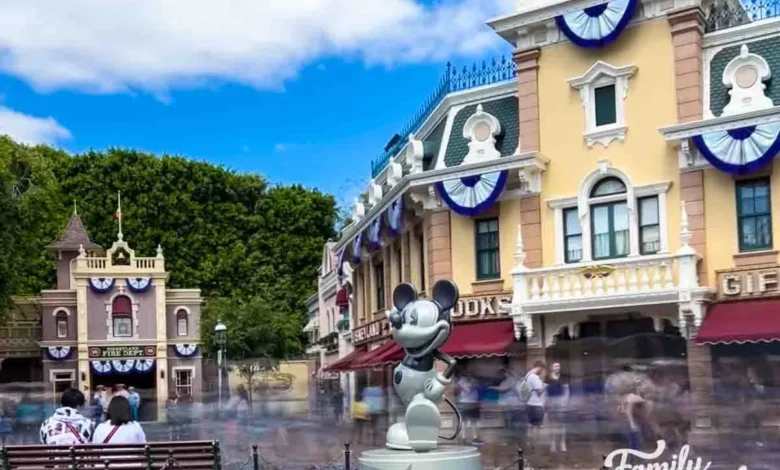
Upon passing through the turnstiles, guests enter Main Street, U.S.A., a stylized recreation of a turn-of-the-century American town, inspired largely by Walt Disney’s hometown of Marceline, Missouri. This land serves a dual purpose: it is both a nostalgic immersive environment and the park’s primary commercial artery.
Main Street is unique among all Disney parks globally because it is the only one where Walt Disney maintained a personal residence—an apartment located above the Firehouse, where a lamp remains lit in the window today as a tribute to his enduring presence. The land features the Disneyland Railroad, a 1.2-mile narrow-gauge heritage railway that encircles the park, and the Great Moments with Mr. Lincoln attraction, which showcased the world’s first fully functional human audio-animatronic figure in 1964.

Logistically, Main Street is the center for guest services, including locker rentals, lost and found, and the park’s largest retail outlet, The Emporium. Industry analysts note that Main Street’s design facilitates a "slow burn" of consumer spending, with most guests engaging in heavy shopping during the evening hours as they exit the park.
Fantasyland: The Narrative Heart of the Park
Located directly through the castle archway, Fantasyland is designed to bring Disney’s animated classics to life. It contains the highest density of attractions in the park, many of which are "dark rides" that utilize omnimover or track-based systems to move guests through scenes from films like Peter Pan, Snow White, and Pinocchio.
Fantasyland is often the primary destination for families with small children, yet it also holds historical significance for engineers. The Matterhorn Bobsleds, opened in 1959, was the first tubular steel roller coaster in the world, a technology that revolutionized the amusement park industry. Furthermore, "it’s a small world," originally designed for the 1964-1965 New York World’s Fair, remains a benchmark in high-capacity ride design, capable of processing thousands of guests per hour.

Tomorrowland: A Vision of the Future Past
Tomorrowland has historically been the most challenging land for Disney to maintain, as the "future" it depicts is constantly being overtaken by reality. Consequently, the land has shifted toward a "retro-futuristic" aesthetic, blending mid-century modernism with sci-fi themes.
The land is anchored by Space Mountain, an indoor high-speed coaster that remains one of the park’s most popular attractions since its 1977 debut. Other key installations include Star Tours – The Adventures Continue, which utilizes flight simulation technology, and Buzz Lightyear Astro Blasters, an interactive gaming experience. Despite the popularity of its rides, Tomorrowland is frequently cited by urban planners as an area in need of a cohesive aesthetic overhaul, reflecting the difficulties of maintaining a "future" theme in a rapidly advancing technological era.
Adventureland and Frontierland: Exoticism and the Old West
Adventureland was designed to satisfy the post-WWII American fascination with exotic locales, particularly the South Pacific and Africa. Its flagship attraction, the Jungle Cruise, is famous for its humorous narration and was originally intended to feature live animals before logistical realities forced the use of animatronics. The land also houses Indiana Jones Adventure: Temple of the Forbidden Eye, which utilizes Enhanced Motion Vehicles (EMV) to simulate rugged terrain.

Contiguous to Adventureland is Frontierland, which celebrates the American pioneer spirit. This land is dominated by Big Thunder Mountain Railroad, a "runaway mine train" coaster. Frontierland also serves as the gateway to the Rivers of America, where the Mark Twain Riverboat and the Sailing Ship Columbia offer scenic tours. Unlike its counterpart at Florida’s Magic Kingdom, Disneyland’s Frontierland maintains a more intimate scale, reflecting the limited acreage available in the Anaheim park.
New Orleans Square and the Recent Transition to Bayou Country
New Orleans Square, added in 1966, was the first land not present on opening day. It is widely considered the most architecturally beautiful area of the park, featuring intricate wrought-iron balconies and narrow alleyways. It is home to two of Disney’s most legendary attractions: Pirates of the Caribbean and The Haunted Mansion. This land also hosts the exclusive, members-only Club 33 and the Blue Bayou Restaurant, which is situated inside the Pirates of the Caribbean show building.
Adjacent to New Orleans Square is the newly rebranded Bayou Country. Formerly known as Critter Country, this area was renamed in 2024 to coincide with the opening of Tiana’s Bayou Adventure, a reimagining of the former Splash Mountain. This transition reflects Disney’s broader corporate strategy of updating older attractions to align with modern intellectual properties (IP) and more inclusive storytelling. Bayou Country remains a quieter pocket of the park, featuring The Many Adventures of Winnie the Pooh and the Hungry Bear Barbecue Jamboree.

Mickey’s Toontown and Star Wars: Galaxy’s Edge: The Modern Era
Mickey’s Toontown underwent a massive reimagining in 2023 to improve accessibility and interactive play. It is designed to look like a living cartoon, with "squash and stretch" architecture. The addition of Mickey & Minnie’s Runaway Railway, which uses a sophisticated trackless ride system and state-of-the-art projection mapping, has revitalized this land, making it a high-traffic destination for both children and adults.
In contrast, Star Wars: Galaxy’s Edge represents the pinnacle of "immersive" theme park design. Representing the Black Spire Outpost on the planet Batuu, the 14-acre land cost an estimated $1 billion to construct. It moved away from the traditional "ride-centric" model to a "land-as-the-attraction" model. Guests can build custom lightsabers at Savi’s Workshop or droids at the Droid Depot, emphasizing experiential retail. The land’s anchor, Star Wars: Rise of the Resistance, is one of the most complex attractions ever built, featuring multiple ride systems, dozens of animatronics, and a seamless blend of physical sets and digital media.
Logistics, Visitor Management, and Economic Impact
The management of these nine lands requires a massive logistical operation. Disneyland Resort is the largest single-site employer in Orange County, California, with a workforce of approximately 35,000 "Cast Members." The introduction of the Lightning Lane Multi-Pass system (formerly Genie+ and FastPass) has changed how guests move between these lands, using data-driven algorithms to distribute crowds and minimize wait times.

From an economic perspective, the distinction between the lands is vital for "yield management." By placing high-demand thrill rides in Tomorrowland and Galaxy’s Edge, and high-capacity family rides in Fantasyland, Disney ensures that guests are spread throughout the park’s 85 acres. This distribution is critical for maintaining a high "Guest Experience" rating, which directly correlates with repeat visitation and per-capita spending.
Implications and Future Outlook
The continued evolution of Disneyland’s nine lands suggests a shift toward deeper immersion and the integration of digital technology. With the "Disneyland Forward" initiative—a multi-decade expansion plan approved by the Anaheim City Council in 2024—the park is poised to potentially add new lands or expand existing ones into currently underutilized parking areas.
As Disneyland approaches its 70th anniversary, the challenge for the Walt Disney Company remains balancing the preservation of the park’s historical legacy with the necessity of modernization. The nine themed lands of Disneyland are not static museum pieces but are part of a "living" park that, as Walt Disney famously stated, "will never be completed as long as there is imagination left in the world." This philosophy ensures that while the names and themes of the lands may change, their role as a global benchmark for themed entertainment remains secure.
Related posts: