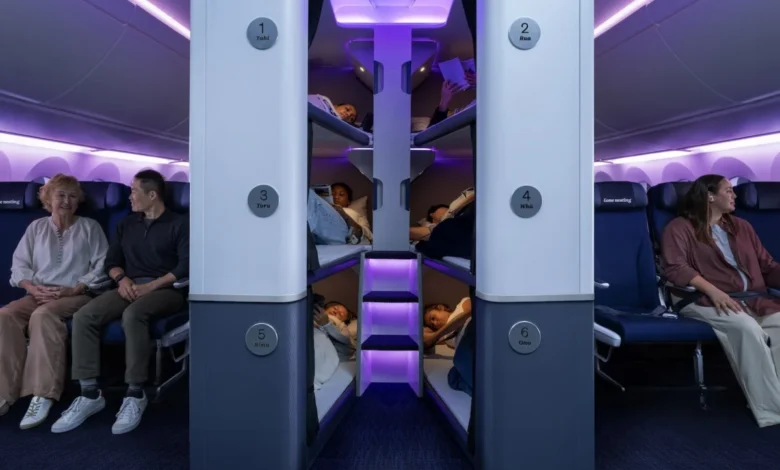
The Economy Skynest represents a significant paradigm shift in airline design and passenger service. Unlike the Skycouch, which modifies an existing economy-class row into a flat space, the Skynest is a completely separate section of the aircraft, housing six individual sleeping pods. These pods are arranged in a bunk-style configuration, nestled between the economy and premium economy cabins, creating a unique, dedicated space for rest and rejuvenation. The service is slated to become available for booking in May 2026, with the inaugural flights featuring the Skynest expected to launch later the same year on the ultra-long-haul route connecting New York City (JFK) and Auckland (AKL). This particular route is renowned as one of the longest commercial flights in the world, spanning approximately 18 hours, making enhanced comfort solutions not just a luxury, but a necessity for many passengers.
The Evolution of Passenger Comfort on Long-Haul Flights
For decades, the standard economy class experience on long-haul flights has been characterized by cramped seating, limited recline, and the pervasive challenge of finding comfortable rest. As aircraft technology advanced, enabling ever-longer direct routes, the demand for improved passenger comfort became increasingly vocal. Airlines, recognizing this burgeoning need, began exploring various solutions to alleviate the physical strain and fatigue associated with extended periods of travel.
One of Air New Zealand’s pioneering efforts in this regard was the introduction of the Skycouch in 2011. Marketed as a "cuddle class," the Skycouch allowed passengers in a row of three economy seats to convert their space into a flat, couch-like area by lifting leg rests and folding down armrests. This innovation, while not a true lie-flat bed, offered families or couples the ability to stretch out and relax more comfortably, proving to be a popular option, particularly for those traveling with young children. The Skycouch demonstrated Air New Zealand’s commitment to pushing the boundaries of economy class comfort and set a precedent for future innovations.
The broader industry also saw the rise of Premium Economy cabins, positioned as a middle ground between standard economy and business class. These cabins typically offer wider seats, increased legroom, and slightly enhanced service, catering to travelers willing to pay a moderate premium for a more comfortable journey without incurring the significantly higher costs of business class. Meanwhile, true lie-flat seats remained the exclusive domain of business and first-class passengers, a luxury often priced at several thousand dollars for a single flight, placing it out of reach for the vast majority of travelers. The Skynest concept emerges from this historical context, seeking to bridge the gap and democratize a degree of lie-flat comfort for the economy traveler.
The Genesis and Design Philosophy of the Skynest
The development of the Skynest was a multi-year endeavor, reflecting Air New Zealand’s ongoing commitment to innovation and passenger well-being. The airline recognized that while the Skycouch offered a solution for groups, a truly individual, private sleeping option for economy passengers was still missing, especially on routes exceeding 15 hours. The objective was to provide a dedicated space for deep, uninterrupted sleep, a critical factor in combating jet lag and enhancing overall travel experience on ultra-long-haul journeys.
The design philosophy behind the Skynest centers on maximizing space efficiency within the aircraft cabin while offering a high degree of comfort and privacy. The bunk-style arrangement, with pods stacked three high, allows for the integration of six individual sleeping units in a relatively compact footprint. This vertical stacking is a clever solution to the perennial challenge of space constraints in aviation. Air New Zealand officials have emphasized that the Skynest is the result of extensive research and development, including ergonomic studies and passenger feedback, to ensure both comfort and practicality. The airline has stated its intention to maintain its reputation as a leader in passenger experience, and the Skynest is a tangible manifestation of this goal.
Each Skynest pod is meticulously designed to provide a restful environment. Passengers will find a full-length mattress, fresh bedding, ambient lighting controls, individual ventilation, and essential charging ports for personal electronic devices. A privacy curtain ensures seclusion, allowing passengers to truly disengage and rest. Notably, the pods do not feature entertainment screens; passengers are encouraged to use their personal devices with mandatory headphones to maintain a quiet environment for all users. This design choice underscores the primary purpose of the Skynest: sleep and relaxation, free from external distractions.
Operational Mechanics and Booking Logistics
The booking and operational model for the Skynest is innovative and designed to optimize its usage. Unlike traditional premium seats that are booked for the entire flight, Skynest pods are available in four-hour blocks. This allows multiple passengers to utilize the same pod over the course of an 18-hour flight, maximizing the utility of the limited number of units. Passengers can select their desired four-hour session at the time of booking, allowing for strategic planning of their rest periods.
A key operational feature is the synchronized rotation of all Skynest users. This means that all passengers utilizing the pods will begin and end their sessions concurrently, preventing disruptions from new occupants climbing into adjacent bunks during a sleep session. This synchronized approach aims to create a consistent and undisturbed environment for everyone. Air New Zealand has outlined that sessions will be scheduled strategically around meal times, ensuring passengers do not miss in-flight service. To facilitate a smooth transition, Skynesters will receive notifications on their seat-back screens when their session is about to begin or end, guiding them to and from their pods.
Between each four-hour session, Air New Zealand crew members will refresh the Skynest pods, replacing bedding and tidying the space to ensure a clean and hygienic environment for the next user. This commitment to hygiene and rapid turnaround is crucial for the successful implementation of the rotating pod system.
The pricing for the Skynest experience starts at $495 USD per four-hour session. This cost includes an amenity kit, thoughtfully curated with items such as an eye mask, ear plugs, socks, and basic wellness products, further enhancing the sleep experience. While this represents a significant add-on to an economy fare, it remains substantially more affordable than a full business class ticket, positioning it as an accessible luxury for the target demographic.
The initial route for the Skynest, New York City to Auckland, is a strategic choice. With an approximate flight duration of 18 hours and often departing New York City in the evening, passengers face a substantial time zone adjustment. According to jet lag calculators and sleep science, the optimal time to sleep to maximize adjustment to New Zealand time is typically towards the second half of the flight, ensuring passengers wake up closer to Auckland’s early morning. Given there are only six pods available, translating to a maximum of 12 four-hour sessions per flight, the most desirable time slots are expected to be highly competitive and likely encourage early bookings. This scarcity underscores the premium nature of the offering despite its economy class accessibility.
Comparison and Differentiation: Skynest vs. Other Comfort Options
To fully appreciate the innovation of the Skynest, it is essential to understand how it differs from existing comfort solutions in air travel.
Firstly, its distinction from Air New Zealand’s own Skycouch is crucial. The Skycouch involves a modification of three adjacent economy seats, transforming them into a flat surface suitable for lying down or lounging. It is an extension of the passenger’s assigned seat. In contrast, the Skynest is a completely separate, dedicated space within the aircraft cabin. Passengers book a Skynest session in addition to their standard economy seat. They leave their assigned seat to utilize the pod for a specific duration, then return to their seat. This makes the Skynest an add-on service rather than a reconfigured seating option.
Secondly, the Skynest fundamentally differs from traditional lie-flat seats found in business and first-class cabins. In premium classes, the lie-flat bed is an integral part of the assigned seat, offering privacy, superior dining, and other luxury perks throughout the entire flight. The cost of such a seat reflects this comprehensive premium experience. The Skynest, conversely, is an hourly-booked sleeping pod for economy passengers, detached from the primary seat. While it offers a flat bed, it does so in a bunk-style, shared environment, focusing purely on sleep rather than an all-encompassing luxury experience. Passengers may need to crouch or climb a ladder to access their assigned pod, a stark difference from the expansive, often direct-aisle access of premium lie-flat suites.
Finally, the Skynest draws parallels to hourly sleeping pods or capsule hotels found in some international airports. These facilities provide travelers with a compact, private space for a few hours of rest during layovers. The innovation of Skynest lies in bringing this concept directly into the aircraft cabin, enabling passengers to rest during their flight, rather than only before or after. This unique integration highlights its "world-first" status, as it democratizes a dedicated sleeping space for a segment of travelers who previously had no such option.
Market Trends and Broader Implications
The launch of the Economy Skynest aligns perfectly with a broader, ongoing trend in the airline industry: the increasing emphasis on offering premium and premium add-on experiences. In recent years, airlines have moved towards an "unbundled" fare structure, where a basic economy ticket provides minimal services, and passengers can then customize their journey by purchasing additional amenities such as checked baggage, seat selection, extra legroom, meals, and now, dedicated sleeping spaces. This strategy allows airlines to cater to a wider spectrum of travelers, from the most budget-conscious to those willing to pay for specific enhancements.
The Skynest specifically targets the "middle class/upper middle class traveler" who values comfort on long-haul flights but cannot justify the several thousand dollars required for a business class ticket. For these travelers, an additional $495 for four hours of quality sleep on an 18-hour flight could be perceived as a worthwhile investment in their well-being and ability to combat jet lag effectively upon arrival. This demographic represents a significant market opportunity for airlines looking to differentiate their offerings without eroding their premium cabin revenues.
The introduction of Skynest could also have significant implications for the competitive landscape of the aviation industry. If the Skynest proves popular and commercially successful, it is highly probable that other airlines operating ultra-long-haul routes will seek to develop similar solutions or innovations. This could spur a new wave of competition in economy class comfort, pushing the boundaries of what passengers can expect without purchasing a premium fare. Airlines are constantly seeking ways to attract and retain passengers on increasingly competitive routes, and unique comfort propositions are powerful differentiators.
Furthermore, the Skynest could serve as a proof-of-concept test for the future of aircraft interior design. If budget-conscious flyers embrace the concept, it may indicate a shift in passenger expectations and willingness to pay for modular comfort solutions. This could lead to a re-evaluation of how cabin space is allocated and designed, moving beyond the traditional three-class model to incorporate more flexible and customizable zones. Regulatory bodies would also likely need to adapt to such innovations, ensuring safety standards, emergency egress, and airworthiness are maintained with these new configurations.
Challenges and Considerations
Despite its innovative nature, the Skynest concept is not without its challenges and considerations. The most immediate is the limited availability. With only six pods on a single aircraft type, and each pod offering two four-hour sessions per 18-hour flight, only a maximum of 12 passengers per flight can experience the Skynest. This scarcity will undoubtedly lead to high demand for preferred time slots, particularly those strategically aligned with optimal jet lag adjustment. Early booking will be essential, and many passengers may be disappointed if they cannot secure a slot.
Logistical complexity is another factor. The efficient cleaning and refreshing of pods between users within a tight turnaround window requires meticulous coordination from the cabin crew. Maintaining high standards of hygiene and presentation will be paramount to passenger satisfaction.
From a passenger experience perspective, while the concept offers significant benefits, there are nuances. The bunk-style arrangement means some passengers will need to climb a ladder to access their pod, which might be challenging for those with mobility issues or claustrophobia. The absence of personal entertainment screens necessitates passengers bringing their own devices and headphones, though this aligns with a broader trend of BYOD (Bring Your Own Device) in air travel.
Ultimately, the cost-value perception will determine its long-term success. Is $495 for four hours of sleep perceived as good value for the target demographic? For an 18-hour flight, four hours of quality sleep can be transformative, making the investment justifiable for many. However, for others, it might still be too high for an add-on service, especially when factoring in the existing economy ticket price.
Conclusion
Air New Zealand’s Economy Skynest is a bold and ambitious venture that stands to significantly impact the landscape of long-haul air travel. By offering a dedicated, bunk-style sleeping pod experience for economy passengers, it addresses a long-standing need for enhanced comfort on ultra-long-haul flights, particularly on routes as demanding as New York City to Auckland.
The Skynest is more than just a new amenity; it represents a philosophical shift in how airlines approach economy class travel. It signifies a move towards democratizing comfort and recognizing that even budget-conscious travelers are willing to invest in their well-being for extended journeys. As a "world-first," it positions Air New Zealand at the forefront of aviation innovation, potentially setting a new benchmark for passenger experience in the global industry. While initial availability will be limited, its success could serve as a powerful proof-of-concept, paving the way for similar innovations and influencing the future design of aircraft cabins. The Skynest is poised to transform the dreaded long-haul economy flight into a more restful and enjoyable experience, truly indicating a new era for air travel.
Related posts: