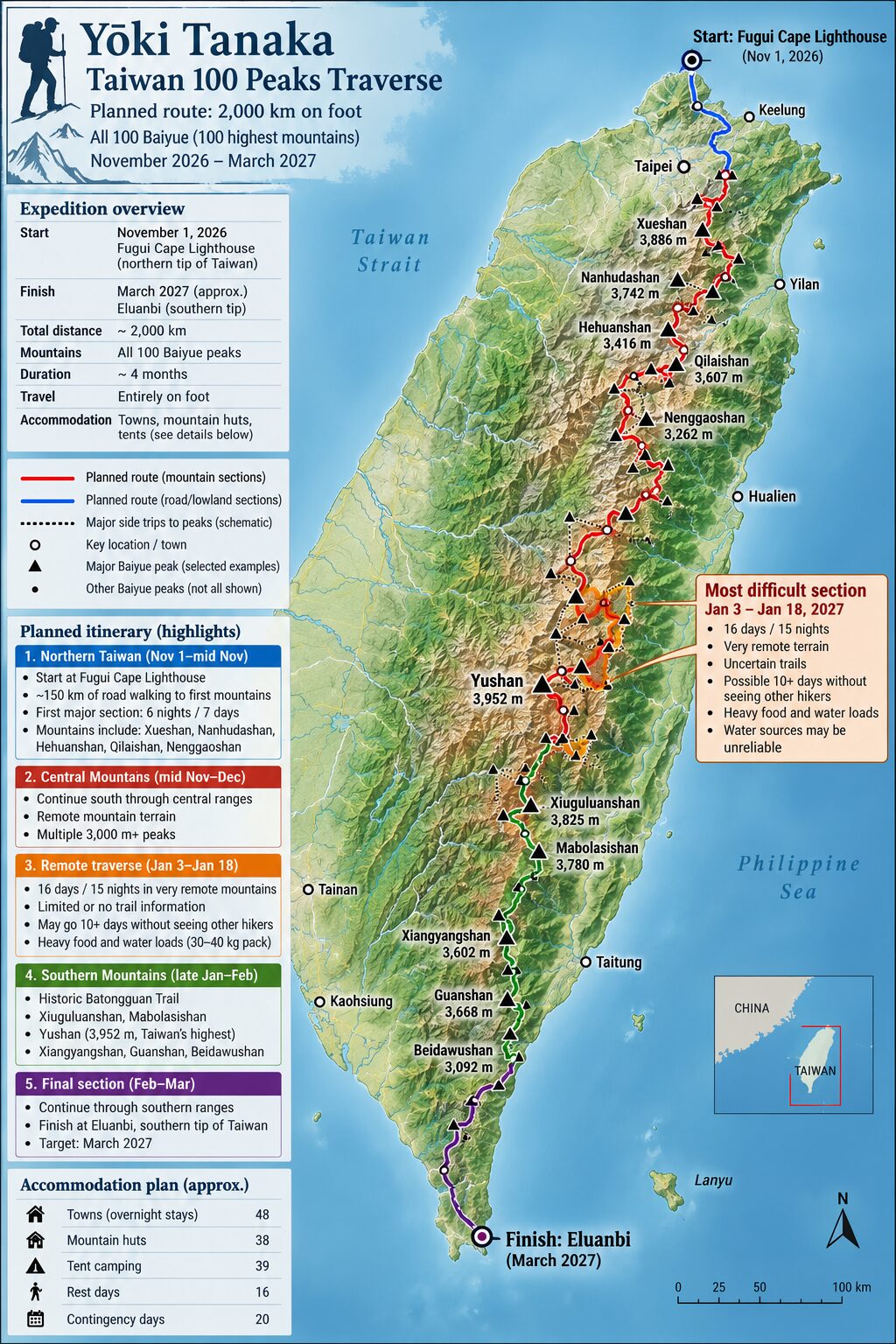
Starting November 1, Japanese endurance athlete Yoki Tanaka will embark on a grueling four-month expedition to traverse the length of Taiwan, a journey that entails summiting all 100 of the island’s prestigious “Baiyue” peaks. This ambitious undertaking, which spans approximately 2,000 kilometers, combines long-distance trekking with high-altitude mountaineering. Tanaka’s route will take him from the northernmost tip of the island, the Cape Fugui lighthouse, to the southern extremity at Eluanbi, navigating some of the most rugged and inaccessible terrain in East Asia.
The Baiyue list, a collection of 100 mountains exceeding 3,000 meters in elevation, serves as the primary objective for this expedition. Compiled by veteran Taiwanese mountaineers in the early 1970s, the list is curated not merely by height, but by the aesthetic quality, technical difficulty, geological prominence, and cultural significance of the summits. While Taiwan boasts approximately 268 peaks surpassing the 3,000-meter mark, the Baiyue list remains the gold standard for local and international climbers alike, functioning similarly to Japan’s own revered list of 100 famous mountains.
A Legacy of Endurance and Record-Setting
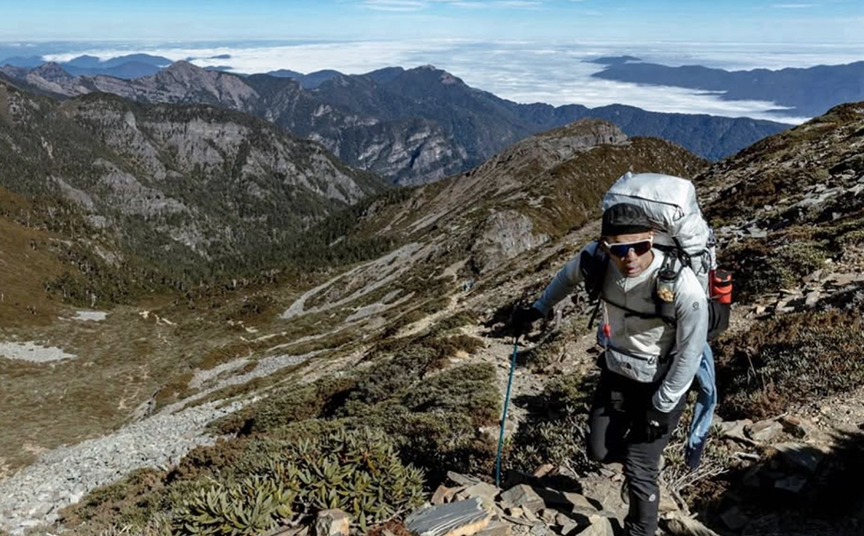
Tanaka, 43, has built a career upon the synthesis of extreme trekking and peak bagging. His methodology typically involves walking vast distances between mountain ranges, eschewing motorized transport whenever possible to maintain a continuous, human-powered line across the landscape.
His history of long-distance feats is well-documented. In 2014, he completed a circuit of Japan’s 100 famous mountains, a journey that involved 7,800 kilometers of travel over 208 days. He refined this approach in 2015 by summiting 200 mountains and covering 8,000 kilometers in 222 days. His most expansive project to date saw him traverse roughly 20,000 kilometers over three years to summit 300 mountains. This current expedition in Taiwan represents a pivot toward a singular, concentrated mission, moving away from the multi-year timelines that have previously characterized his work.
The Logistics of a 2,000-Kilometer Traverse
The expedition is categorized by rigorous logistical planning. Tanaka’s itinerary accounts for 120 days of activity, with a breakdown that reflects the reality of high-altitude travel: 48 days spent in town for resupply and rest, 38 days in mountain huts, and 39 days of autonomous tent camping. He has also built in 16 dedicated rest days and 20 contingency days to account for weather-related delays—a prudent measure in a region prone to seismic activity, unpredictable mountain weather, and rapid climate shifts.

The trek begins with an initial 150-kilometer road phase, leading to the base of his first series of summits: Xueshan (3,886m), Nanhudashan (3,742m), Hehuanshan (3,417m), Qilaishan (3,560m), and Nenggaoshan (3,262m).
The Challenges of the Central Mountain Range
The most daunting phase of the traverse is scheduled for early January, when Tanaka enters the remote interior of the Central Mountain Range. This stretch will demand complete self-sufficiency for over two weeks. In this wilderness, trails are often poorly maintained or entirely reclaimed by the dense, subtropical vegetation.
Water scarcity, surprisingly, remains a critical concern. During a reconnaissance trip in December 2025, Tanaka found that water sources identified on standard topographic maps were dry, forcing a reassessment of his supply strategy. Furthermore, he must navigate the historical complexities of the region, including the Batongguan Trail. Originally carved in 1875 by the Qing dynasty and later expanded by Japanese colonial authorities, the trail acts as a conduit through the island’s interior. Traversing it requires both physical resilience and an understanding of the region’s shifting environmental conditions.
Scientific and Cultural Context of the Baiyue
The Baiyue list is not without its peculiarities. Of the 100 peaks, one—Lushan—sits below the 3,000-meter threshold, currently measured at 2,981 meters. Originally cataloged at 3,043 meters, subsequent geological measurements downgraded its height. However, the mountain retains its status as a member of the 100, illustrating that the list is rooted in cultural identity as much as topographical metrics.
For Taiwan, Tanaka’s attempt highlights the global interest in the island’s alpine ecosystem. Historically, foreign climbers have rarely attempted the full Baiyue in a single push. Official accounts from Taiwan’s representatives in Japan indicate that the fastest recorded completion by a foreign climber was achieved over three years and eight months, involving multiple disjointed trips. Tanaka’s attempt to consolidate this into a single four-month window is an unprecedented challenge.
Strategic Planning and Risk Mitigation
Tanaka’s decision to move his start date from the spring to November was a direct result of consultations with local mountaineers. The original plan to traverse the island in the spring conflicted with the local monsoon and typhoon seasons, which bring heavy rainfall and increased landslide risks. By opting for a winter start, Tanaka faces colder temperatures and potential snow at higher elevations, but significantly reduced precipitation and more stable meteorological patterns in the lower-lying areas.
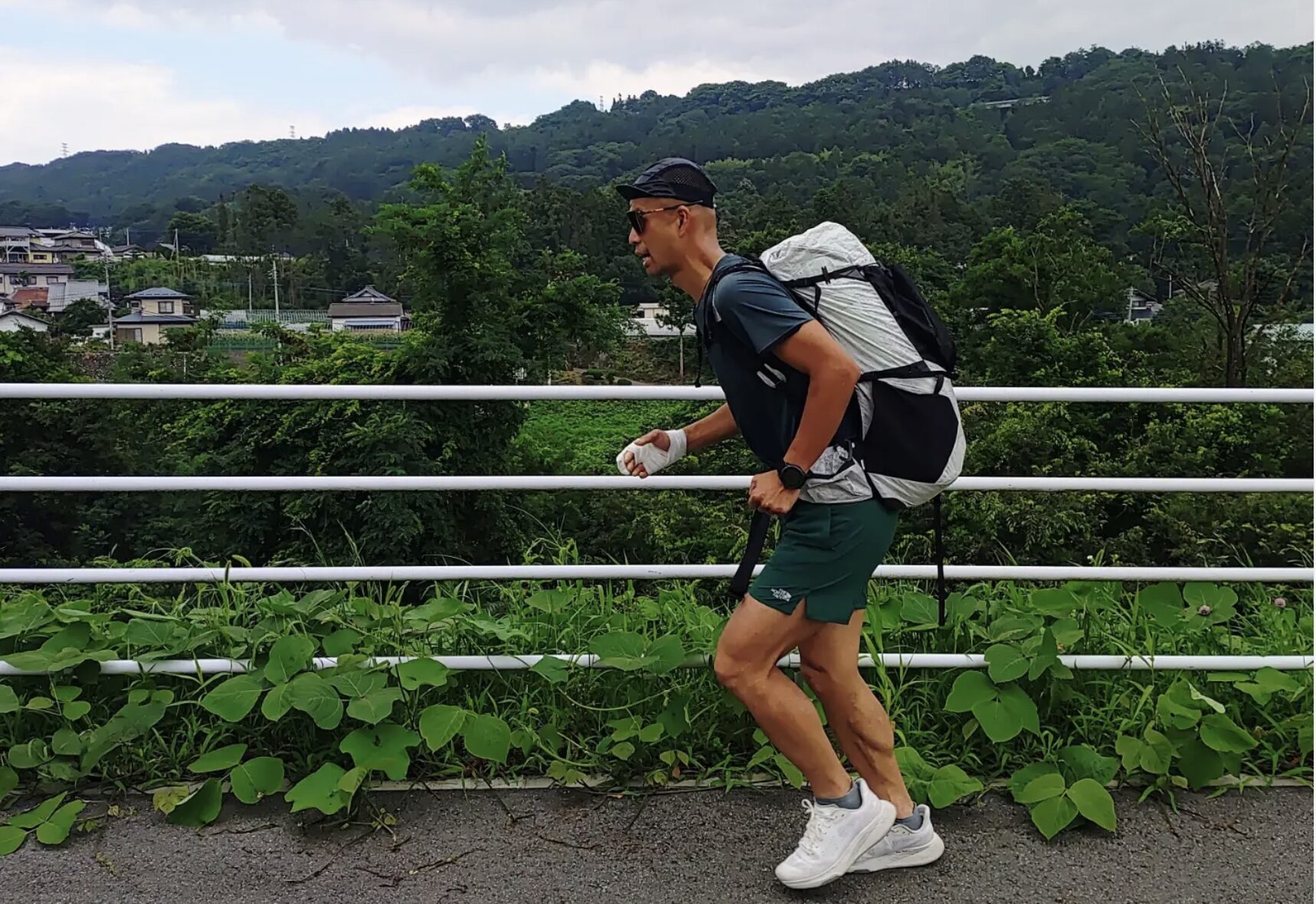
His preparation included multiple reconnaissance missions throughout 2025, including a successful east-west crossing of the island. This deep-dive approach is standard for Tanaka, who prioritizes local knowledge and historical trail data over modern GPS reliance.
Broader Implications and Public Interest
The implications of this expedition extend beyond mere athletic achievement. By drawing international attention to the Central Mountain Range, Tanaka is expected to highlight the importance of trail preservation and environmental conservation in Taiwan.
The public can follow his progress via his official expedition website, which will provide real-time updates and location tracking. For the mountaineering community, the data generated from his trek—regarding water availability, trail conditions, and the feasibility of high-altitude winter travel in Taiwan—will provide a valuable repository for future explorers.
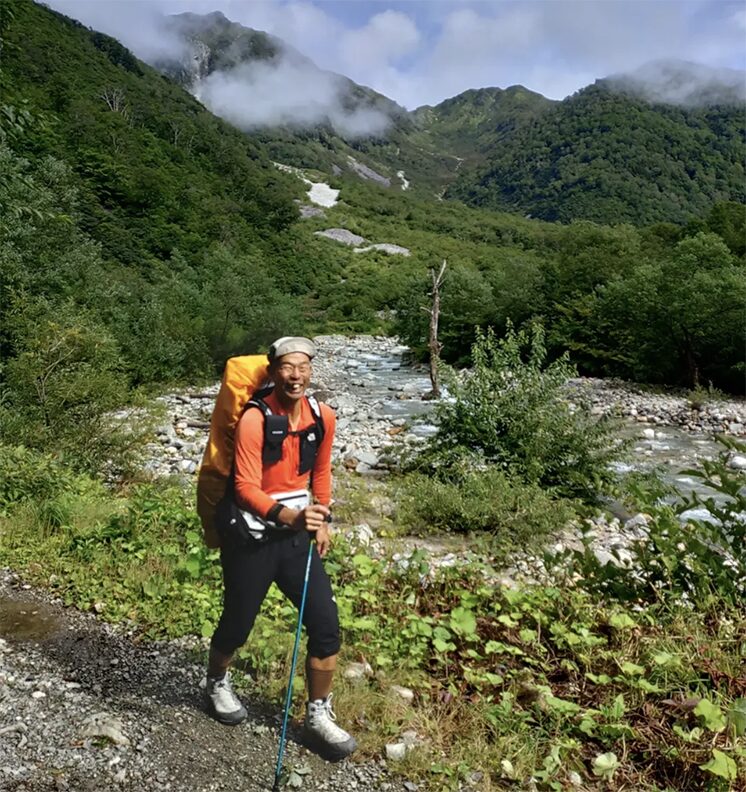
As he stands at the Cape Fugui lighthouse, the scale of the endeavor becomes clear. The 2,000-kilometer path is not just a collection of peaks, but a test of human endurance against a complex, shifting landscape. If successful, Tanaka will set a benchmark for mountain traversing in Taiwan, potentially inspiring a new generation of hikers to look beyond the popular tourist trails and toward the deep, often unforgiving heart of the island’s mountainous spine. The coming four months will be a masterclass in logistics, resilience, and the relentless pursuit of one of the world’s most unique high-altitude challenges.