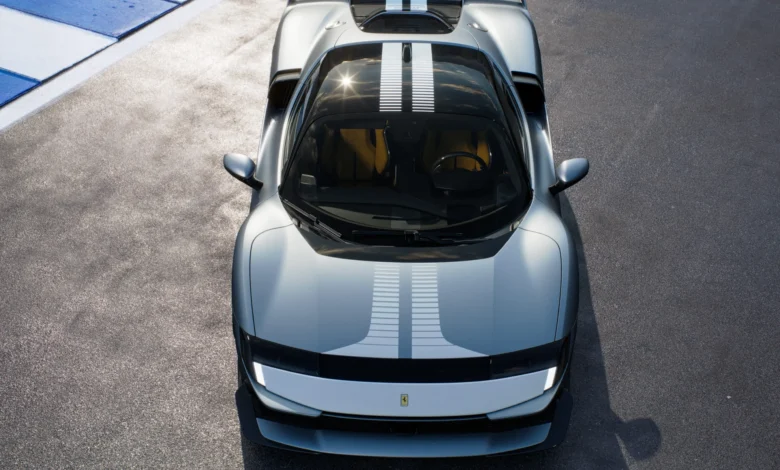
The arrival of the new Ferrari Testarossa marks a watershed moment in the evolution of the grand tourer, bridging the gap between the analog nostalgia of the 1980s and the hyper-digital capabilities of the mid-2020s. As the successor to the SF90, this vehicle does not merely revive a famous nameplate; it redefines the parameters of performance, safety, and hybridization within the Prancing Horse’s stable. By integrating a 1,035-horsepower hybrid powertrain with advanced computational modeling, Ferrari has transformed a design icon into a technological powerhouse capable of navigating modern road conditions with a level of poise that its predecessor could never have achieved.
A Chronology of the Testarossa Legacy
To understand the significance of the new Testarossa, one must look at the historical trajectory of the brand’s flagship models. The original Testarossa, introduced in 1984, was defined by its wide, aggressive stance and its iconic side-mounted "cheese grater" cooling slats. It became the definitive supercar of the 1980s, largely propelled by its association with pop culture, most notably appearing as the primary transport for Detective Sonny Crockett in the television series Miami Vice.
During its production run from 1984 to 1991, the Testarossa became a symbol of excess and high-performance engineering. Following the conclusion of its cycle, the brand pivoted through several eras—the 512 TR, the F512 M, and later the mid-engine V8 platforms like the F430, 458, and the hybrid-pioneering SF90. The 2026 Testarossa serves as a spiritual successor that acknowledges this lineage while utilizing the lessons learned from the brand’s contemporary Formula 1 program.

Engineering the Future: The Hybrid Powertrain
The mechanical architecture of the new Testarossa is a masterclass in complexity. At the heart of the vehicle lies a twin-turbocharged, 4.0-liter V8 engine, which, in isolation, produces 818 horsepower—the highest output ever recorded for a roadgoing V8 unit from Maranello. This combustion engine is augmented by a sophisticated three-motor hybrid system.
Two electric motors are dedicated to the front wheels, providing independent torque vectoring, while a third motor—the MGU-K (Motor Generator Unit-Kinetic)—is positioned between the engine and the transmission. This configuration mirrors the hybrid deployment strategies used in Ferrari’s current F1 racing cars. The result is a combined output of 1,035 horsepower, enabling the vehicle to accelerate from 0 to 60 mph in approximately 2.1 seconds. The vehicle also offers an electric-only mode with a range of 15 miles, allowing for silent, zero-emission operation in urban environments, a necessity for modern luxury vehicle compliance in major metropolitan centers.
The FIVE System: Digital Doppelgängers
Perhaps the most significant advancement in this iteration is the integration of the Ferrari Integrated Vehicle Estimator (FIVE). This system operates by creating an onboard digital twin of the vehicle. By utilizing a constant stream of sensor data, the system performs real-time mathematical simulations to predict how the car will react to road surfaces, lateral forces, and driver input.
This predictive capability allows the car’s electronic control units (ECUs) to adjust suspension dampening, traction control, and torque delivery with a margin of error of less than one mile per hour. For the driver, this translates into a heightened sense of connection and security. On winding, uneven roads—such as those found in the Berkshires—the system mitigates the "white-knuckle" experience historically associated with high-horsepower mid-engine cars, replacing it with a predictable and fluid handling experience.

Design Language and Aerodynamic Philosophy
Under the guidance of Chief Designer Flavio Manzoni, the new Testarossa eschews a literal, retro-inspired aesthetic in favor of a forward-looking design language. While the "twin-tail" rear design draws inspiration from the 512 S and 512 M sports prototypes of the 1970s, the overall silhouette is strictly optimized for downforce and thermal management.
The vehicle features a motorized spoiler capable of adjusting its profile in under one second, responding to real-time data from the FIVE system. While some traditionalists have expressed debate regarding the departure from the pop-up headlights and the signature intake strakes of the original, the current design has proven effective in high-speed wind tunnel testing. The exterior serves as a functional shell for the sophisticated thermodynamics required to cool a 1,035-horsepower hybrid system.
Market Positioning and Economic Impact
The financial profile of the Testarossa is as aggressive as its performance statistics. With a base MSRP of approximately $566,000, the final cost of a fully configured model can easily exceed $883,000. A significant portion of this premium—over $41,000 in the U.S. market—is attributed to import tariffs and logistics, which the manufacturer classifies as a "Tariff Contribution."
This pricing places the Testarossa in direct competition with the Lamborghini Revuelto ($1,001 hp), the Aston Martin Valhalla ($1,063 hp), and the Corvette ZR1X ($1,250 hp). Despite the high entry cost, market demand remains robust. Ferrari’s strategy of limited production runs, combined with the brand’s exclusive status, ensures that the Testarossa will likely appreciate as a collector’s item rather than depreciate as a standard production vehicle.

Practicality and User Experience
Despite its track-focused credentials, the new Testarossa maintains a focus on grand touring comfort. The cabin is equipped with adjustable magnetic suspension that allows for a "bumpy-road" setting, effectively smoothing out road imperfections for long-distance travel. However, storage remains a constraint. With electric motors occupying significant real estate under the hood, the luggage capacity is limited to a single backpack. Prospective owners are encouraged to utilize courier services for long-distance transit, emphasizing the vehicle’s role as a driver’s machine rather than a utilitarian cruiser.
Broader Implications for the Supercar Industry
The introduction of the Testarossa signifies a broader industry shift toward the "electrified supercar." As manufacturers face increasingly stringent emissions regulations in Europe and North America, the transition to hybrid and eventually battery-electric powertrains is mandatory. Ferrari’s ability to retain the emotional appeal of the internal combustion engine—specifically the auditory profile of a high-revving V8—while utilizing the torque-filling capabilities of electric motors, provides a roadmap for the future of the segment.
Analysts note that the success of the Testarossa will depend on the brand’s ability to maintain its identity as it navigates the total transition to electrification expected in the 2030s. For now, the integration of digital twin technology and hybrid power has effectively modernized the legend, ensuring that the Testarossa remains relevant to both the legacy collector and the modern performance enthusiast. Whether in the rain of the Northeast or on the precision-engineered curves of a private track, the vehicle stands as a testament to the intersection of raw mechanical brawn and computational intelligence.