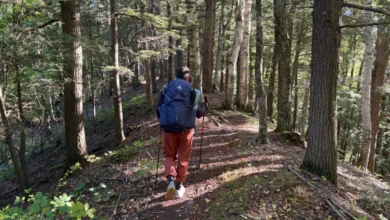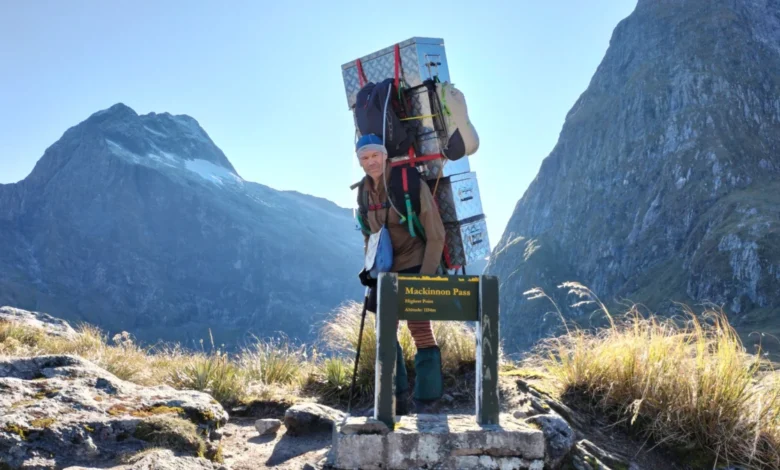
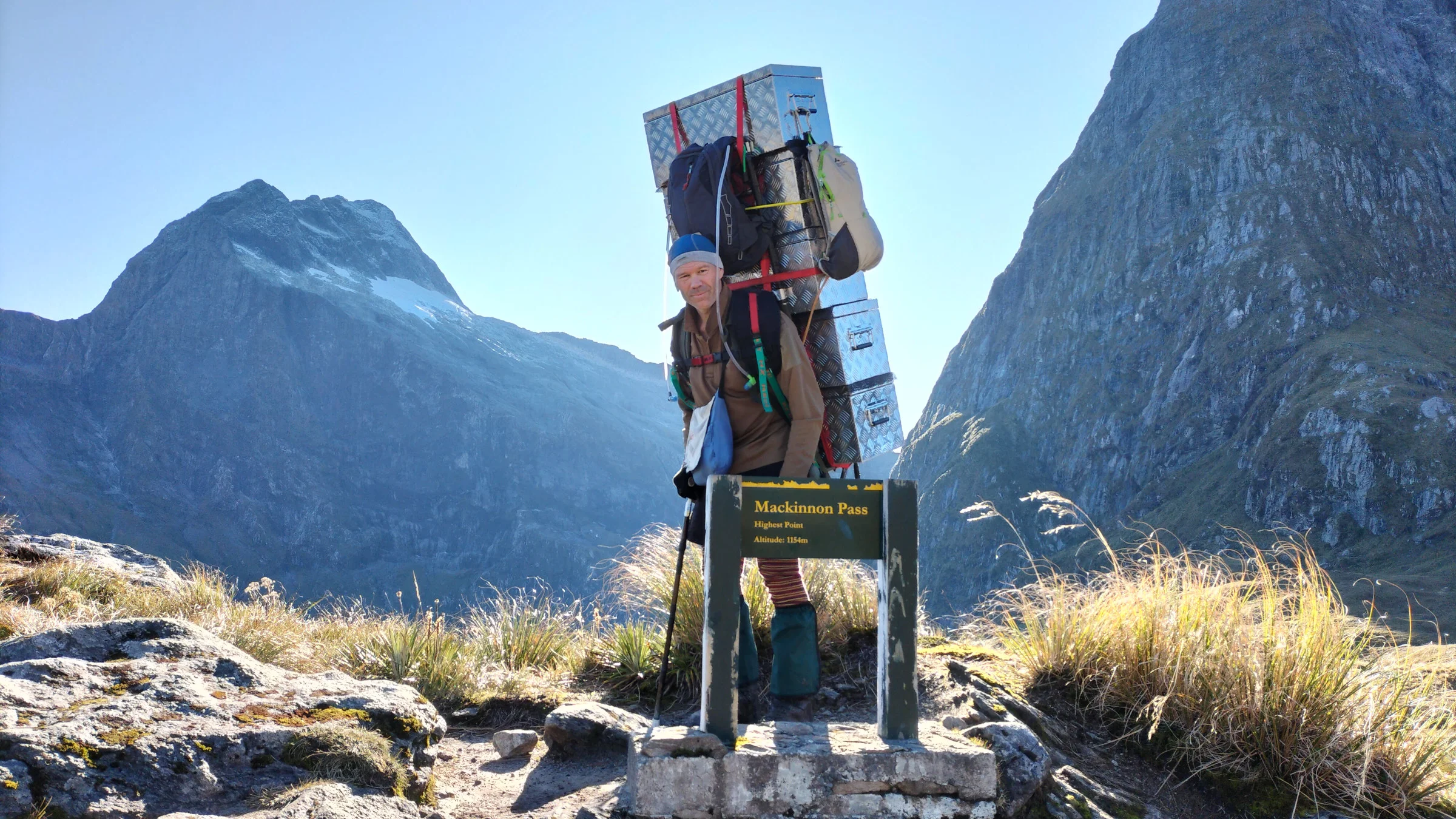
The quiet trails of New Zealand and the rugged limestone cliffs of Slovakia’s Tatra Mountains are typically sanctuaries for ultralight backpackers striving to minimize ounce counts and eliminate redundant gear. Yet, defying modern trends of minimalism, 54-year-old log truck driver Regan Bridge has carved out a distinct niche for himself in the realm of maximalist outdoor recreation. Carrying setups that weigh up to 220 pounds—consisting of stacked toolboxes, ladders, duplicate hiking boots, and heavy water volumes—Bridge operates entirely outside the commercialized ecosystem of modern outdoor sports. Lacking social media channels, brand sponsorships, or monetization models, his heavy-hauling practice is driven by personal endurance, historical appreciation of mountain labor, and a rigorous internal code of ethics regarding physical achievement.
The Genesis of an Extreme Habit
Bridge’s journey into extreme load-bearing began not as a stunt, but out of logistical necessity during a volunteer conservation initiative in New Zealand. While assisting with the deployment of predator traps designed to protect native fauna, Bridge observed that standard protocols restricted volunteers to carrying only two traps at a time due to perceived physical safety limits. Recognizing an opportunity to optimize the conservation effort, Bridge petitioned the organization to waive its strict weight regulations for his deployments.
Granted permission, Bridge successfully transported 15 heavy predator traps across treacherous terrain in just two trips. The experience fundamentally altered his perception of human biomechanics and physical limits. What began as a practical contribution to environmental preservation quickly transformed into a personal obsession with load carriage. Over the subsequent years, Bridge systematically increased his pack weight, experimenting with various configurations of equipment, specialized framing, and psychological coping mechanisms designed to endure prolonged muscular strain.
Engineering the Maximalist Setup
The mechanics behind Bridge’s 220-pound setup require meticulous preparation and engineering. Because lifting a pack exceeding 110 pounds directly from the ground poses severe structural risks to the spine and joints, Bridge utilizes a specialized aluminum ladder to hoist, mount, and stabilize his equipment. His standard configuration incorporates redundant items, including multiple pairs of footwear and duplicate layers of technical hiking apparel, specifically chosen to artificially elevate the payload’s mass.
To manage fluid requirements during grueling ascents, Bridge packs multiple water bottles within industrial toolboxes securely fastened to his frame. As he ascends, the consumption and subsequent disposal of water at summit markers reduce his total load by roughly half, mitigating some musculoskeletal stress during the descent phase. However, these massive configurations introduce severe environmental vulnerabilities. According to Bridge, strong gusts of wind against the broad surface area of his stacked gear create hazardous sailing effects on exposed ridges, describing high-altitude wind resistance as a "diabolical" variable that requires constant physical compensation.
International Exchange in the Tatra Mountains
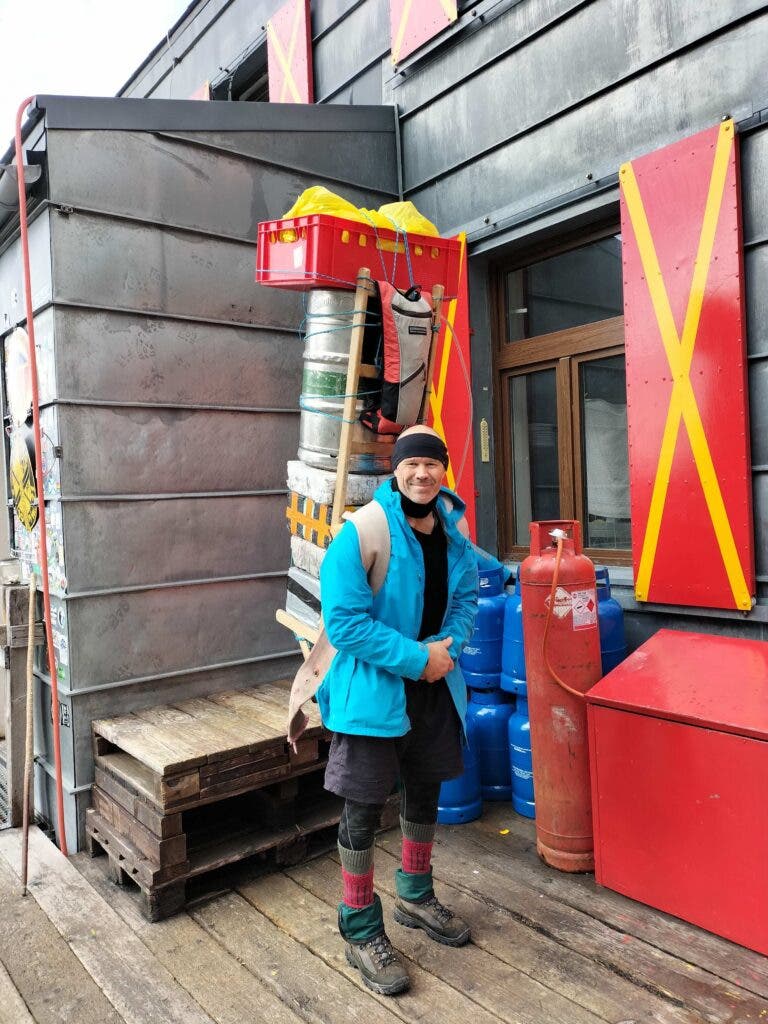
Bridge’s dedication to heavy load-bearing ultimately drew him to the Tatra Mountains of Slovakia, a region globally renowned for its historic nosiči—traditional mountain porters who supply remote, inaccessible alpine huts entirely on foot. Inspired by documentary footage of these Slovak laborers, Bridge and his wife traveled to Central Europe to observe the tradition firsthand.
While commercial tourist programs in the region typically offer visitors the opportunity to carry modest 44-pound (20-kilogram) loads between mountain chalets in exchange for coffee, Bridge rejected the baseline restriction. On his first day, he voluntarily shouldered double the suggested weight up to a high-altitude hut, earning a traditional reward of coffee and local rum.
His physical capabilities gained the respect of the local nosiči the following day when, struggling to navigate his oversized military pack through a technical cliff section featuring vertical ladders and fixed chains, he bypassed the designated ascent path and climbed the descent chains in full view of the resident porters. Recognizing his raw strength, the professional porters invited Bridge to test their authentic wooden carrying frames, laden with 110 pounds of commercial supplies. While the professional porters initially viewed his hobby as eccentric, they ultimately welcomed him into their subculture as a peer rather than a novelty.
Industry Perspectives and Societal Reception
The rise of maximalist hiking challenges dominant paradigms within the contemporary outdoor recreation industry, which has spent the past two decades heavily promoting ultralight backpacking philosophies. Ultralight gear manufacturers and hiking culture generally emphasize reducing base weights to under 10 pounds to preserve joint health, maximize daily mileage, and reduce fatigue.
By contrast, Bridge’s approach embraces structural wear, intense physical stress, and deliberate discomfort. This philosophical divergence frequently draws skepticism from fellow outdoor enthusiasts. On hiking trails, Bridge regularly encounters hikers warning him about long-term joint degradation, spinal compression, and the apparent futility of hauling excessive mass. Bridge remains indifferent to these critiques, often redirecting the argument toward the inherent subjectivity of outdoor activities. In interviews, he notes that traditional recreational hiking—undertaken without a utilitarian purpose—is viewed by non-participants as equally arbitrary, maintaining that personal fulfillment supersedes conventional risk aversion.
Medical and biomechanical analyses of heavy load carriage highlight both the acute risks and specific conditioning adaptations associated with extreme backpacking. Carrying loads exceeding 50 percent of an individual’s body weight dramatically increases compressive forces on the lumbar spine, accelerates cartilage wear in the knees and hips, and elevates the risk of acute soft-tissue injuries, particularly during descents where eccentric muscle contractions peak. Conversely, progressive resistance training under heavy axial loads can stimulate bone mineral density increases and enhance core stabilizing musculature, provided the athlete maintains rigorous recovery protocols. Bridge acknowledges these physiological realities, adopting a pragmatic philosophy regarding future medical intervention: prioritizing active engagement with life over preemptive physical preservation.
Psychological Motivations and the Soundtrack of Endurance
Beyond physical conditioning, Bridge utilizes heavy load carriage as a distinct form of mental decompression. Rejecting the stoic, silent archetype often associated with extreme endurance sports, Bridge typically completes his grueling climbs accompanied by an eclectic audio soundtrack ranging from classic rock bands like AC/DC to 1990s electronic dance music.
According to Bridge, the ascent phase requires total cognitive focus, effectively quieting mental distractions while allowing brief moments to appreciate alpine panoramas. Descending, however, demands heightened vigilance due to the dynamic instability of a top-heavy, multi-hulled load shifting against gravity. He describes the practice fundamentally as a method of "feeding the soul," providing a structured escape from the routine demands of his profession as a log truck driver.
Verification, Ethics, and Future Objectives
Despite operating entirely outside the digital creator economy—maintaining no social media presence, securing no brand sponsorships, and generating zero financial revenue from his endeavors—Bridge exhibits an obsessive commitment to factual accuracy regarding his achievements. During interviews, he meticulously cross-references transcripts and statistical data to ensure that weights, distances, and elevations are neither exaggerated nor misconstrued through translation errors.
"I don’t want people to think that I’ve done something that I haven’t," Bridge emphasizes, highlighting an ethical stance against the inflation of athletic accomplishments common in digital spaces. His transparency extends to his refusal to accept unverified credit for heavier loads, insisting that every kilogram be accounted for precisely as measured.
Looking forward, Bridge’s immediate athletic ambitions include tackling the grueling 2,200 steps of the Sealy Tarns Track within New Zealand’s Aoraki Mount Cook National Park, aiming to transport a 220-pound payload up the steep alpine staircase. When questioned by peers regarding when he plans to scale back his training regimen or establish a definitive limit on his payloads, Bridge maintains that his progression is governed entirely by internal satisfaction rather than external milestones. Operating on a rigorous training schedule six days a week, he continues his ascents simply because the endeavor remains a source of personal enjoyment, noting that he will cease only when his intrinsic motivation shifts.