The enduring legacy of ancient Greek sculpture continues to captivate art historians, archaeologists, and travelers worldwide, serving as the cornerstone of Western aesthetic tradition. Characterized by a relentless pursuit of realism, anatomical balance, and technical mastery, these works—ranging from idealized depictions of athletes to majestic representations of the Olympian gods—form an irreplaceable part of global cultural heritage. While popular assumption often places every masterwork of Hellenic art within the borders of modern-day Greece, historical displacements, archaeological discoveries, and international acquisitions mean that these treasures are now dispersed across major cultural capitals globally. From the halls of the Louvre in Paris and the British Museum in London to the National Archaeological Museum in Athens and the Vatican Museums, understanding the true locations, historical context, and physical composition of these artifacts is vital for academic researchers and cultural tourists alike.

The Evolution and Chronology of Ancient Greek Sculpture
To understand the collection of surviving masterworks, it is essential to examine the historical trajectory of Greek art, which is traditionally divided into several distinct epochs. The Archaic period (c. 800–480 BCE) established the foundational forms, heavily influenced by Egyptian monumental art, characterized by stiff, frontal postures seen in early kouroi (youths) and korai (maidens). This transitioned into the Classical period (c. 480–323 BCE), a golden age defined by unprecedented naturalism, contrapposto stances, and emotional restraint, championed by legendary sculptors such as Phidias, Polykleitos, and Myron. Following the conquests of Alexander the Great, the Hellenistic period (c. 323–31 BCE) introduced dramatic movement, theatrical emotion, and psychological complexity, moving away from idealized perfection toward raw human drama.
Despite this rich history, a vast majority of original bronze masterpieces from the Classical era did not survive antiquity. Bronze was frequently melted down for weaponry or coinage during times of conflict. Consequently, much of what art historians study today survives through Roman marble copies—often produced en masse during the Roman Empire to satisfy a voracious domestic appetite for Greek culture. Distinguishing between original Greek marbles, rare surviving bronzes, and later Roman interpretations remains a central challenge in classical archaeology.

Masterworks of the Louvre Museum (Paris, France)
Paris plays a disproportionately large role in the global exhibition of Hellenic sculpture, hosting some of the most recognizable icons of antiquity.
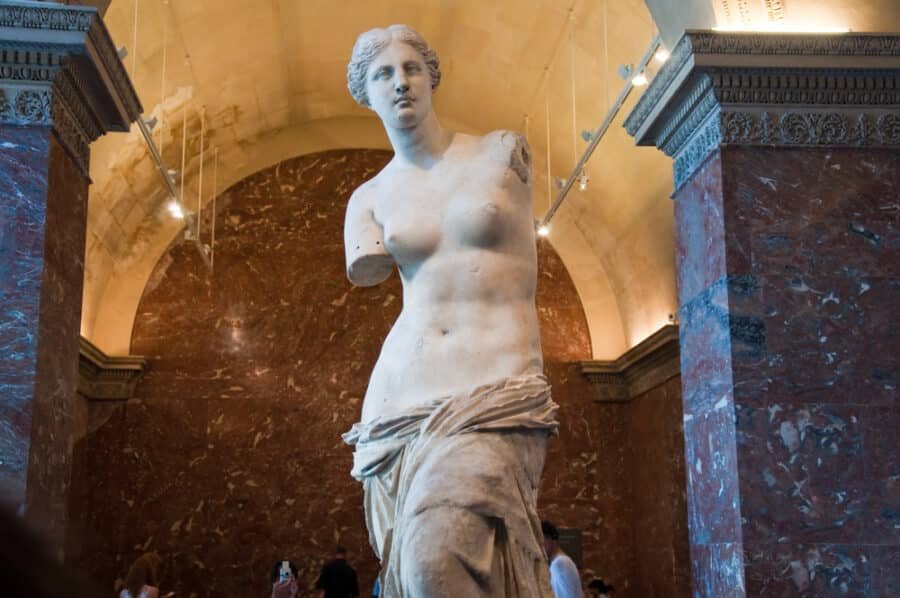
Among them is the Venus de Milo (Aphrodite of Milos), generally dated to the late 2nd century BCE (c. 160–110 BCE). Carved from Parian marble and standing at 2.03 meters tall, the statue was unearthed on the Aegean island of Milos in 1820. While historical tradition sometimes attributes the work to Alexandros of Antioch, this attribution remains a subject of ongoing scholarly debate. The missing arms and the original setting of the goddess continue to puzzle art historians, yet its refined proportions remain a pinnacle of Hellenistic grace.
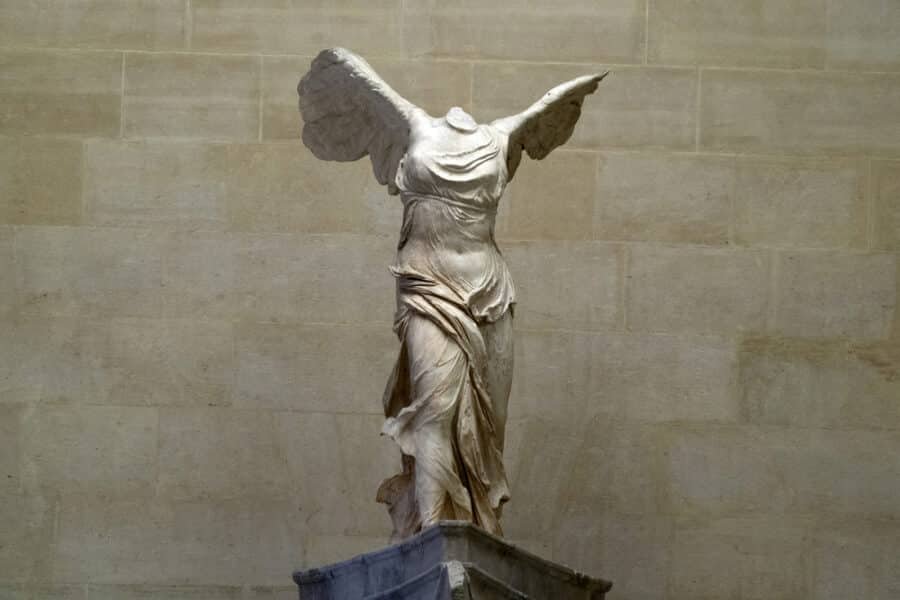
Equally prominent in the Louvre is the Winged Victory of Samothrace (Nike of Samothrace), crafted around 190 BCE. Discovered in fragments on the island of Samothrace in 1863 by French archaeologist Charles Champoiseau, the monument depicts the goddess of victory descending upon the prow of a warship. Though the sculptor’s identity is not securely established—frequently associated with the Rhodian sculptor Pythokritos—the dynamic interplay of wind-swept drapery and powerful anatomy exemplifies the dramatic peak of Hellenistic artistry.
Treasures of Athens and Mainland Greece
While international museums hold significant pieces, Greece’s domestic institutions house the foundational core of its sculptural heritage, preserved in close geographic proximity to their original archaeological contexts.
The National Archaeological Museum in Athens serves as the primary repository for monumental finds. Here stands the Artemision Bronze, an exceptional original bronze statue recovered from a shipwreck off Cape Artemision in 1926. Dating to approximately 460 BCE, the towering, dynamic figure—depicting either Zeus or Poseidon poised to hurl a weapon—showcases the technical mastery of early Classical bronze casting, an art form where very few original works survived.
Also in Athens, the Acropolis Museum houses crucial masterworks retrieved directly from the sacred rock. The Kritios Boy, carved around 480 BCE, represents a revolutionary turning point in art history. Discovered during excavations on the Acropolis, this small marble sculpture is widely credited as the first depiction of the human body utilizing true contrapposto—shifting weight onto one leg, thereby introducing a naturalistic asymmetry that broke entirely from Archaic stiffness.
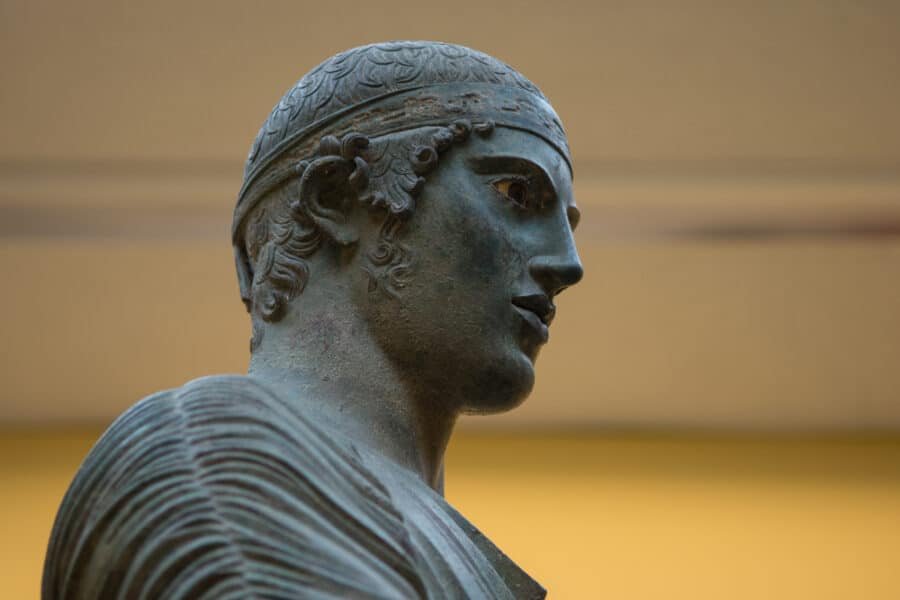
Further north, the Delphi Archaeological Museum preserves artifacts recovered from the Sanctuary of Apollo, most notably the Charioteer of Delphi (Heniokhos). Cast in bronze between 478 and 474 BCE, this surviving element of a larger victorious racing group commemorates a chariot victory at the Pythian Games. Unlike many other statues, it retains its original inlaid glass eyes, offering a rare, lifelike gaze across millennia.
Italian Collections: Rome, Naples, and Reggio Calabria
Italy’s deep historical ties to ancient Greece have yielded extraordinary archaeological discoveries, both on land and beneath the sea.
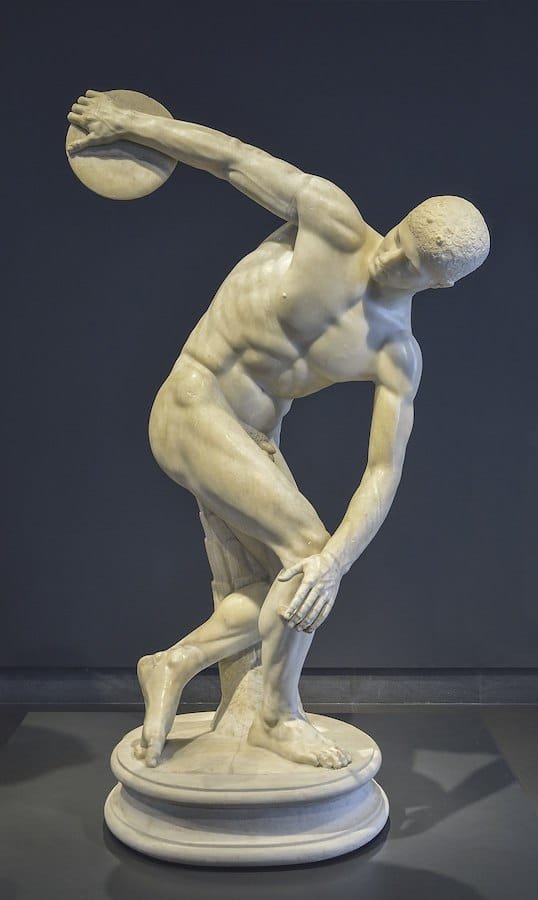
In Rome, the National Roman Museum (spread across multiple venues, including Palazzo Massimo alle Terme) displays the Discobolus (Discus Thrower). The original bronze, created by Myron in the mid-5th century BCE, is entirely lost; however, the surviving Roman marble copies preserved in Italy allow modern audiences to study the peak of athletic idealism captured at the fractional moment of release. The same museum houses the Boxer at Rest (also known as the Terme Boxer), a stunning Hellenistic bronze from the 1st or 2nd century BCE. Unecovered on the Quirinal Hill in Rome in 1885, the seated athlete features meticulous detailing of cauliflowered ears, facial swelling, and copper inlay representing blood drips, offering a starkly realistic portrayal of the physical toll of ancient athletic combat.
Meanwhile, the National Archaeological Museum of Naples holds the monumental Farnese Hercules. Signed by the Athenian sculptor Glykon during the Roman imperial era, the statue is a colossal Roman marble adaptation of a lost bronze original by Lysippos. It portrays a weary Hercules leaning on his club, draped in the skin of the Nemean Lion, symbolizing the immense physical and mental exhaustion following the completion of his twelve labors.
Down in the south, the National Museum of Magna Graecia in Reggio Calabria houses the Riace Bronzes. Discovered in 1972 by a recreational diver off the coast of Calabria, these two full-size, bearded warrior statues date to the mid-5th century BCE (c. 460–450 BCE). Manufactured using the indirect lost-wax casting method, their pristine condition and complex metallurgical composition make them among the rarest and most valuable survivals of Classical Greek statuary.
Lost Icons and Archaeological Context
A comprehensive survey of ancient Greek sculpture must account for works that exist today only through historical record, literary descriptions, or fragmentary remains.
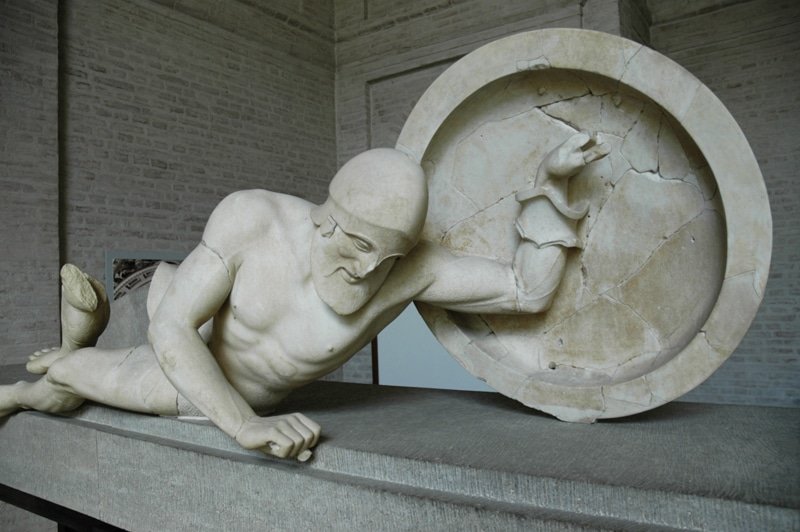
The Colossus of Rhodes, one of the Seven Wonders of the Ancient World, was a colossal bronze statue of the sun god Helios erected by Chares of Lindos on the island of Rhodes to celebrate a military victory in 305 BCE. Standing approximately 33 meters high, it was toppled by a catastrophic earthquake in 226 BCE. Despite centuries of legends, no confirmed physical remains of the statue have ever been recovered, though archaeological research continues to investigate its likely harbor-side placement.
Similarly, the Statue of Zeus at Olympia, created by the master sculptor Phidias inside the Temple of Zeus around 435 BCE, is entirely lost. Constructed as a chryselephantine monument—utilizing plates of ivory and gold over a wooden core—the 12-meter-seated deity was considered the supreme artistic achievement of classical antiquity before its destruction under uncertain circumstances in late antiquity. Visitors to Olympia today encounter the monumental architectural ruins and the archaeological museum, but the cult statue survives solely through ancient coin depictions and contemporary descriptions.
Preservation, Provenance, and Modern Exhibitions
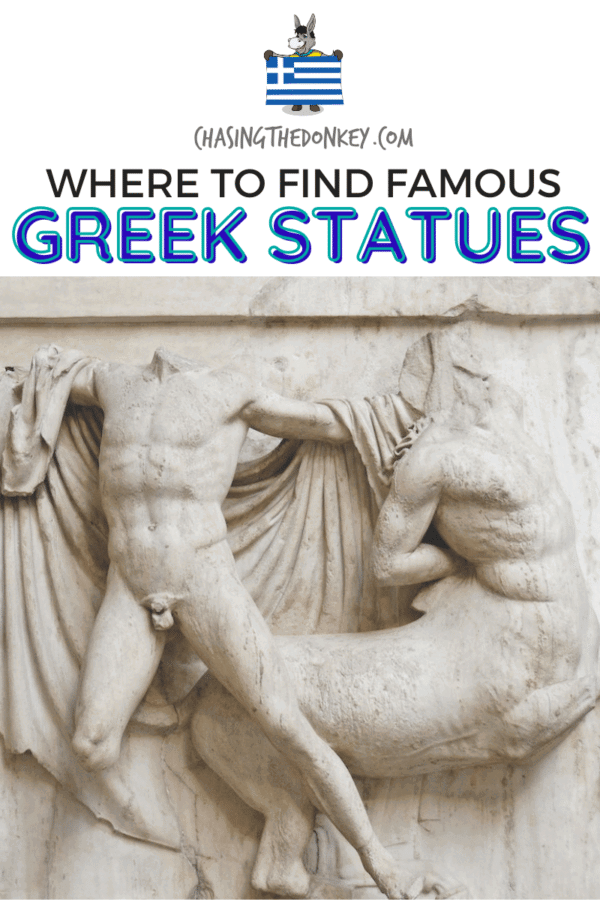
The distribution of these cultural assets has sparked decades of international debate regarding provenance, repatriation, and museum ethics. Prominent controversies, such as the ongoing dispute over the Parthenon Marbles (including the surviving metopes and pedimental sculptures currently housed in the British Museum in London), highlight deep tensions between nations of origin and major international institutions. Cultural authorities in Athens continue to advocate for the reunification of these sculptural programs within the Acropolis Museum, while host institutions defend their roles as universal repositories of global art history.
Furthermore, contemporary scientific analysis has profoundly altered modern understanding of these works. Advanced ultraviolet and chemical testing has conclusively disproved the long-held neoclassical assumption that ancient Greek statues were uniformly stark white. Evidence of pigments confirms that statues like the Peplos Kore and the Parthenon friezes were originally painted in vivid, saturated primary colors, challenging historical perceptions and reshaping museum curation through digital color reconstructions.
For travelers and researchers mapping out itineraries across Athens, Delphi, Olympia, Rome, Paris, London, and Munich, verifying the specific gallery locations and temporary exhibition rotations remains a vital logistical step. As institutions continuously update their conservation protocols, these ancient sculptures continue to bridge the gap between myth and historical reality, offering enduring testimony to the intellectual and technical ambitions of the classical world.
Related posts: