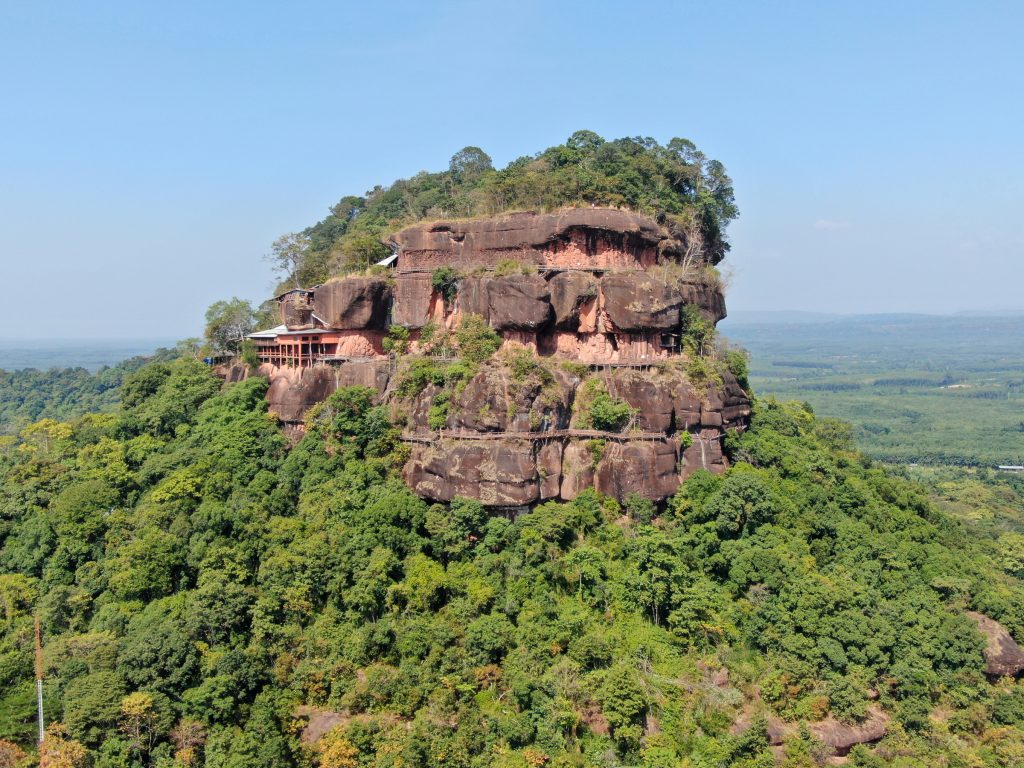
Nestled deep within the remote and verdant landscapes of Bueng Kan province in northeastern Thailand’s Isan region lies Wat Jetiyakhiri, more commonly known as Wat Phu Tok. Translating locally to the "lonely mountain," this striking 359-meter-high isolated sandstone formation bears a distinct geographical resemblance to Sri Lanka’s famous Sigiriya rock fortress. Over the past several decades, this off-the-beaten-path destination has evolved from an isolated sanctuary for ascetic Buddhist monks into one of the most mechanically and architecturally unique pilgrimage sites in Southeast Asia. Characterized by a dizzying network of hand-built wooden staircases and cliff-anchored walkways, the temple presents a rare intersection of architectural audacity, ecological preservation, and spiritual devotion.
Main Facts and Architectural Engineering
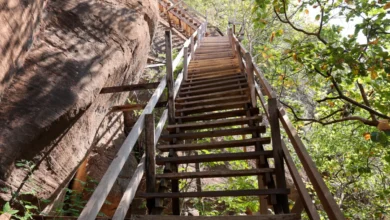
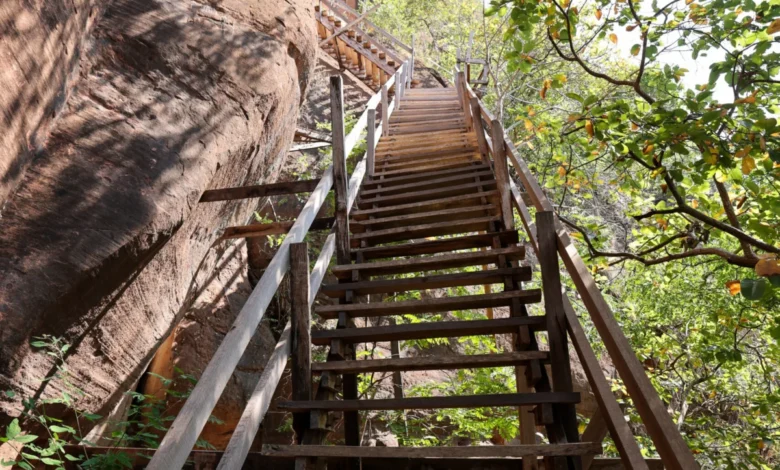
The defining feature of Wat Phu Tok is its intricate system of wooden boardwalks and stairways that cling precariously to the sheer vertical faces of the red rock mountain. Constructed entirely to facilitate meditative circumambulation, the pathways span seven distinct levels, symbolizing the seven stages of enlightenment in Buddhist philosophy.

The ascent begins modestly near the base of the mountain, where visitors encounter a sprawling park area, a tranquil lake, and a primary temple complex. However, the path rapidly transitions into steep wooden stairs and ladder-like inclines that test the physical endurance and nerve of climbers. While the structure relies on wooden planks anchored directly into the rock face—yielding slightly underfoot and swaying gently in the mountain breeze—engineers and local caretakers maintain the infrastructure rigorously to ensure public safety.
Chronology and Historical Origins

The history of Wat Phu Tok is deeply intertwined with the traditions of Thailand’s forest monk movement. Historically, the rugged terrain, dense vegetation, and dense populations of venomous snakes rendered the mountain largely impassable and uninhabited, save for wildlife. However, these very environmental challenges made the remote outcrop an ideal location for spiritual introspection and meditation.
The transformation of the mountain began under the leadership of the revered monk Luang Pu Juan. Recognizing the spiritual potential of the isolated landscape, Luang Pu Juan spearheaded the monumental effort to carve out a habitable sanctuary. Monks, novices, and local volunteers labored by hand to construct the initial wooden staircases, ladders, and meditation platforms, linking the base of the mountain to its upper reaches.

Following the establishment of the seven-level design to mirror Buddhist doctrinal stages, the site gained regional prominence. The chronology of the temple took a tragic turn when Luang Pu Juan perished in a high-profile commercial aircraft accident, an event that deeply shook the Thai monastic community. Despite this loss, a dedicated group of resident monks and local authorities have continued to preserve and maintain the intricate wooden scaffolding, ensuring the legacy of its founder endures.
Supporting Data and Level-by-Level Breakdown

Geographically, Bueng Kan is among Thailand’s newest provinces, having been officially established in 2011 after separating from Nong Khai province to improve regional administration and border security. Because of its remote location near the Mekong River and the border with Laos, Bueng Kan remains one of the least densely populated and touristed provinces in the country, preserving vast tracts of natural habitat.
The ascent of Wat Phu Tok is categorized into distinct tiers, each offering varying architectural and spiritual experiences:

Levels One through Four: These initial tiers serve primarily as transitional zones. The paths transition from packed earth trails to increasingly steep wooden staircases. Visitors encounter occasional minor shrines, though the density of structures remains low as the focus shifts toward physical ascension.
Level Five: Serving as the administrative and communal heart of the mountain complex, the fifth level features the primary ordination hall and a concentration of monastic shrines and gathering spaces. Unlike the upper tiers, much of the fifth level consists of stable ground pathways rather than cliffside suspensions, allowing visitors to rest before tackling the more demanding upper sections. A notable detour on this level leads to a secluded rock-carved temple connected via a suspension bridge, offering panoramic vistas of the surrounding terrain.

Level Six: Universally regarded as the architectural highlight of Wat Phu Tok, the sixth level features a network of cantilevered wooden walkways anchored directly into the vertical cliff face. Comprising a roughly balanced mix of ground-level paths and sheer cliff-hanging planks, this tier offers unobstructed views of the Mekong River basin and the sprawling forest canopy below. While structural stability is maintained, the psychological impact of navigating a narrow wooden plankway with a sheer drop-off demands absolute concentration.
Level Seven: The summit of the mountain represents the final tier. Devoid of architectural structures or wooden pathways, the seventh level is a natural forest canopy area historically noted for its high concentration of venomous snakes. Local authorities and temple guardians officially advise visitors to ascend this level strictly at their own risk, noting that the primary attractions of the site reside on the levels below.

Broader Impact and Regional Implications
From an economic and tourism perspective, the ongoing popularity of Wat Phu Tok highlights a broader shift in Thailand’s national tourism strategy toward promoting secondary provinces. For decades, international tourism has remained heavily concentrated in major hubs such as Bangkok, Chiang Mai, Phuket, and Pattaya. The rise of destinations like Bueng Kan helps distribute economic benefits to more rural regions while alleviating over-tourism pressures in major urban centers.

At the same time, managing an influx of domestic and international visitors to an ecologically sensitive and physically hazardous site presents ongoing challenges for local administrators. Balancing public accessibility with structural safety, wildlife protection, and the preservation of a working monastic environment requires careful regulatory oversight.
Ultimately, Wat Phu Tok stands as a testament to human ingenuity and spiritual perseverance. By transforming a forbidding and dangerous natural landmark into a vertically integrated sanctuary of faith, its creators established a landmark that continues to captivate travelers, architects, and spiritual seekers alike.