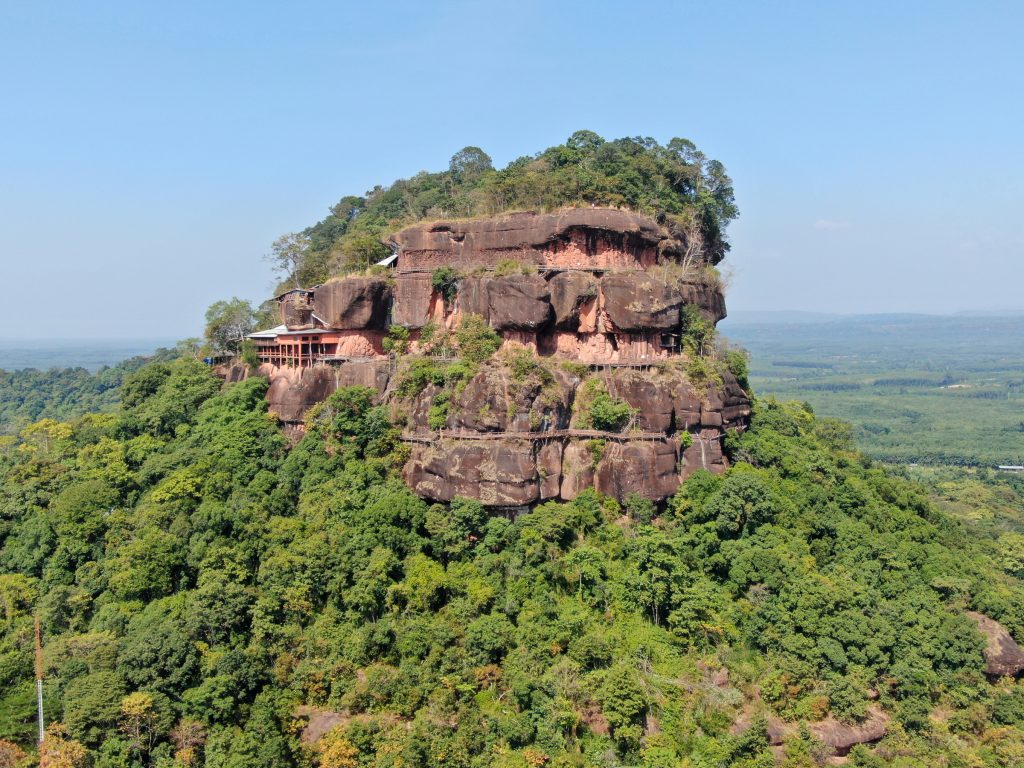
Tucked away in the remote northeastern reaches of Thailand’s Bueng Kan province, the Buddhist temple complex of Wat Phu Tok stands as a monumental testament to both architectural ingenuity and spiritual devotion. Officially designated as Wat Jetiyakhiri, this extraordinary site rises 359 meters above the flat Isan landscape, commanding attention with its sheer isolation and rugged topography. Often likened to a smaller, more secluded iteration of Sri Lanka’s famed Sigiriya rock fortress, Wat Phu Tok translates locally to the "lonely mountain"—an apt descriptor for a solitary sandstone monolith that dominates the surrounding horizon.
For travelers seeking a departure from Thailand’s heavily touristed southern beaches and urban cultural hubs, Bueng Kan offers a tranquil expanse of nature, biodiversity, and off-the-beaten-path exploration. Yet, the primary draw for the intrepid visitor is the temple complex itself, a labyrinth of suspended wooden walkways and vertical staircases engineered directly into the vertical cliffs of the mountain.
Main Facts of the Architectural Marvel

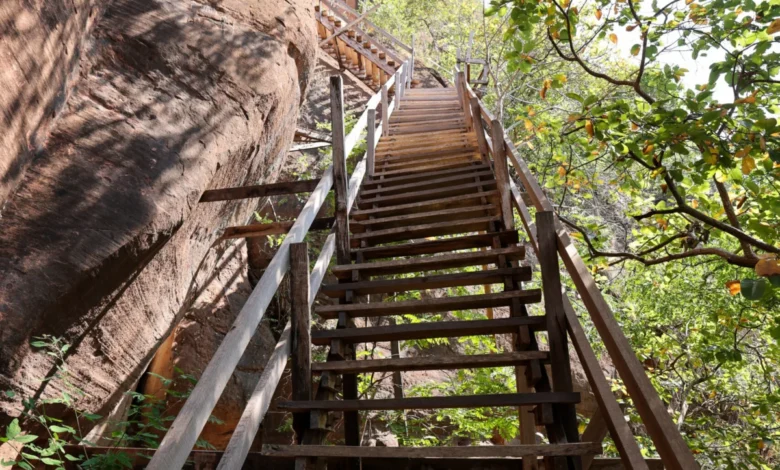
The defining feature of Wat Phu Tok is its intricate system of wooden scaffolding, ladders, and walkways that allow pilgrims and tourists to circumnavigate the mountain’s vertical precipices. Constructed entirely by hand through decades of labor, these pathways serve a profound religious purpose. The seven distinct levels of the mountain were intentionally designed to mirror the seven stages of Buddhist enlightenment, requiring practitioners to physically and mentally transcend the material world as they ascend.
The journey begins at the base of the mountain, situated approximately a 30-minute drive from Bueng Kan city. Visitors are greeted by a sprawling park area, a serene lake, and a secondary temple before encountering the trailheads. The ascent commences via relatively gentle earthen paths and wooden steps, which progressively steepen into vertical ladder-like structures. While the wooden planks flex and angle sharply underfoot, the structural integrity remains meticulously maintained by the resident monastic community, offering a safe yet adrenaline-inducing experience for those willing to brave the heights.

Chronology and Historical Origins
The history of Wat Phu Tok is inextricably linked to the region’s natural isolation and its history as a sanctuary for ascetic meditation. For generations, the rugged terrain of the sandstone mountain was largely untouched, serving primarily as a natural habitat for diverse wildlife, including populations of venomous snakes. This inherent element of physical danger, combined with the profound peace of the remote forest, made the location ideal for Buddhist meditation masters seeking solitude.

The transformation of the lonely mountain into a sacred architectural wonder was spearheaded by the revered monk Luang Pu Juan. Recognizing the potential for spiritual elevation within the rugged landscape, Luang Pu Juan initiated the ambitious project to carve pathways into the rock face. Monks and local laborers worked collaboratively over many years, manually anchoring wooden beams and staircases into the sheer cliffs to connect various shrines, meditation cells, and ordination halls.
Tragedy struck the temple’s history when Luang Pu Juan tragically lost his life in a commercial aviation accident. Despite the loss of its visionary founder, the monastic community and local devotees have continued to preserve and maintain the infrastructure, ensuring that Wat Phu Tok remains both a functioning place of worship and a majestic historical landmark.

Detailed Level-by-Level Analysis
The ascent through the seven levels of Wat Phu Tok offers distinct geographical and spiritual experiences, culminating in panoramic views of the Mekong River basin.

Levels One through Four serve primarily as a transitional phase for visitors. The initial staircases test the physical endurance of climbers, gradually shifting from standard wooden steps to steep vertical ascents. While these lower tiers feature minor shrines and resting points, they are largely regarded by travelers as pathways to the more significant architectural achievements higher up.
The Fifth Level marks a major structural shift, transitioning away from cliffside ladders to expansive ground-level terrain. This tier hosts the primary concentration of religious architecture, including the temple’s largest ordination hall, multiple shrines, and assembly rooms. Additionally, the fifth level provides access to a notable detour leading to a small rock temple situated on an isolated spur of the mountain. Accessible via an elevated stone walkway and a modest wooden bridge, this secondary shrine offers one of the most picturesque architectural details of the complex.

The Sixth Level is widely recognized as the architectural masterpiece and primary focal point of the entire complex. Approximately half of this level’s circumference consists of wooden plank walkways anchored directly into the vertical rock face, suspended hundreds of feet above the forest canopy. While the open-air design and panoramic drops present a formidable challenge for individuals with a fear of heights, the stability of the walkways allows visitors to complete the full circumnavigation. From this vantage point, unobstructed vistas open up across the lush green expanse of Bueng Kan and the distant Mekong River basin, accompanied by a constant alpine breeze.
The Seventh Level represents the final physical tier of the mountain. Historically noted for high concentrations of venomous snakes, access to this summit is undertaken at the visitor’s own risk. Unlike the meticulously engineered walkways of the lower tiers, the top of the mountain features no artificial structures, shrines, or boardwalks. Instead, it offers a rugged clearing at the apex of the monolith, providing additional viewing angles for those who complete the ultimate ascent. However, tourism authorities and experienced visitors generally agree that the sixth level remains the architectural and visual peak of the journey.

Broader Impact and Regional Implications
Beyond its status as an adventure tourism hotspot, Wat Phu Tok plays a vital role in the economic and cultural development of Bueng Kan province. Formed as Thailand’s 76th province as recently as 2011 by partitioning Nong Khai province, Bueng Kan has historically sought sustainable avenues to draw domestic and international travelers away from saturated hubs like Chiang Mai and Bangkok.

The influx of visitors to Wat Phu Tok has catalyzed minor infrastructure improvements in the surrounding district, supporting local hospitality businesses, guides, and regional transportation services. At the same time, conservationists and cultural preservationists emphasize the importance of balancing tourism growth with the preservation of the mountain’s delicate ecosystem and spiritual sanctity. Management authorities continue to monitor visitor flow to ensure that the fragile cliffside wooden structures are not overburdened, maintaining the safety and historical integrity of Thailand’s most daring mountain temple.