Nestled within the remote landscapes of Thailand’s northeastern Isan region, Bueng Kan province remains one of the country’s most undiscovered frontiers. Far from the bustling tourist corridors of Bangkok, Chiang Mai, or the southern islands, this tranquil province offers sweeping vistas, dense biodiversity, and off-the-beaten-path cultural landmarks. Among these, Wat Jetiyakhiri—universally known as Wat Phu Tok—stands out as an architectural marvel and a daring pilgrimage site. Rising 359 meters above the flat terrain, the temple is anchored to a solitary sandstone monolith, offering visitors a blend of spiritual introspection and heart-pounding physical elevation.
Main Facts and Geographic Overview
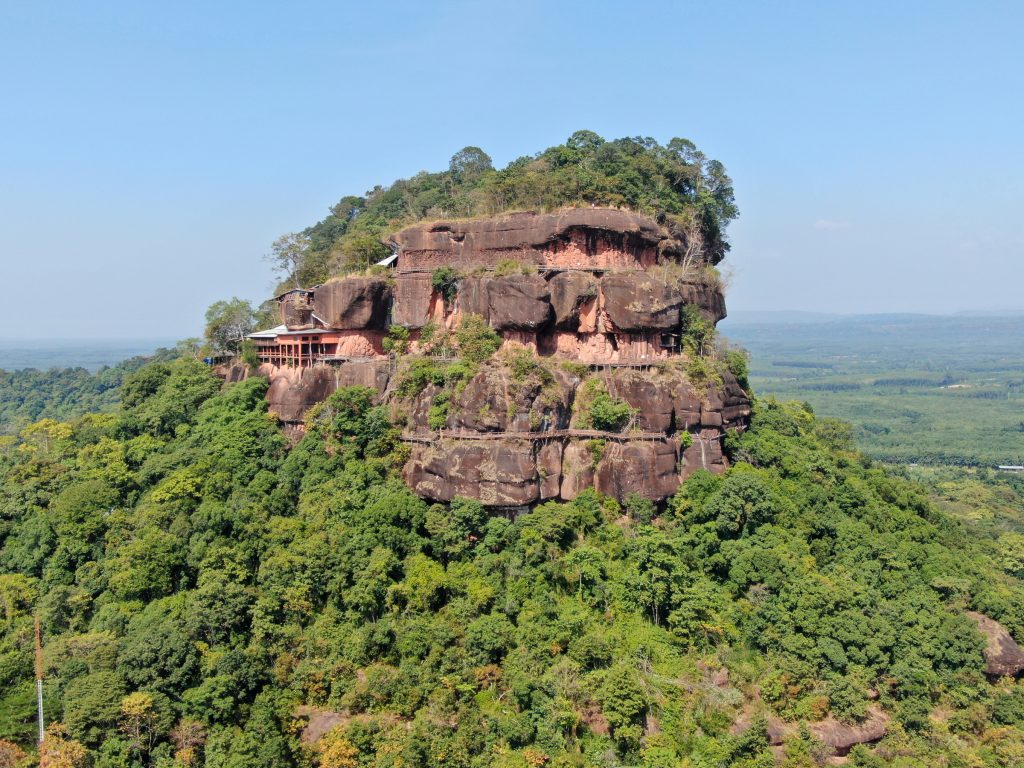
Officially designated as Wat Jetiyakhiri, the site derives its common name from the local Isan dialect, where "Wat" translates to temple and "Phu Tok" means lonely mountain. Standing at 359 meters in height, the monolithic reddish-brown sandstone mountain evokes comparisons to smaller formations like Sigiriya in Sri Lanka. Situated approximately 30 minutes from Bueng Kan city, the temple grounds encompass a sprawling base featuring a large lake, verdant parklands, and comprehensive visitor facilities.

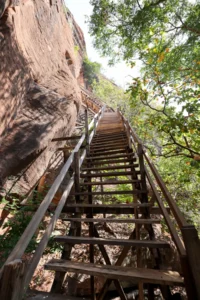
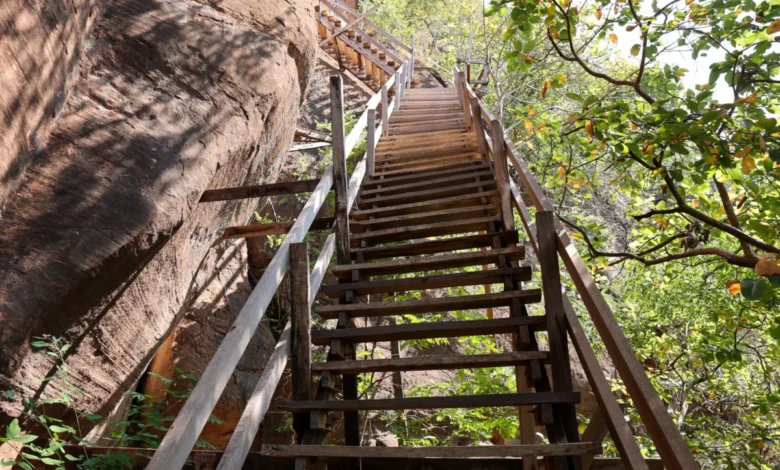
However, the defining feature of Wat Phu Tok is its intricate system of wooden staircases, ladders, and cantilevered walkways that cling precariously to the vertical rock face. Constructed by hand over decades, these pathways allow monks, pilgrims, and intrepid travelers to navigate the rugged terrain, transforming a sheer geological barrier into a vertical labyrinth of faith and endurance.
Chronology and Historical Development

The history of Wat Phu Tok is deeply intertwined with the ascetic traditions of Thai Buddhism. For generations, the rugged and isolated nature of the mountain made it an inhospitable environment dominated by dense wildlife, particularly populations of venomous snakes. Paradoxically, this same isolation made the location ideal for Buddhist monks seeking solitude for intense meditation, as the harsh environment presented physical and psychological obstacles to be overcome.
The formal establishment of the temple is credited to the revered monk Luang Pu Juan. Recognizing the mountain’s potential as a sanctuary for spiritual practice, Luang Pu Juan spearheaded the monumental engineering effort to make the upper elevations accessible. Monks, novices, and local volunteers labored to construct wooden staircases, ladders, and scaffolding-style walkways along the sheer cliffs.

The architecture of the ascent was deliberately designed to reflect Buddhist cosmology. The builders engineered seven distinct levels, directly corresponding to the seven stages of spiritual awakening and meditation in Buddhist philosophy. Tragically, the visionary monk Luang Pu Juan did not live to see the completion of his life’s work; he perished in a tragic aircraft accident. Despite his passing, the monastic community and local authorities have maintained the structures, preserving Wat Phu Tok as both an active place of worship and a monument to human determination.
Structural Layout and the Seven Levels of Ascent

The journey through Wat Phu Tok begins at the base of the mountain, where visitors transition from conventional park trails to the beginning of the wooden infrastructure. The initial ascent is relatively gentle, featuring timber staircases that gradually steepen into ladder-like configurations. While the wooden planks flex and angle with the contours of the cliff, the engineering remains remarkably stable, offering a secure footing for those willing to brave the heights.
Levels One through Four serve primarily as transitional zones, featuring scattered shrines, forested alcoves, and quiet resting points amidst the expanding vertical perspective.

The Fifth Level marks a significant shift in the landscape. Unlike the sheer cliff paths, the fifth level broadens into ground-level terrain, housing the temple’s primary ordination hall and a high concentration of secondary shrines and monastic residences. Visitors frequently take a well-documented detour from the main circuit on this level, traversing an elevated rock bridge that leads to a secluded rock-cut temple perched dramatically on a remote shoulder of the mountain.
The Sixth Level represents the climax of the Wat Phu Tok experience. Comprising a combination of ground paths and cantilevered wooden walkways anchored directly into the vertical rock face, this level encircles the mountain. Offering panoramic views of the surrounding Mekong River basin and the unbroken canopy of Bueng Kan’s forests, the sixth level combines breathtaking natural beauty with psychological intensity. While the structural integrity of the walkways is meticulously maintained, the absence of modern safety barriers other than the cliffside walls demands absolute focus from every visitor.

The Seventh Level marks the physical summit of the mountain. Reached via a final vertical climb, the apex offers open vistas of the region. However, conservation and safety warnings are prominently noted regarding the high population of venomous snakes inhabiting the upper plateau. Consequently, the seventh level lacks the elaborate wooden walkways and shrines found below, serving primarily as the ultimate physical boundary of the pilgrimage rather than a tourist attraction.
Supporting Data and Tourism Implications

As Bueng Kan remains one of Thailand’s newest provinces—having been established as a separate administrative entity in 2011—tourism infrastructure is still developing compared to traditional regional hubs. Local tourism boards view sites like Wat Phu Tok as vital anchors for sustainable, low-impact cultural tourism in the Isan region.
Safety statistics provided by local administrative authorities indicate that despite the precipitous nature of the sixth-level walkways, serious accidents are exceedingly rare, largely due to the cautious behavior of visitors and ongoing maintenance by temple caretakers. Economic analysts note that increased interest in off-the-beaten-path destinations has gradually stimulated local hospitality sectors in Bueng Kan city, providing alternative revenue streams for rural communities outside the central Thai tourism circuit.

Broader Impact and Cultural Significance
Beyond its appeal as an adventure tourism destination, Wat Phu Tok holds profound religious significance for practitioners of the Thai Forest Tradition. The physical act of climbing the seven levels is viewed as a meditative metaphor, requiring mindfulness, balance, and the steady overcoming of fear—core tenets of Buddhist monastic training.

The enduring legacy of Wat Phu Tok underscores the intersection of human engineering and natural preservation. By utilizing lightweight timber construction anchored directly into sandstone rather than engaging in heavy industrial excavation, the creators of the temple preserved the ecological integrity of the solitary mountain. As global interest in experiential and sustainable travel grows, Wat Phu Tok stands as a testament to the resilience of Isan’s cultural heritage, offering an unmatched encounter with Thailand’s spiritual and natural landscapes.