Vertical Explorations in Bosnia and Herzegovina: A Comprehensive Guide to Via Ferrata Routes in Sarajevo and Mostar

Bosnia and Herzegovina is rapidly emerging as a premier adventure tourism destination in Southeastern Europe, drawing outdoor enthusiasts from across the globe with its dramatic topography, limestone massifs, and rich cultural heritage. While millions of international travelers visit the country annually to experience its iconic Ottoman-era architecture, traditional cuisine, and historical landmarks—such as Mostar’s Stari Most (Old Bridge) and Sarajevo’s Baščaršija—a growing segment of visitors is seeking high-adrenaline experiences away from the traditional sightseeing trails. Among the most popular vertical adventure offerings are via ferratas—protected climbing routes equipped with continuous steel cables, iron rungs, and suspension bridges that allow novices and seasoned hikers alike to scale sheer rock faces with safety and precision.
Managed by local operators such as Bosnia Outdoor Adventures (BOA), the network of via ferratas spanning the regions of Sarajevo and Mostar has transformed the country’s adventure sports landscape. These routes offer an alternative perspective of the nation’s stunning geography, blending rugged physical exertion with panoramic vistas of historic urban centers and untouched natural reserves.
Understanding the Via Ferrata System: Engineering and Safety Standards
Originating in the Italian Dolomites during World War I to safely transport troops across difficult mountain terrain, a via ferrata—literally translating to "iron path"—has evolved into a mainstream recreational activity. The modern system relies on a permanent steel cable anchored directly into the rock face. Climbers wear a certified climbing harness attached to a specialized via ferrata energy-absorbing lanyard system equipped with two carabiners. By systematically clipping and unclipping past anchor points, the climber ensures that at least one carabiner remains securely fastened to the steel cable at all times, drastically reducing the risk of a catastrophic fall.

Unlike technical rock climbing, which demands advanced rope-handling skills, finger strength, and complex knot-tying abilities, via ferratas are designed to be accessible. Participants require basic physical fitness, comfort with heights, and an introductory briefing on gear management. European grading systems classify these routes from A (easy, protected walking terrain) to E (extremely steep, highly strenuous, and physically demanding). The primary routes established in Sarajevo and Mostar generally fall within the A/B to B/C spectrum, making them ideal for physically active beginners, families, and intermediate adventurers seeking a controlled yet thrilling alpine challenge.
Mostar’s Vertical Escapes: Hum and Fortica
In the southern city of Mostar, tourism has traditionally centered around the Neretva River valley, where spectators gaze up at the iconic stone arch of the Stari Most or watch professional divers plunge into the turquoise waters below. However, the surrounding topography offers a starkly different vantage point.
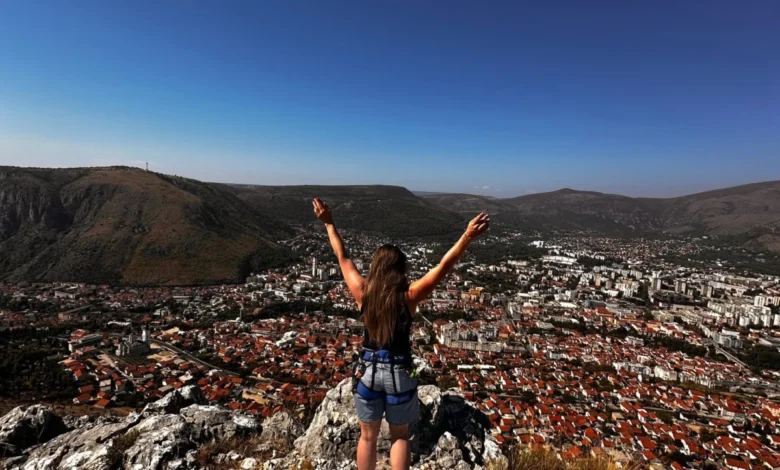
The most prominent vertical route in the city is Via Ferrata Hum, ascending the massive limestone wall of Mount Hum—the prominent hill crowned by a large white cross that dominates the background of nearly every classic Mostar photograph. This demanding route features approximately 600 meters of steel cable and commands a vertical height gain of roughly 350 meters. Divided into sections by three suspension bridges that span rocky chasms and sway slightly underfoot, Hum offers a progressive ascent. As climbers gain elevation, panoramic views of the Neretva valley, minarets, and the historic old town unfold beneath them. Due to its length and exposure, Hum is best suited for fit individuals who are comfortable with heights.
For a gentler alternative on the same hillside, Via Ferrata Fortica offers an accessible introduction to vertical climbing. Spanning about 200 meters of cable with an 80-meter height gain, Fortica is graded A/B and typically takes around 30 minutes to complete. The route features a suspension bridge and culminates near the Fortica Skywalk, a glass-floored viewing platform that serves as a popular resting spot for visitors. Because Mostar experiences intensely hot Mediterranean summers—with July and August temperatures frequently soaring past 40°C—local guides strongly advise scheduling climbs during the early morning or late afternoon hours. Spring and autumn offer optimal weather conditions, though the routes remain accessible year-round during favorable weather windows.

Sarajevo’s Alpine Perimeter: Trebević, Bukovik, and Romanija
Shifting focus to the capital city of Sarajevo, adventure routes take advantage of the dramatic Dinaric Alps rising directly from the urban basin. Sarajevo has long been celebrated for its multicultural history and its legacy as the host of the 1984 Winter Olympics. Today, outdoor infrastructure capitalizes on both natural and historical assets.
Via Ferrata Trebević ascends the white limestone cliffs known locally as Bijele Stijene on Mount Trebević, the city’s iconic southern guardian. Spanning roughly 180 meters of cable with a 90-meter height gain, this B/C-graded route begins with a tranquil 15-minute walk through a beech forest before breaking out onto exposed limestone cliffs. Climbers are rewarded with sweeping views of Sarajevo’s rooftops. The route’s proximity to the city center allows participants to complete the climb in the morning and return to the Baščaršija district for traditional cevapi by lunchtime. Furthermore, adventurers frequently combine the excursion with a walk along the decaying, graffiti-covered concrete of the historic Olympic bobsled track located nearby.
For absolute beginners seeking a shaded, low-pressure environment, Via Ferrata Bukovik is situated further north within the protected confines of Skakavac Nature Park. Featuring 105 meters of cable and a modest 70-meter height gain graded at B, Bukovik provides ample opportunity for novices to master the mechanics of clipping gear without the pressure of crowds. The route can be paired seamlessly with a hike to the nearby 98-meter Skakavac waterfall.
At the most challenging end of the regional spectrum lies Via Ferrata Sokolov Put on the Romanija mountain massif, located approximately 28 kilometers east of Sarajevo. Featuring 350 meters of cable and a 160-meter height gain, Sokolov Put requires a 20-minute approach hike followed by a rigorous 90-minute climb. Crossing suspension bridges suspended high above deep, forested ravines, this route is classified as B/C but demands significantly more commitment and endurance than its urban counterparts. Industry professionals strongly recommend that first-time visitors tackle easier routes like Bukovik or Trebević before attempting Romanija, and advise utilizing professional guide services for those lacking prior experience. The operating season for all Sarajevo-side routes typically spans from April through October.

Demographics, Accessibility, and Family Participation
The expansion of via ferratas in Bosnia and Herzegovina has democratized extreme sports, allowing multi-generational families to participate in alpine recreation. Local guiding companies report an increasing number of family bookings, noting that children as young as seven years old can safely navigate the routes provided they are properly fitted with youth-sized harnesses and maintain a strict one-to-one adult-to-child supervision ratio.
Operators emphasize that physical conditioning requirements are moderate rather than elite; individuals capable of hiking a steep incline without chronic exhaustion can successfully complete the introductory routes. To ensure safety, international visitors are advised to utilize certified equipment—including dynamic energy-absorbing lanyards, climbing helmets, and robust footwear with high-friction rubber soles—all of which are available for rent through local outfitters in Sarajevo and Mostar.
Economic Implications and Tourism Growth
The integration of via ferratas into Bosnia and Herzegovina’s tourism portfolio represents a broader strategic shift toward sustainable, active travel. Tourism authorities and regional municipalities have recognized that diversifying visitor activities beyond historical sightseeing extends average length-of-stay metrics and disperses economic benefits into rural and mountainous peripheries.

By partnering with specialized local operators, international travelers gain safe, regulated access to pristine natural environments that were previously the exclusive domain of elite mountaineers. As regional infrastructure continues to modernize and safety standards align with broader European frameworks, Bosnia and Herzegovina is cementing its reputation as a world-class hub for vertical exploration, bridging the gap between urban cultural immersion and untamed alpine adventure.
Related posts: