How 1871 Photographs and Artistry Overcame Congressional Skepticism to Help Create Yellowstone National Park

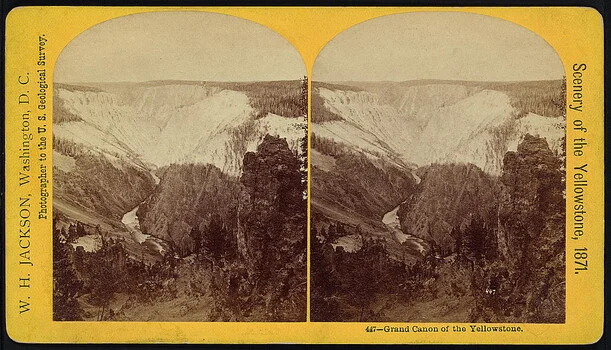
On March 1, 1872, President Ulysses S. Grant signed into law the legislation establishing Yellowstone National Park, setting aside more than two million acres of the public domain as a "public park or pleasuring-ground for the benefit and enjoyment of the people." Comprising a mere few hundred words, the foundational text of the act makes no explicit reference to photography, nor does it explicitly detail the intense visual lobbying campaign that preceded its passage. Yet, long before the measure cleared the United States Senate and the House of Representatives, a potent collection of physical evidence—consisting of field watercolors, sketches, and groundbreaking wet-plate photographs—had quietly permeated the corridors of power in Washington, D.C. This visual documentation effectively transformed regional tall tales into undeniable geographical realities, bridging the credibility gap for skeptical lawmakers who had never witnessed the American West’s volatile geothermal wonders firsthand.
The Genesis of the 1871 Hayden Geological Survey
The journey of these influential images began in the early summer of 1871, when geologist Ferdinand V. Hayden organized and led the United States Geological and Geographical Survey of the Territories. Funded by the federal government, the ambitious expedition departed Ogden, Utah, on June 8, 1871, and concluded its field operations on October 2, 1871. The core of the expedition spent the critical months of late July and August exploring the high-altitude wilderness of northwestern Wyoming, a region previously shrouded in mystery and dismissed by the American public as frontier folklore.
Hayden assembled a multidisciplinary team of approximately 32 men, intentionally integrating specialists whose professional responsibilities extended far beyond traditional geological sampling and topographical elevation readings. Among them were official photographer William Henry Jackson, then just 28 years old, and official artist Henry Wood Elliott. Jackson, who had already gained valuable field experience during Hayden’s 1870 survey, was embarking on a remarkably prolific career that would span nearly seven decades until his death in 1942.
Thomas Moran, another pivotal visual chronicler of the expedition, secured his place through different channels. Moran, an accomplished painter based in the East who had never before traveled west, lacked a formal government appointment. Recognizing the vast commercial and promotional potential of the region’s dramatic topography, Jay Cooke—the influential financier bankrolling the Northern Pacific Railroad—intervened. Cooke helped fund Moran’s inclusion in the expedition, as the railroad company actively sought compelling vistas to convert into promotional material that would eventually encourage passenger travel along its nascent western routes. Moran and Jackson met for the first time on the expedition, subsequently establishing a productive working relationship as they scouted identical viewpoints—Jackson exposing fragile glass negatives while Moran rapidly filled his sketchbooks with precise color notes.
Logistical Hardships of Wet-Plate Photography in the Wilderness
Operating in the field during the wet-plate collodion era presented staggering technical and physical challenges. Decades prior to the invention of flexible roll film, every photographic negative required a fragile sheet of clear glass. In the field, this glass had to be meticulously coated with a viscous collodion solution, sensitized by immersion in a hazardous silver nitrate bath, loaded carefully into a heavy wooden plate holder, exposed in the camera, and fully developed—all before the chemical emulsion dried. If the plate dried prematurely, the exposure was completely ruined, rendering the entire painstaking process useless. A single finished, washed negative could consume the better part of an hour.
Jackson performed this delicate chemical choreography at elevations exceeding 8,000 feet, operating entirely on foot and via pack mules across rugged terrain devoid of established roads or modern conveniences. His dedicated photographic unit comprised between five and seven men, who collectively hauled roughly 400 pounds of specialized cameras, fragile glass plates, and volatile chemical supplies through punishing backcountry conditions. Jackson primarily utilized an 8×10-inch field camera alongside a stereographic camera designed to capture dual images for the era’s popular parlor stereoscopes.
Operating under such austere conditions required immense ingenuity. In one of the few fortuitous circumstances afforded by the harsh landscape, Jackson utilized boiling water sourced directly from the region’s geyser basins—averaging approximately 160 degrees Fahrenheit—to accelerate the drying and processing of his plates. By the conclusion of the survey, Jackson’s published catalog featured more than 150 photographs in the 8×10 format alone, accompanied by numerous stereographs. These images represented the first authentic photographic documentation of the region’s travertine terraces, deep river canyons, and active geysers to reach a wide national audience.
Chronology of the Legislative Push and Visual Lobbying
Prior to the 1871 survey, official written accounts detailing the geothermal phenomena of the Yellowstone region had routinely been dismissed by Eastern readers and legislators as exaggerated frontier tall tales. Stories of boiling rivers, hissing fumaroles, and massive columns of water erupting hundreds of feet into the air on a regular schedule sounded entirely fictitious. While written reports could be doubted and hand-drawn illustrations could be easily dismissed as the product of an artist’s overactive imagination, photographic evidence carried a unique, objective authority that proved far more difficult for skeptical lawmakers to dispute.
Following the conclusion of the summer field season, Jackson returned East with his exposed glass plates, from which high-quality prints were rapidly produced. Capitalizing on this invaluable asset, Hayden utilized the prints as direct lobbying instruments in Washington, D.C. During the autumn of 1871, Hayden presented Congress with an extensive, comprehensive report on the Yellowstone region. According to historical accounts from the Office of the House Historian, Moran’s evocative paintings and Jackson’s striking photographs provided lawmakers with their first vivid, undeniable accounts of the territory’s unique landscape.
While popular lore often portrays Hayden physically cornering individual congressmen with photographs on the Capitol floor while the legislation hung in the balance—anecdotes that remain difficult to verify through official congressional records—the practical impact of the imagery is undisputed. The visual artifacts effectively transformed secondhand rumors into tangible evidence that skeptical legislators could hold in their hands.
The formal legislative timeline for the establishment of the park progressed with remarkable swiftness:
- January 30, 1872: The Senate successfully passed the Yellowstone legislation.
- February 27, 1872: The House of Representatives approved the bill by a decisive 115 to 65 margin.
- March 1, 1872: President Ulysses S. Grant officially signed the legislation into law, codifying the creation of America’s first national park.
Broader Impacts, Economic Interests, and Historical Omissions
While the visual campaign spearheaded by Jackson and Moran played a critical role in shifting congressional sentiment, historians emphasize that photography was merely one force among many operating during the winter of 1872. The legislative success was also propelled by powerful economic interests, most notably the Northern Pacific Railroad. The railroad held a direct financial stake in the creation of a protected scenic attraction that would secure passenger traffic along its rail lines, and its organized lobbying muscle provided essential administrative backing. Furthermore, Hayden’s comprehensive scientific documentation lent official governmental weight to the proposal, while earlier expeditions, such as the 1870 Washburn party, had spent months lecturing and publishing articles to seed the conservation concept across the Eastern states.
Despite the profound impact of these visual records, the creation of Yellowstone National Park under the banner of pristine preservation carried significant historical omissions. The legislative debate and subsequent promotional materials routinely framed the region as an empty, untouched wilderness waiting to be discovered and protected. In reality, the land was far from uninhabited. The National Park Service currently recognizes 27 distinct Native American tribes with deep ancestral ties to the Yellowstone ecosystem and its vital resources, with indigenous peoples having utilized the region for more than 11,000 years. The establishment of federal boundaries imposed strict government jurisdiction over ancestral hunting grounds, traditional travel routes, and sacred gathering places. Decades of subsequent park administration actively worked to exclude Native Americans from the newly minted park, underscoring a complex legacy where environmental preservation simultaneously intersected with Indigenous displacement.
Legacy of the 1871 Photographic Record
Today, the physical legacy of the 1871 Hayden Geological Survey endures through its surviving photographic and artistic masterworks. While Moran’s monumental oil painting, "The Grand Canyon of the Yellowstone"—subsequently purchased by Congress for $10,000 to hang in the Capitol—became an enduring symbol of the American landscape art movement, it arrived months after the park had already been officially established. It was Jackson’s field photographs that served as the immediate, indispensable tactical evidence during the critical legislative debates.
The wet-plate collodion process utilized by Jackson has never completely vanished; modern practitioners continue to transport large-format field cameras and glass plate holders into remote wilderness areas, willingly embracing the intense physical labor and patience required by the medium. Jackson’s original 1871 glass plate negatives remain preserved within major public institutions, such as the Library of Congress, ensuring that generations to come can examine the exact visual evidence that helped convince a 19th-century legislature to permanently preserve a uniquely American landscape.