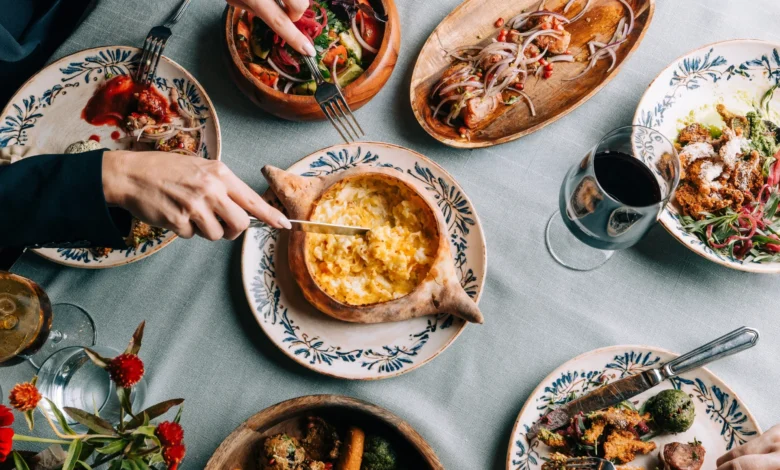
The culinary landscape of major Western metropolises is undergoing a profound transformation, marked by the rapid emergence and proliferation of Georgian cuisine. From the bustling avenues of New York City to the sophisticated dining districts of London, the Republic of Georgia—a nation long obscured by the political barriers of the 20th century—is finally securing its place on the international gastronomic map. This surge is not merely a transient food trend but the result of decades of post-Soviet cultural reclamation, now intersecting with a global appetite for authentic, historical, and terroir-driven culinary experiences.
In the past twelve months alone, New York City has witnessed the debut of at least four major Georgian establishments, including Let’s Chama, The History Restaurant, Ghemo, and Saperavi in the Upper West Side. Simultaneously, London has seen a flourishing of Georgian-inspired ventures. DakaDaka and Aba-Ra have anchored themselves in the city’s competitive dining scene, while the Notting Hill-based Sova, a “wine and vinyl” concept, serves as a testament to the versatility of Georgian flavors, rituals, and aesthetics.
A Historical Pivot: From Isolation to Global Presence

To understand the current momentum, one must look at the historical context of Georgia’s isolation. For much of the 20th century, as part of the Soviet Union, the country’s culinary traditions were largely confined within its borders or shared only among fellow Eastern Bloc nations. The collapse of the Soviet Union in 1991 served as the primary catalyst for change. As Georgia transitioned toward independence, its citizens began to integrate into global urban hubs.
Giorgi Mindiashvili, co-founder of London’s DakaDaka and an entrepreneur behind the boutique hotel collection Communal in Tbilisi, notes that this migration was the foundational step. “Georgian food has always been deeply ingrained in our culture, but the world was closed off to us for so long,” Mindiashvili explains. “As we gained our independence, Georgians started traveling, living, and settling in cities like London, New York, Washington D.C., and Madrid. The restaurant scenes we are seeing now are a direct result of that diaspora finding its voice and sharing its heritage with a wider, more curious audience.”
The Supra Phenomenon: A Feast of Cultural Synthesis
The defining feature of this culinary movement is the supra, a traditional Georgian feast that transcends simple dining to become a performative act of hospitality. These feasts are characterized by a bounty of dishes: khinkali (spiced meat or vegetable dumplings), khachapuri (cheese-stuffed bread), roasted meats, fish, and an array of piquant sauces like tkemali (plum sauce), all set against a backdrop of fresh herbs and walnuts.

Jonathan Nelms, owner of the Washington D.C.-based restaurant Supra, describes the cuisine as a complex cultural mosaic. “It’s a little Mediterranean, a little Middle Eastern, and then a lot of their own unique identity,” Nelms observes. “When guests look at the menu, they find the components familiar, but every bite offers an unexpected harmony of flavors. That element of surprise is what is driving repeat business.”
The Viticulture Renaissance: The Qvevri Revival
Where food leads, wine follows, and the Georgian resurgence is inextricably linked to the country’s 8,000-year history of winemaking. Georgia is home to more than 520 native grape varieties, but it is the method of production that has captivated the international wine community. The use of qvevri—large, beeswax-lined clay vessels buried underground—represents an ancient technology that is now being embraced by modern, natural-wine-focused producers.
Unlike wooden barrels, which impart oaky profiles, the qvevri provides a neutral, breathable environment that allows the wine to develop through natural convection. The egg shape of the vessel promotes the movement of lees and sediment, creating wines with significant texture and aromatic complexity. When these wines are fermented with skin contact—a hallmark of the eastern Kakheti region—the result is “amber” or “orange” wine.

Sarah Abbott, a Master of Wine who has extensively studied the region, notes the specific sensory experience of these wines. “I think of qvevri wines as being more voluminous; they have a looser weave. They are mellow but rich,” Abbott states. This style has found a receptive audience among sommeliers and consumers who value wines that evolve in the glass, offering a versatility that allows them to pair with complex dishes from start to finish.
Five Winemakers Shaping the New Era
The current surge in Georgian wine exports is driven by a new generation of producers who are blending ancestral techniques with contemporary precision.
-
Pheasant’s Tears
Founded in 2007 by American painter John Wurdeman and Georgian winemaker Gela Patalashvili, this winery has achieved cult status. By utilizing indigenous grapes and qvevri that date back to the mid-19th century, they emphasize the cultural rather than just the commercial aspect of wine. Their Poliphonia 2023, a field blend of over a hundred varieties, is a signature of their “harmonious chaos” philosophy.
-
Chateau Mukhrani
Representing the more classical side of the spectrum, this estate near the Kartli region combines 19th-century royal history with modern viticulture. While they honor their heritage, they also utilize international techniques to ensure a standard of refinement that appeals to those familiar with Bordeaux-style structures. Their Shavkapito 2021 is a standout, offering the vibrancy of a Pinot Noir with distinct Georgian terroir. -
Ikano
Established in 2008, Ikano operates with a collective spirit, incorporating biodynamic farming principles. Their winemaker, Davit Gamgoneishvili, views the qvevri as a tool for artistic intervention. Their Mtsvane 2021, an amber wine, exemplifies the balance between fruit-forward aromatics and the textural complexity required for a diverse food menu. -
Dakishvili Family Vineyards
Often cited as the “godfather of the new wave,” Giorgi “Gogi” Dakishvili has been instrumental in the professionalization of the qvevri craft. The family’s Orgo range, specifically the Rkatsiteli 2024, is considered a benchmark for modern amber wine, showcasing the ability of these wines to age gracefully and pair with diverse proteins, from light salads to wild boar. -
Ethno Wines
Located in the Manavi region, Ethno represents the marriage of finance-backed ambition and viticultural tradition. Co-founder Lado Robakidze, a former trader, notes that the shift in global demand is rooted in a search for authenticity. “People are looking for wines with character, a real sense of place, and a story behind them,” Robakidze says. Their Ethno Rkatsiteli 2022, a recent trophy winner at the International Wine & Spirits Competition, illustrates the potential for high-quality, filtered amber wines to compete on a global stage.
Broader Economic and Cultural Implications
The proliferation of these restaurants and the increased presence of Georgian wines in international retail outlets signal a broader economic shift. For Georgia, this represents a significant increase in soft power and export revenue. The establishment of these businesses in cities like New York and London creates a permanent infrastructure for the promotion of Georgian culture, tourism, and agriculture.
As these trends continue, analysts expect to see further integration of Georgian winemaking techniques into the broader global wine industry. The move away from heavily manipulated, oak-dominated wines toward more natural, skin-contact styles aligns with current consumer trends prioritizing health, transparency, and tradition.
In conclusion, the rise of Georgian gastronomy is not a temporary market fluctuation. It is a long-overdue reintroduction of one of the world’s oldest winemaking cultures into the modern global economy. With its unique combination of ancient methods, diverse indigenous grape varieties, and a hospitable, communal approach to dining, Georgia has successfully positioned itself as a significant contributor to the future of the international culinary scene. Whether through the lens of an amber wine or a plate of warm khinkali, the message is clear: the history of Georgia is now a part of the global present.