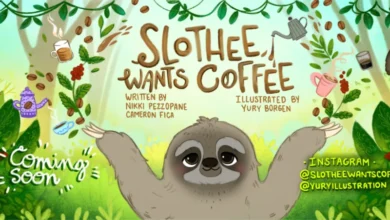
The literary world is abuzz with the release of Slothee Still Wants Coffee, the highly anticipated second installment in the "Slothee and Friends" series. This charming children’s book, penned by an unnamed author, promises to take young readers and their accompanying adults on an educational and adventurous journey across continents, all in pursuit of the ultimate cup of coffee. Beyond its engaging narrative, the book subtly weaves in lessons about diverse cultures, the art of friendship, and the fascinating global journey of one of the world’s most beloved beverages. The series, as indicated by the publisher’s statement, is poised to delve further into coffee and tea explorations, expanding its scope of worldly adventures and introducing a wider array of characters and experiences in subsequent volumes.
A Brew-tiful Expedition Across Continents
Slothee Still Wants Coffee chronicles the determined efforts of its titular character, Slothee, as he traverses an impressive seven countries in his quest for the perfect coffee. His itinerary reads like a veritable coffee lover’s pilgrimage: from the verdant highlands of Costa Rica and the ancient Inca landscapes of Peru, through the vibrant markets of Mexico and the sun-drenched plantations of Jamaica, to the rich soils of Uganda, the bustling coffee farms of Vietnam, and finally to the unique terroirs of Australia. Each destination is not merely a stop on a map but a gateway to understanding the distinct cultural nuances and agricultural practices associated with coffee production and consumption.
The narrative structure, as described, suggests an episodic adventure. Slothee encounters new friends in each locale, forging connections that enrich his journey and broaden his perspective. These interactions are central to the book’s educational mission, as they provide opportunities for him to learn about the specific coffee varieties, cultivation methods, roasting techniques, and brewing traditions unique to each region. The overarching question that propels the story forward – "Will Slothee find the best cup of coffee?" – serves as an accessible hook for young readers, while the underlying exploration of culture and friendship offers a more profound takeaway.
The Global Coffee Landscape: A Statistical Overview
The journey undertaken by Slothee mirrors the immense global reach and economic significance of coffee. According to the International Coffee Organization (ICO), coffee is one of the most traded agricultural commodities worldwide, with annual global production consistently exceeding 160 million 60-kilogram bags. The industry supports the livelihoods of an estimated 25 million farmers, primarily in developing countries across the "Bean Belt," which spans regions in Latin America, Africa, and Asia – precisely the areas visited by Slothee.
Costa Rica, a prominent stop on Slothee’s tour, is renowned for its high-quality Arabica beans, often grown at high altitudes, contributing to its distinct acidity and complex flavor profiles. Peru, another featured nation, has seen a significant rise in its coffee production, particularly in organic and fair-trade sectors, catering to a growing global demand for ethically sourced beans. Mexico, a long-standing coffee producer, offers diverse microclimates that yield a range of coffee types, from mild to full-bodied.
Jamaica, though perhaps more globally recognized for its music and culture, boasts a historical connection to premium coffee, most notably the Blue Mountain variety, which is highly prized for its smooth, mild flavor and lack of bitterness. Uganda, a significant coffee producer in Africa, is known for its robust Robusta beans, often used in espresso blends for their crema and caffeine content, alongside a growing interest in specialty Arabica cultivation. Vietnam has rapidly ascended to become the world’s second-largest coffee producer, primarily through its extensive Robusta output, playing a crucial role in the global instant coffee market. Australia, the final destination, represents a more recent, yet burgeoning, chapter in the coffee story, with a sophisticated café culture and a growing focus on specialty coffee cultivation in regions like Queensland and Western Australia.
Cultural Immersion Through Coffee
The "Slothee and Friends" series aims to achieve more than just a geographical tour. By immersing Slothee in the daily lives and traditions of people from these diverse nations, the book implicitly highlights how coffee is deeply interwoven with cultural identity. In many of these regions, coffee is not merely a beverage but a social lubricant, a ritual, and a symbol of hospitality.
For instance, in Peru, the preparation and sharing of coffee can be a communal activity, often involving intricate brewing methods passed down through generations. Mexican coffee culture often features vibrant markets where vendors expertly roast and grind beans, with coffee being an integral part of family gatherings and social events. Jamaican coffee traditions might involve specific brewing techniques to accentuate the unique characteristics of Blue Mountain beans, often enjoyed in a relaxed, island setting.
Ugandan coffee ceremonies can be deeply rooted in tradition, involving specific steps and gestures that signify respect and community bonding. Vietnamese coffee, famously strong and often served with condensed milk (cà phê sữa đá), is a ubiquitous part of daily life, enjoyed from street-side stalls to bustling urban cafes. Australia’s coffee culture, heavily influenced by European immigration, is characterized by its sophisticated café scene, precision in espresso-making, and a discerning palate for single-origin beans.
The book’s approach, focusing on Slothee’s interactions and learnings, suggests a gentle introduction to these cultural aspects for young readers. The "making friends" element is critical here, as it humanizes the global coffee narrative, transforming abstract concepts into relatable experiences.
The Broader Implications for Early Education and Global Awareness
The "Slothee and Friends" series, with Slothee Still Wants Coffee as its latest offering, taps into a growing educational trend that emphasizes experiential learning and global citizenship from an early age. In an increasingly interconnected world, fostering an understanding and appreciation for diverse cultures is paramount. Books that achieve this through engaging narratives, such as Slothee’s coffee quest, are invaluable tools for educators and parents alike.
The series’ focus on a specific commodity like coffee allows for a tangible entry point into broader discussions about global trade, agriculture, economics, and sustainability. For instance, future explorations within the series could delve into the challenges faced by coffee farmers, the impact of climate change on coffee production, or the principles of fair trade – all complex issues that can be simplified and introduced to young minds through relatable stories.
The success of such books can also be measured by their ability to spark curiosity. A child who reads about Slothee’s adventures might be inspired to learn more about the countries he visited, the people he met, or the journey of the coffee beans from farm to cup. This intrinsic motivation to learn is a cornerstone of effective education.
Furthermore, the series’ commitment to including adults in the reading experience acknowledges the dual role of such books: to educate children and to provide a shared learning opportunity for families. This collaborative approach to reading can strengthen family bonds and create lasting memories, all while imparting valuable knowledge about the world.
Anticipating Future Adventures
The announcement of future books in the "Slothee and Friends" series, promising more coffee and tea explorations, alongside broader world adventures, suggests a long-term vision for this literary franchise. The foundation laid by Slothee Still Wants Coffee appears robust, designed to cater to a wide range of interests and to grow with its readership.
The inclusion of tea explorations, in particular, opens up another vast and culturally rich domain. From the meticulously prepared matcha ceremonies of Japan to the robust black teas of India and Sri Lanka, and the diverse herbal infusions found across the globe, tea offers a parallel yet distinct avenue for cultural and educational exploration.
The overarching goal of guiding children and adults through worldly adventures and fostering an understanding of different cultures positions the "Slothee and Friends" series as more than just entertainment. It is an endeavor to cultivate informed, curious, and empathetic global citizens, one delightful story at a time, with the humble coffee bean serving as its initial, aromatic ambassador.