Gear failure in the backcountry presents a unique challenge for long-distance hikers, mountaineers, and outdoor enthusiasts, often transforming a carefully planned expedition into an emergency survival scenario. Whether caused by abrasive terrain, extreme weather conditions, or simple wear and tear from thousands of miles of trail use, equipment breakdowns are an inevitable reality of wilderness travel. Industry data from outdoor recreation safety organizations indicate that nearly 40 percent of unexpected backcountry evacuations or shortened trips stem from non-catastrophic gear failures—such as delaminated footwear, punctured sleeping pads, or structural tent damage—rather than medical emergencies. While catastrophic structural damage, such as a completely melted down jacket or shattered frame backpack, generally requires professional repair or replacement, many common equipment failures can be successfully managed in the field. Establishing a standardized protocol for emergency field maintenance allows adventurers to preserve the integrity of their shelter, footwear, and cooking systems, ensuring safe passage to the nearest resupply point or road crossing without relying on outside rescue assistance.
Historical Context and the Evolution of Field Repairs
The discipline of backcountry gear maintenance has evolved significantly alongside the outdoor recreation industry over the past half-century. During the early eras of modern backpacking in the 1960s and 1970s, outdoor equipment relied heavily on canvas, leather, and external metal frames. Repairs during this period typically required heavy-duty waxed thread, shoemaker’s glue, and pliers, often adding substantial weight to a hiker’s pack.
The introduction of high-tech synthetic fabrics—such as ripstop nylon, Gore-Tex membranes, and ultralight polyurethane-coated silnylon—revolutionized lightweight backpacking in the late 20th century while simultaneously creating new vulnerabilities. Punctures, seam tape degradation, and fabric delamination became common issues that traditional thread and heavy patches could not adequately resolve without compromising waterproofing.
By the early 2000s, the advent of specialized pressure-sensitive repair tapes, such as Tenacious Tape, and cyanoacrylate-based field adhesives transformed emergency gear maintenance. Modern thru-hiking culture, popularized by the rapid growth of long-distance trails like the Appalachian Trail, Pacific Crest Trail, and Continental Divide Trail, further accelerated the demand for ultralight, multi-use repair methodologies. Today’s outdoor athletes routinely carry micro-repair kits weighing less than three ounces, capable of addressing complex structural failures far from civilization.
Anatomy of Common Field Failures: Footwear and Shelter Integrity
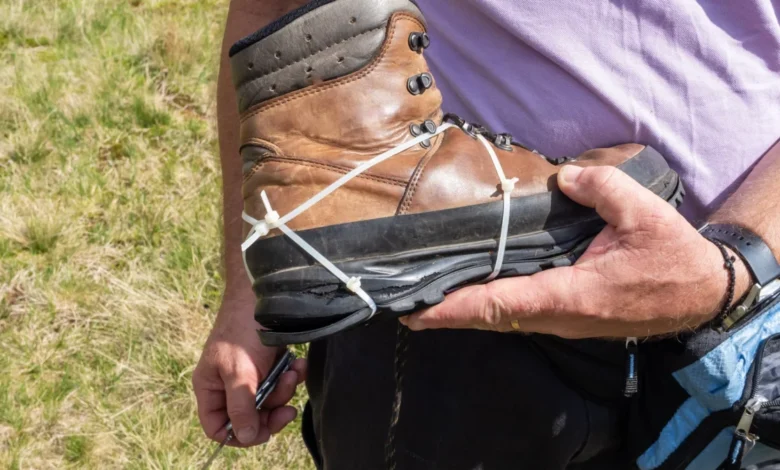
Among the most critical structural failures a hiker can encounter is footwear delamination, wherein the bottom package—consisting of the midsole and outsole—separates entirely from the shoe upper. Footwear manufacturing relies heavily on advanced industrial adhesives that can degrade under repetitive flex stress, high temperatures, and moisture. When an outsole begins to flap, it destabilizes the user’s gait, rapidly leading to severe blisters, muscle strain, or joint injury on uneven terrain.
Industry experts recommend a multi-layered mechanical and adhesive approach to stabilize separated footwear. If duct tape alone is applied to a wet or dusty shoe, it will quickly shed its adhesive properties. Instead, field mechanics advise using a figure-eight lacing pattern—or utilizing spare shock cord and industrial zip ties—to physically anchor the outsole to the upper. By punching strategic holes through the edge of the outsole and the upper material away from high-friction zones, hikers can secure zip ties tightly before reinforcing the assembly with waterproof duct tape wrapped in an ankle-sprain configuration. This mechanical interlock distributes tension across the entire shoe structure, providing enough stability to endure dozens of miles of rough trail.
Shelter vulnerabilities present an equally pressing hazard, particularly in alpine environments characterized by high winds and severe weather. Tent poles, which endure constant bending tension and environmental stress, are notoriously prone to snapping or buckling. Conventional field fixes, such as taping a tent stake alongside the break, routinely fail because stakes lack the structural rigidity to resist lateral bending forces.
Standard emergency protocols require the deployment of a dedicated tent pole splint—a cylindrical aluminum sleeve slightly larger in diameter than the pole itself. By straightening the damaged pole section as much as possible, sliding the sleeve centrally over the fracture point, and securing it with robust adhesive tape, the pole regains its load-bearing capacity. Similarly, tent fly tears demand specialized solutions rather than standard household tape. Because tent flies rely on continuous waterproof coatings, fabric repairs must utilize high-tensile ripstop nylon patches backed by aggressive, moisture-resistant adhesives that withstand fluctuating humidity and condensation without failing.
Functional Mechanics of Cooking and Heating Systems
Beyond shelter and footwear, maintaining functional cooking equipment is vital for caloric intake, hydration safety, and morale in cold or wet environments. Modern backcountry stoves frequently utilize piezoelectric ignitors to create a spark for fuel combustion. However, these systems are notoriously sensitive to moisture, altitude, and mechanical vibration.
When a stove ignitor fails to produce a flame despite audible clicking, the underlying issue is typically geometric rather than electrical. The delicate metal electrode wire is susceptible to bending during packing or transit, which alters the spark gap distance from the burner port. Utilizing the pliers on a multi-tool to reposition the electrode tip precisely five millimeters (just under one-quarter of an inch) from the center ring restores the optimal electrical arc necessary to ignite pressurized gas. For popular stove models like the MSR PocketRocket, the electrode wire frequently slips out of its alignment sleeve; sliding the wire back into its designated channel immediately restores functionality, eliminating the need for matches or a secondary lighter—though outdoor safety instructors universally recommend carrying a backup mechanical lighter as a failsafe.
Composition of the Ultimate Three-Ounce Backcountry Repair Kit
To mitigate the risks associated with unexpected equipment failure, outdoor safety organizations recommend carrying a standardized, lightweight repair kit. Weighing approximately three ounces, this minimal kit should be integrated into every backpacker’s core gear list.
Component List for an Optimal Field Repair Kit:
- Multi-Purpose Adhesive Tape: Heavy-duty duct tape wrapped around trekking poles or a small container, valued for its high tensile strength and temporary structural binding capabilities.
- Specialized Fabric Patches: A selection of Tenacious Tape or NoSo patches designed to seal waterproof membranes on rain jackets, sleeping bags, and tent flies without losing adhesion in wet conditions.
- Mechanical Fasteners: Heavy-duty zip ties and safety pins capable of securing load-bearing pack straps, broken zippers, or torn mesh.
- Structural Hardware: A rigid aluminum tent pole splint sized to match the primary shelter’s diameter.
- Cutting and Utility Tools: A lightweight multi-tool featuring pliers, a knife blade, and a screwdriver attachment for mechanical adjustments.
- Sleeping Pad Patch Kit: Alcohol prep wipes and manufacturer-matched adhesive patches tailored to the specific material composition of inflatable sleeping mats.
Industry Analysis and Safety Implications
Search and rescue (SAR) professionals and outdoor industry analysts emphasize that the psychological and physical benefits of effective field repairs extend far beyond mere equipment preservation. When gear fails in remote backcountry corridors, the inability to execute a timely repair can induce acute stress, leading to poor decision-making, hypothermia, or accidental injury.
Statistics compiled by wilderness medical registries demonstrate that hikers equipped with basic self-sufficiency skills and repair resources experience significantly lower rates of emergency evacuation for non-injury-related gear failures. Furthermore, mastering field maintenance reduces consumer waste, aligning with broader sustainability initiatives within the outdoor industry by extending the lifecycle of technical garments and equipment.
As lightweight backpacking trends continue to push the boundaries of ultralight gear design—often utilizing thinner, more delicate materials to reduce pack weight—the importance of proactive gear maintenance and emergency field readiness will only increase. By investing minimal weight in a dedicated repair kit and learning foundational mechanics, backcountry travelers ensure greater resilience against the unpredictable nature of wilderness environments.