Conquering Wat Phu Tok: Thailand’s Architectural Wonder on the Lonely Mountain Rises in Bueng Kan Province


Rising sharply from the flat, agrarian terrain of Thailand’s northeastern Isan region, Wat Jetiyakhiri—universally known as Wat Phu Tok—stands as one of the most astonishing architectural and spiritual achievements in Southeast Asia. Located in the remote Bueng Kan province, which borders Laos along the Mekong River, the temple complex is built upon an isolated sandstone monolith that reaches 359 meters above sea level. The local Isan designation, "Phu Tok," translates directly to "lonely mountain," a fitting description for a geological formation that appears entirely disconnected from surrounding regional topography, evoking comparisons to Sigiriya in Sri Lanka.
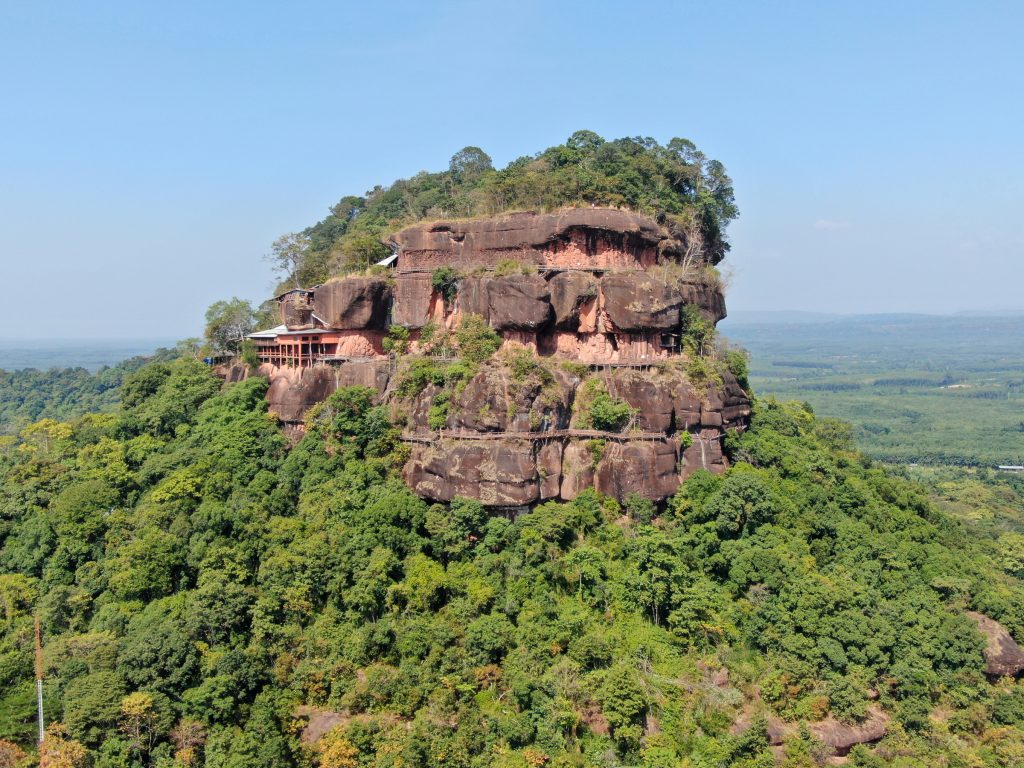
The primary feature that draws intrepid travelers and devoted pilgrims alike is a complex, multi-tiered scaffolding system of wooden stairs, ladders, and cantilevered walkways. These structures cling directly to the vertical rock faces, allowing visitors to circumnavigate the precipitous cliffs across seven distinct levels. Designed to symbolize the seven stages of Buddhist enlightenment, the ascent offers a synthesis of physical peril, architectural ingenuity, and profound spiritual isolation.
Historical Evolution and Vision of the Mountain Sanctuary

The establishment of Wat Phu Tok dates back to the late 20th century, transforming a rugged, wildlife-dense wilderness into a dedicated center for Buddhist meditation. Historically, the isolated sandstone mountain was avoided by locals due to its dense population of venomous snakes and the severe physical hazards posed by its vertical topography. However, these very characteristics made the site ideal for monastic isolation and ascetic practice.
The monumental task of carving a trail network into the rock face was initiated by the revered Isan monk Luang Pu Juan. Recognizing the potential for spiritual introspection provided by the remote environment, Luang Pu Juan led a monastic and local labor effort to construct the foundational wooden staircases and connecting walkways. The master plan was explicitly tied to Buddhist philosophy: the seven levels of the mountain were engineered to correspond to the seven tiers of spiritual awareness required to transition from worldly attachment to enlightenment.

Monks and laborers manually anchored wooden planks into the sandstone cliffs, creating a precarious yet functional network of paths that linked remote meditation caves, shrines, and gathering halls. Although Luang Pu Juan tragically died in an aviation accident prior to the completion of the master plan, his disciples and local authorities have continued maintenance efforts, preserving the structural integrity of the labyrinthine pathways.
Architectural Layout and the Seven Stages of Ascent

Accessing the temple grounds begins at the base of the mountain, where a sprawling complex featuring a large lake, administrative structures, and extensive parking facilities serves as a staging ground. From the base, the ascent is categorized into progressive levels, each offering distinct architectural features and environmental shifts.
The initial levels of the mountain present relatively moderate wooden staircases and natural dirt pathways, winding through dense secondary forest and past minor shrines. As climbers progress, the angle of the stairs increases significantly, frequently transitioning into near-vertical wooden ladders that require careful footing.

Upon reaching the fifth level, the spatial dynamic of the mountain shifts dramatically. Eschewing the narrow cliffside paths, the fifth tier opens onto a wide ground-level plateau. This level serves as the administrative and ceremonial heart of the complex, housing the main ordination hall and numerous secondary shrines. It is also the access point for a popular detour leading to a detached rock temple, reachable via an elevated sandstone walkway and a suspension bridge that spans a natural chasm.
The sixth level is widely recognized by visitors and architectural historians as the structural and experiential pinnacle of Wat Phu Tok. Approximately half of this level consists of wooden plank walkways cantilevered directly out from the vertical rock face, anchored by iron pins driven into the sandstone. While the structure exhibits a degree of elasticity—causing the wood to flex slightly underfoot—structural engineers and regular maintenance teams ensure the stability of the pathway. Despite general public anxiety regarding heights, the primary hazard remains individual attentiveness, as the outer edge drops away completely toward the Mekong River basin below.

The final tier, the seventh level, represents the physical summit of the mountain. Accessible via remaining steep ladders, the top of the monolith features dense vegetation and natural rock formations. In accordance with local warnings, the uppermost tier retains a significant population of venomous snakes, prompting authorities to advise caution for those attempting the final climb. Unlike the lower levels, the seventh tier contains no artificial wooden walkways or prominent shrines, functioning strictly as a natural viewing platform overlooking the unbroken canopy of Bueng Kan and the distant waters of the Mekong.
Regional Tourism and Economic Implications for Bueng Kan

The incorporation of Bueng Kan as Thailand’s 77th province in 2011 brought increased administrative focus to remote infrastructure, indirectly benefiting sites like Wat Phu Tok. Previously governed as part of Nong Khai province, Bueng Kan remains one of the least densely populated and least commercialized regions in the country, prioritizing agricultural production, rubber plantations, and eco-tourism over mass-market resort development.
Local tourism authorities view Wat Phu Tok as a crucial anchor for regional travel, drawing visitors who seek alternatives to the heavily congested cultural centers of Chiang Mai or Bangkok. The influx of tourism provides supplementary income for surrounding rural communities through guesthouses, local eateries, and transportation services. However, regional planners maintain a delicate balance between encouraging sustainable tourism and preserving the tranquil, ascetic atmosphere required for ongoing monastic practices at the temple.

Safety Guidelines and Visitor Logistics
Given the physical demands and inherent risks of navigating cliffside wooden scaffolding, management and tourism boards emphasize strict safety protocols for visitors. The site is open daily, though access to upper levels may be restricted during severe weather events, particularly heavy monsoon rains that can render wooden planks slippery and hazardous.

Travelers planning an excursion to Wat Phu Tok from Bueng Kan city face a straightforward 30-minute drive via provincial roadways. Experts recommend early morning ascents to avoid daytime heat and humidity, which can exacerbate physical exhaustion on the steeper staircases. Appropriate footwear with substantial traction is mandatory, and visitors with severe vertigo are advised to limit their ascent to the fifth level, bypassing the cantilevered walkways of the sixth tier. Through careful preservation and adherence to safety standards, Wat Phu Tok remains a vital intersection of natural geography, religious architecture, and adventurous tourism in the Isan landscape.
Related posts: