Confronting Mortality in Bangkok: How One Traveler Found Solace in Death Awareness Cafes While Facing Her Mother’s Terminal Diagnosis


The intersection of travel, personal grief, and cultural perspectives on mortality has increasingly become a subject of psychological and sociological study. In an era where death is largely sanitized and sequestered away in clinical environments, alternative approaches to processing the end of life are gaining visibility. Nowhere is this more pronounced than in Bangkok, Thailand, where unique cultural institutions—ranging from death awareness cafes to centuries-old Buddhist monuments—offer unconventional spaces for individuals to grapple with the inevitability of human impermanence. For travelers navigating personal crises, such as coping with a parent’s terminal illness, these environments can provide unexpected frameworks for emotional resilience.
The Anatomy of Modern Anxiety and the Search for Presence
In contemporary urban societies, anxiety disorders frequently manifest as an obsession with future uncertainties. Clinical psychologists note that chronic worry often serves as an unconscious, albeit ineffective, mechanism to control outcomes that are fundamentally uncontrollable. For Liv Arnold, an Australian writer and columnist based in Melbourne, this anxiety was compounded by a lifelong preoccupation with her parents’ aging and mortality. Growing up, Arnold frequently calculated the remaining years of her parents’ lives, driven by a persistent dread of abandonment.

This psychological burden shifted from abstract fear to acute reality when her mother was diagnosed with liver cancer for a third time. Unlike previous recurrences, this diagnosis moved the conversation among medical professionals from remission to palliative management and life extension. Confronted with the immediate threat of losing her mother, Arnold’s habitual coping mechanisms—ranging from rigorous mental calculations to physical displacement—proved insufficient.
Seeking a geographical and psychological break from the impending crisis, Arnold traveled to Bangkok, a city known for its vibrant street life juxtaposed with deeply embedded Buddhist philosophies regarding impermanence (anicca). Rather than escaping her anxieties through traditional leisure tourism, her itinerary inadvertently transformed into a form of experiential exposure therapy, blending physical disciplines like Muay Thai boxing with philosophical confrontations with mortality.
Cultural Frameworks of Impermanence: The Kid Mai Death Awareness Cafe
Bangkok’s approach to existential philosophy is perhaps best encapsulated by the Kid Mai Death Awareness Cafe, located in the Phra Khanong district. Founded in 2018 by Buddhist philosopher Veeranut Rojanaprapa as part of his doctoral fieldwork, the cafe was designed to challenge societal taboos surrounding death. Thailand is predominantly Buddhist, with approximately 90 percent of its population adhering to the faith, which teaches that recognizing the certainty of death is essential for living an ethical, compassionate, and mindful life.

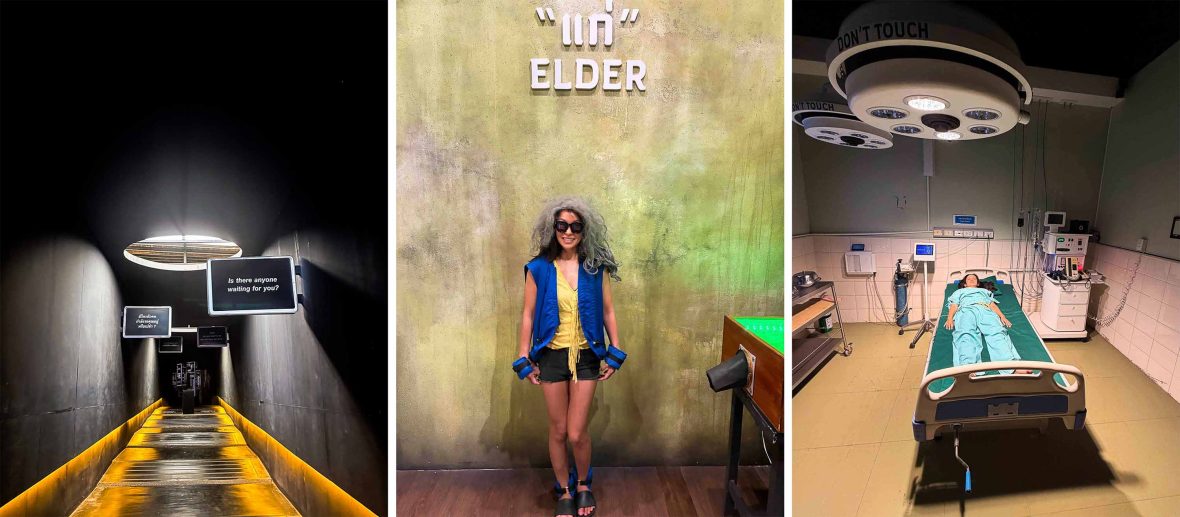
Rojanaprapa’s hypothesis was straightforward: if a population regularly confronts its own mortality, individuals may exhibit decreased levels of greed, anger, and corruption. The cafe operationalizes this philosophy through a series of interactive exhibits mapped across four stages of human existence: Birth, Elder, Pain, and Death.
Visitors are invited to walk through installations that simulate the physical vulnerabilities of aging—such as wearing weighted vests, clouded glasses, and restricted movement gear—as well as intensive care unit simulations complete with operational medical monitors and surgical gowns. The centerpiece of the experience is a wooden coffin situated in the final exhibit room. Visitors are encouraged to climb inside, close the lid, and spend a few minutes in complete darkness contemplating the finality of life and prioritizing what truly matters before their time runs out.
While local residential reactions to the initial delivery of caskets were predictably resistant, Rojanaprapa welcomed the community friction. In interviews, he emphasized that public complaints were indicative of a successful psychological intervention; if neighbors were objecting to caskets, it meant they were actively thinking about death. For international visitors like Arnold, stepping into the coffin offered a stark exercise in stripping away future-oriented anxieties, forcing an encounter with the present moment where grief for the future could no longer overshadow the reality of the now.

Historical Context and Public Health Interventions in Thailand
Bangkok’s institutional willingness to confront societal taboos extends beyond existential philosophy into public health initiatives that have shaped modern Thai culture. A notable parallel to the death awareness movement is the legacy of Mechai Viravaidya, affectionately known in Thailand as the "Condom King." Founder of the restaurant Cabbages & Condoms—where interior decor prominently features safe-sex messaging and contraceptive art—Viravaidya revolutionized public health education during the peak of the global HIV epidemic.
In the 1980s and 1990s, Viravaidya integrated discussions of safe sex into unprecedented spaces, distributing condoms to taxi drivers, traffic police, and even Buddhist monks. His campaigns successfully dismantled cultural reticence regarding sexual health, contributing to a reported 90 percent reduction in new HIV infections in Thailand and averting an estimated 7.7 million cases.
Both the Cabbages & Condoms initiative and the Kid Mai Death Awareness Cafe share a common cultural methodology: bringing uncomfortable, high-stakes realities out of the shadows and into daily public discourse. By normalizing conversations around contraception, aging, illness, and death, Thai social innovators have fostered an environment where collective vulnerability is treated not as a morbid weakness, but as a pragmatic step toward communal well-being.

Chronology of Grief: Navigating Distance and Denial
The emotional trajectory experienced by families dealing with terminal illness is frequently characterized by protective deception—a dynamic where aging parents attempt to shield their adult children from the full severity of their medical setbacks. This phenomenon was mirrored in Arnold’s relationship with her mother during her travels in Bangkok.
While touring historical landmarks such as the Grand Palace and Wat Pho—home to the 151-foot-long Reclining Buddha symbolizing entry into Nirvana—Arnold maintained digital contact with her mother in Melbourne. Despite undergoing taxing cancer treatments, her mother consistently minimized her physical suffering, offering reassurances via text message accompanied by lighthearted emojis.
It was only months later that the full extent of the medical emergency became apparent, revealing that severe complications and emergency hospitalizations had occurred concurrently with Arnold’s sightseeing. This dynamic reflects a lifelong maternal role: protecting offspring from existential terror, even when the parent is the one facing bodily failure. The realization highlighted a generational divide in processing grief. While younger generations often seek externalized therapeutic outlets, digital connectivity, and explicit verbal processing, older generations frequently rely on stoicism, physical labor (such as traditional food preparation and sun-curing ingredients), and quiet endurance.
Broader Implications and Psychological Insights
The integration of mortality-focused tourism and philosophical cafes points to a broader global shift in mental health care and wellness travel. As burnout and anxiety disorders rise in industrialized nations, traditional spa retreats focused solely on physical relaxation are increasingly being complemented—or replaced—by existential tourism.
Psychologists suggest that mortality salience, when encountered in a controlled and reflective environment, can lead to positive psychological restructuring. Known in terror management theory as the mortality salience effect, confronting the reality of death can diminish petty interpersonal conflicts, enhance appreciation for interpersonal connections, and encourage individuals to realign their daily priorities with their core values.
For Arnold, her time in Bangkok did not eradicate her generalized anxiety disorder, nor did it soften the impending reality of her mother’s terminal prognosis. Impermanence, she observed, does not require philosophical belief or religious certainty to be universally felt. However, the journey altered her communicative approach. By stepping away from the reflexive habit of avoiding difficult conversations, she found the courage to bridge the generational gap of silence, initiating a direct dialogue with her mother about the emotional weight of endurance and the reality of aging.
Ultimately, the experience in Bangkok underscores a universal truth regarding the human condition: while suffering and mortality cannot be engineered away through hyper-vigilance or anxiety, acknowledging them openly can transform fear into presence. By trading imagined future disasters for the immediate reality of the present moment, travelers navigating profound personal loss can discover that confronting the end of life is, paradoxically, one of the most effective ways to learn how to live.