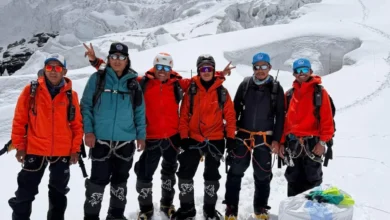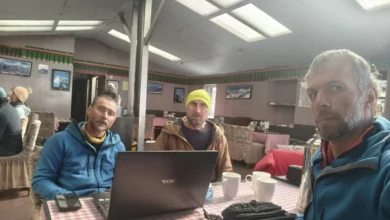
The Russian expedition currently operating on the slopes of Mount Everest has been forced to halt its progress once again, as relentless high-altitude winds continue to create a hostile environment for the three-man team. Andrei Vasiliev, Sergey Kondrashkin, and Vitaly Shipilov, who are attempting to navigate the challenging West Ridge, found themselves immobilized at 5,600 meters yesterday after failing to push higher due to the intensity of the jet stream. This latest setback represents the fourth attempt by the team to gain altitude, marking a critical juncture in their permit-limited winter window.
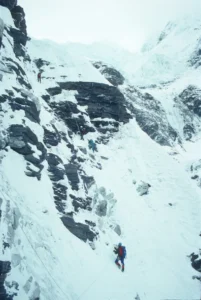
The team’s current position, situated midway up the vertical mixed terrain connecting the Khumbu Glacier to the Lho La Pass, was confirmed through InReach tracker data and verified by expert observers, including fellow winter Everest aspirant Jost Kobusch. The decision to remain hunkered down in their cached tent at 5,600 meters was a tactical necessity, as the wind speeds at higher elevations—and even at their current station—posed a significant risk to their safety and equipment integrity.
A Chronology of the Expedition
The current expedition, which arrived in the Khumbu region earlier this winter, has been characterized by a persistent struggle against the unpredictable and often violent weather patterns synonymous with Everest’s winter season. The climbers have maintained a methodical, albeit difficult, approach to their acclimatization.
- Phase One: The team established their base and initial support lines, aiming to secure routes toward the Lho La Pass.
- Phase Two: Multiple forays were launched to test the stability of the terrain and weather windows, with each attempt requiring a retreat to lower camps as weather systems moved through the region.
- Phase Three: A strategic cache was established at 5,600 meters, serving as the current staging ground for their high-altitude efforts.
- Current Status: The fourth attempt, intended to push the team toward the 7,500-meter threshold, remains stalled as the team waits for a marginal improvement in wind conditions.
Vasiliev, acting as the expedition leader, has noted that the team’s objective was to maintain their presence in lower, more sheltered areas while waiting for the summit-level winds to subside. However, the intensity of the current weather system has breached even these lower elevations, effectively pinning the climbers to the mountainside and forcing a pause in their planned acclimatization schedule.
The Challenges of Winter Everest
The Russian team’s endeavor highlights the extreme difficulties inherent in winter mountaineering on the world’s highest peak. Unlike the spring climbing season, when the jet stream typically moves north and offers a "window" of stable, if cold, weather, winter on Everest is dominated by the near-constant presence of the subtropical jet stream.
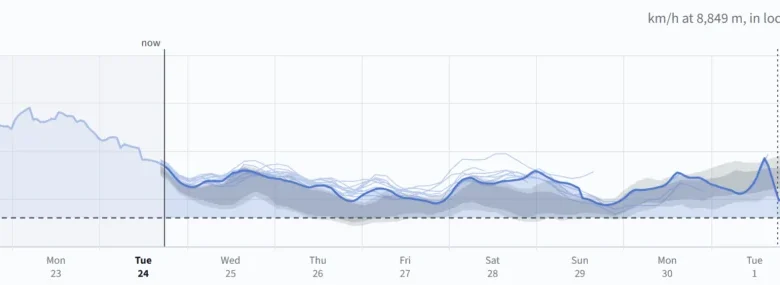
Data provided by the High Asia Avalanche Watch illustrates the severity of these conditions. According to a multi-model forecast analysis, wind speeds at the summit are not expected to drop below 45 kilometers per hour (kph) during the immediate window of Thursday and Friday. Furthermore, these velocities are projected to increase shortly thereafter, complicating any potential summit push. For the climbers, 45 kph is often the threshold of usability; while manageable in lower camps, such winds at high altitudes create severe wind chill, increase the risk of frostbite, and make the navigation of technical terrain nearly impossible.
The expedition operates under a permit valid until December 15. This looming deadline creates a "use it or lose it" dynamic. With this current outing described by the team as their final opportunity for meaningful acclimatization before a potential summit attempt, the pressure to move is immense. However, the climbers must balance this urgency against the physical reality of the mountain. Pushing into high-wind zones without adequate acclimatization or visibility would significantly heighten the risk of an accident or an emergency rescue scenario.

Expert Analysis and Context
The route chosen by the Russian team—the West Ridge—is one of the most technical and exposed paths on Everest. Unlike the standard South Col route, which sees significant traffic and established infrastructure, the West Ridge requires extensive technical climbing and carries a higher degree of objective danger, particularly from avalanches and wind exposure.
Jost Kobusch, who is currently conducting his own independent assessment of the West Ridge, has noted the difficulty of the terrain. The vertical mixed section leading to the Lho La Pass is notorious for shifting snow conditions and high winds that funnel through the gap, acting like a wind tunnel. Experts tracking the expedition note that the team’s location at 5,600 meters is currently the most viable point for them to remain, as ascending further would expose them to the full force of the gale-strength winds currently buffeting the upper mountain.
The implications for the expedition are significant. Should the weather fail to improve by the end of the week, the team will have lost their final window to reach the necessary physiological state for a high-altitude summit bid. In such a scenario, the team would be faced with the difficult decision of whether to attempt a push regardless of their current acclimatization levels—an action that significantly lowers the probability of success and increases the risk of mortality—or to accept that the mountain has remained unconquered for the season.
The Role of Meteorological Forecasting
The reliance on sophisticated weather modeling, such as the seven-model comparison provided by High Asia Avalanche Watch, has become a cornerstone of modern high-altitude mountaineering. In previous decades, climbers relied on localized barometric pressure readings and visual observation. Today, the ability to see a two-week outlook allows teams to optimize their limited time on the mountain.
However, as this expedition demonstrates, data does not equate to control. While the models provide a clear picture of the wind speeds at the summit, the localized micro-climates of the Khumbu and the Lho La Pass can differ significantly from the broader forecasts. The fact that the team is currently stuck at 5,600 meters—a height where they expected to find refuge—is a testament to the unpredictable nature of winter conditions on the world’s highest peak.
Future Outlook and Safety Protocols
As the team waits, their safety remains the primary concern for the local authorities and the global mountaineering community. The expedition is being monitored closely by supporters and mountaineering organizations who receive updates through the team’s InReach satellite communication system.
If the wind conditions do not moderate by the weekend, the team will likely be forced to descend to Base Camp to wait for the next break in the weather, effectively burning more of their remaining time. The physical toll of "waiting out" a storm at 5,600 meters is substantial; the body continues to consume energy even in a resting state, and the mental strain of being trapped in a small, wind-battered tent for days at a time can degrade a climber’s decision-making capabilities.
For now, Vasiliev and his team remain in a state of suspended animation, tethered to the side of the mountain by the unforgiving physics of the jet stream. The coming 48 hours will be decisive. If the wind speeds drop as predicted by the models on Thursday, the team may have a brief window to move upward, attempting to reach the 7,500-meter mark before the next surge in velocity. If not, the window for their winter ascent will close, leaving the mountain, as it so often does, as the final arbiter of human ambition.