The D.B. Cooper Tie Analysis Reveals New Clues More Than Five Decades After Infamous Hijacking

More than half a century after one of the most baffling aviation mysteries in American history captivated the public imagination, microscopic forensic analysis of a clip-on tie left behind by the hijacker known as D.B. Cooper continues to yield provocative clues—and scientific corrections. A comprehensive new study published in the Journal of Forensic Sciences details advanced scanning electron microscope scans of the neckwear recovered from Northwest Orient Flight 305, shedding light on the elusive suspect’s potential occupational environment while ultimately debunking some long-held theories regarding a direct link to aerospace giant Boeing.
The enduring saga began on the afternoon of November 24, 1971, the day before Thanksgiving. A well-dressed man purchasing a one-way ticket under the alias "Dan Cooper" boarded a Northwest Orient Airlines Boeing 727 flying from Portland, Oregon, to Seattle, Washington. Shortly after takeoff, Cooper handed a flight attendant a note claiming he possessed a bomb in his briefcase. He demanded four parachutes and $200,000 in negotiable American currency—equivalent to nearly $1.5 million today.
Upon landing in Seattle, Cooper traded the 35 remaining passengers and several flight crew members for the ransom money and the requested parachutes. He then ordered the flight crew to take off again, directing the aircraft toward Mexico City under specific, highly restrictive flight conditions: low altitude, reduced speed, and extended wing flaps. Sometime after 8:00 p.m., while flying over the rugged, heavily forested terrain of southwestern Washington state, Cooper executed a daring parachute jump into the dark night. He vanished without a trace, leaving behind an indelible legend, an unsolved mystery, and a scattering of physical artifacts that federal investigators would scrutinize for decades.
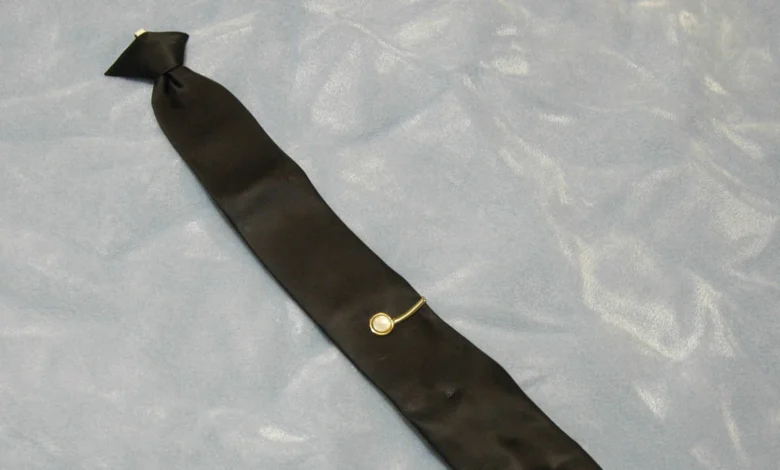
Among the most critical pieces of physical evidence recovered was a narrow, black Towncraft clip-on tie found resting on seat 18E when FBI agents searched the abandoned aircraft at Reno’s municipal airport in Nevada late that night. Investigators deduced that Cooper had removed the neckwear before making his fateful leap into the stormy night. For years, the tie remained stored in FBI field offices, serving as a silent witness to a crime that would eventually become the only unsolved air piracy case in the history of commercial aviation.
The investigative trajectory of the tie shifted dramatically in the late 2000s when the FBI, under the leadership of Seattle Special Agent Larry Carr, opened portions of the inactive case file to the public and enlisted the help of an independent, multidisciplinary volunteer group known as the Citizen Sleuths. Headed by paleontologist Tom Kaye, the team applied adhesive carbon tabs to the fabric to lift microscopic particles for examination under advanced scanning electron microscopes (SEMs).
Over more than a decade of successive analyses—culminating in a massive 2024 rescan funded partly through public interest and media projects—scientists cataloged roughly 180,000 individual particles trapped within the unwashed fabric of the tie. Because ties are rarely laundered, they act as environmental traps, collecting dust, spores, and industrial debris from every location visited by the wearer.
The chemical and biological signatures extracted from Cooper’s tie paint a complex picture of a man navigating specific industrial and everyday environments. Early manual analyses conducted by Kaye’s team revealed club moss spores (Lycopodium clavatum), traces of paper match-head residue consistent with the flight attendant’s accounts of Cooper chain-smoking throughout the flight, and microscopic shards of pure titanium.
The discovery of pure titanium initially electrified investigators and amateur sleuths alike. In 2011, Kaye publicly hypothesized that the titanium shards might link Cooper to the aerospace industry, specifically pointing to Boeing’s development of an all-titanium supersonic transport (SST) aircraft. When Congress abruptly canceled federal funding for the SST project in March 1971—resulting in massive layoffs across the local manufacturing sector—the timing aligned neatly with a disgruntled, displaced engineer or technical manager who might have worn a tie on the factory floor.
However, subsequent scientific rigor ultimately complicated the Boeing hypothesis. While the SST project utilized alloyed titanium, the microscopic shards discovered on the tie were unalloyed, pure titanium. Furthermore, advanced automated scans conducted in 2016 and 2024 failed to replicate or confirm any additional titanium metal particles on the fabric. A meticulous 2024 reanalysis published in May 2026 revealed that particles initially flagged as rare titanium-antimony alloys were instead separate grains of titanium and antimony sitting adjacent to one another, likely originating from common pigments such as titanium yellow rather than specialized aerospace manufacturing.
Despite the rolling back of the titanium-Boeing theory, the 2024 study uncovered other compelling microscopic traces. Among the 180,000 particles cataloged from a single stub taken from the tie’s knot were rare traces of gold and palladium, mercury-silver combinations, and a definitive particle of tungsten-cobalt—a precise match for cemented carbide cutting tools heavily utilized in metalworking machinery during the early 1970s. Additionally, the massive presence of industrial aluminosilicate mineral dust suggested exposure to specific manufacturing or industrial facilities, though researchers cautioned that modern background contamination and a lack of baseline control studies on contemporaneous ties make definitive occupational matching exceedingly difficult.
The release of these detailed findings arrives long after the federal government officially closed the book on active investigative efforts. On July 8, 2016, the Federal Bureau of Investigation formally suspended the D.B. Cooper investigation, announcing that resources and personnel would be redirected to higher-priority national security and criminal threats. The bureau noted that despite evaluating thousands of tips and potential suspects over 45 years, no piece of evidence had ever produced a definitive, verifiable identification of the hijacker. The remaining physical evidence, including the famous tie, was transferred to FBI headquarters in Washington, D.C., to be preserved strictly as historical material.
While federal agents have stepped back from active pursuit, the scientific community and civilian researchers continue to push the boundaries of forensic archaeology. The data sets from the 2024 tie rescan have been made publicly accessible through the Journal of Forensic Sciences, inviting independent scientists and data analysts to scrutinize the microscopic remnants of a decades-old crime.
Whether these technological advancements will ever definitively unmask the man who stepped into the abyss as "Dan Cooper" remains uncertain. Yet, the persistent examination of a humble, inexpensive department-store tie demonstrates how modern forensic science can extract profound historical insights from the smallest fragments of physical evidence, keeping one of America’s greatest mysteries alive in the digital age.