In a landmark achievement for high-altitude snow sports, an American team consisting of snowboarder Nick Russell and skiers Adam Fabrikant and Billy Haas has successfully completed the first-ever snowboard and ski descent of the formidable south face of Dorje Lhakpa. Standing at 6,966 meters (22,854 feet), the peak—often referred to as the "Langtang Pyramid"—is a prominent feature of the Nepal Himalaya, visible from the Kathmandu Valley on clear days. This descent represents a significant milestone in the evolution of big-mountain alpine-style riding, bridging the gap between technical mountaineering and extreme skiing.
Expedition Chronology and Execution
The expedition commenced on October 6, 2026, when the team established base camp. The arrival was preceded by an intense cyclonic storm system that had swept across Nepal, depositing significant quantities of snow across the higher elevations. While such weather events often present life-threatening challenges to Himalayan expeditions, the team viewed the precipitation as a logistical boon. The added snow cover provided the necessary surface continuity required for a continuous ski and snowboard line, effectively eliminating the need for rappels or down-climbing, which would have been unavoidable on the typically exposed, rocky faces of the peak.
The path to the summit was not without early setbacks. The team faced health challenges upon arrival, with three of the five expedition members, including Russell, contracting COVID-19. This forced a period of mandatory acclimatization and recovery, pushing the schedule back. However, the delay ultimately proved advantageous, as it allowed the weather to stabilize, providing a window of clear, calm, and predictable conditions for the final push.
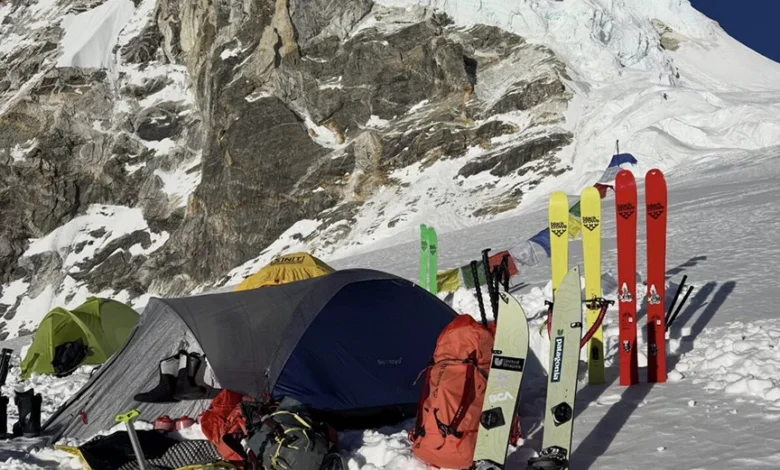
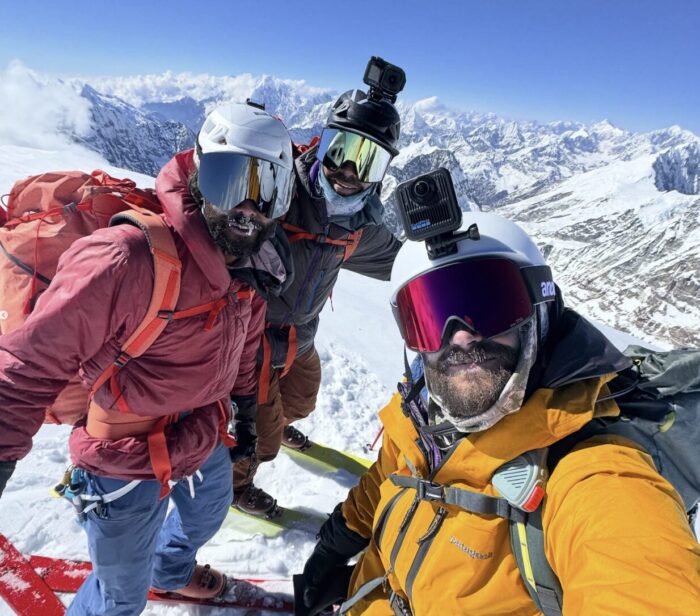
On October 20, the team reached the summit after a rigorous two-day climb. They utilized an alpine-style approach, carrying their own equipment and breaking their own trail. They were supported by a professional camera crew, including photographer Blake Gordon and cinematographer Leo Hoorn, who operated from a high-altitude camp at 6,000 meters to document the ascent and descent. The logistical support was bolstered by a team of experienced Sherpa climbers—Dawa Geljee Sherpa, Kami Sherpa, and Nuri Sherpa—who assisted in establishing the high camp and managing the safety of the media personnel.
Technical Challenges and Environmental Hazards
The ascent was not merely a physical test of endurance but a complex exercise in risk management. The crux of the route was identified as an icefall section situated between 4,500 and 4,900 meters. This area was subject to significant overhead serac hazards, requiring the climbers to move swiftly through the zone; the team estimated their exposure time to these unstable ice structures was less than an hour.
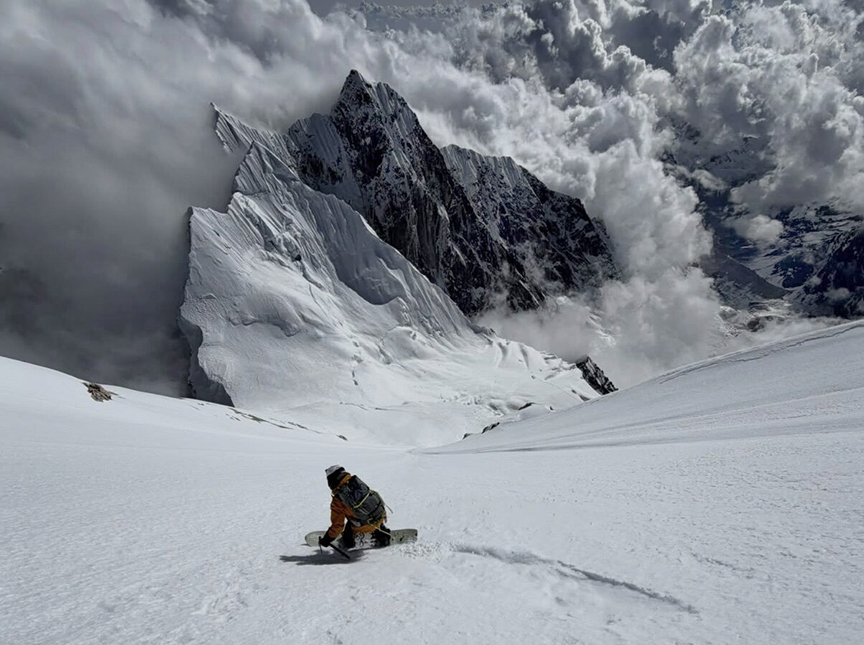
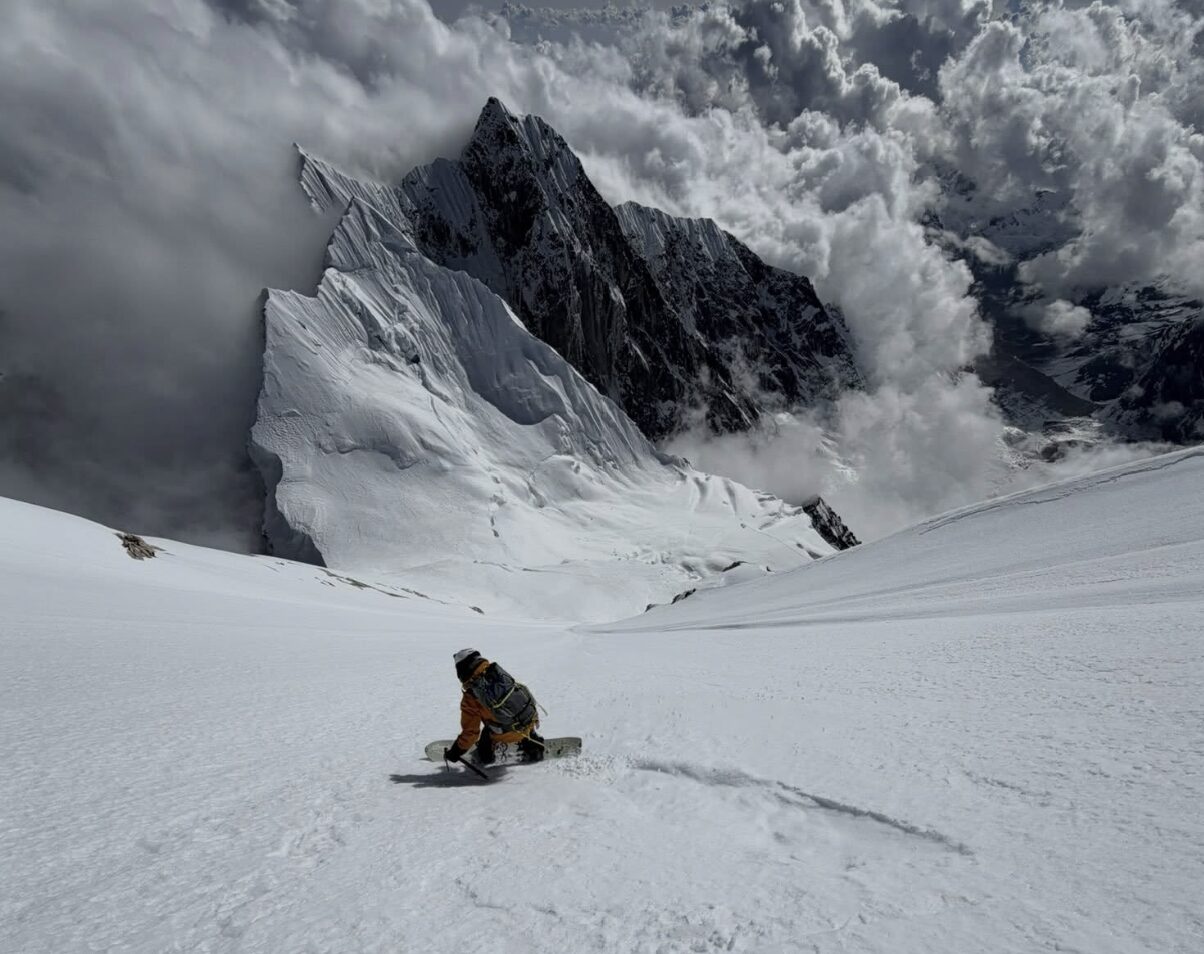
Beyond the icefall, the south face presented a formidable gradient. Russell described the terrain as sustained 45 to 50-degree slopes, with sections reaching upwards of 55 degrees. Because the face had been exposed to intense solar radiation for two weeks prior to their arrival, the snow conditions were a major point of uncertainty. Upon reaching the face, the team encountered firm, high-density snow that was barely "edge-able," necessitating the use of ice tools and crampons for the entire 7.5-hour ascent.
The descent, which took approximately 90 minutes with intermittent pauses for camera adjustments, was characterized by extreme technical demands. Russell noted that the descent was a "no-fall zone." Given the firm nature of the snow, any loss of an edge or a miscalculation in balance would have resulted in an uncontrollable slide down the steep, high-altitude face. The successful completion of this descent without the aid of safety ropes or anchors underscores the high level of technical proficiency possessed by the trio.
Background and Historical Context
Dorje Lhakpa has long been a target for elite alpinists, though it remains relatively elusive for those attempting to ski or ride its slopes. The mountain was first climbed via the south face in 2021 by a Spanish expedition featuring Mikel Inoriza, Iker Madoz, and Mikel Zabalza. The difficulty of the route, combined with the extreme altitude and the inherent risks of Himalayan weather, has kept the number of successful attempts low.
The mountain holds a specific place in the history of extreme snowboarding. In 1999, the legendary snowboarder Marco Siffredi, accompanied by Bertrand Delapierre, completed a descent of the west ridge. Siffredi’s pioneering spirit served as a primary inspiration for Russell’s own ambitions. The connection to Siffredi adds a layer of historical continuity to the 2026 expedition, as Russell sought to honor the traditions of the early pioneers while pushing the boundaries of what is possible on the mountain’s more challenging aspects.
Profiles of the Expedition Team
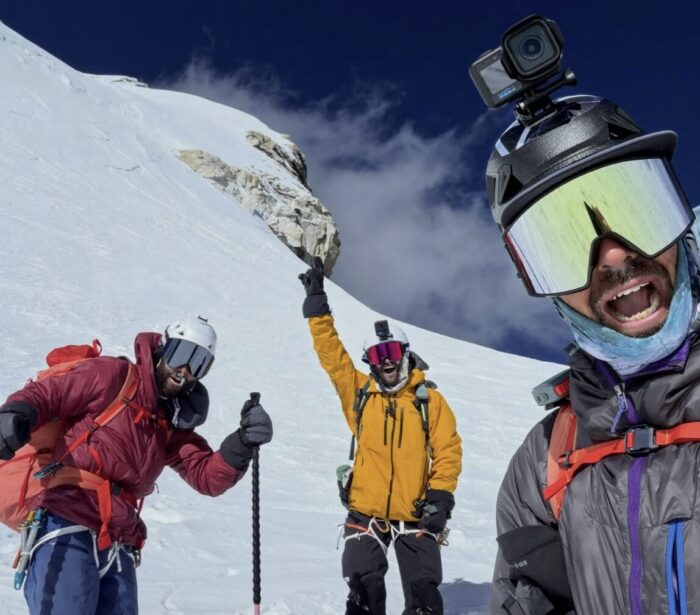
The success of the expedition was largely attributed to the synergy between the team members. Adam Fabrikant and Billy Haas, both childhood friends, have established themselves as fixtures in the high-altitude skiing community. Their collective experience includes significant achievements in the Alaska Range and the Himalaya, most notably the 2024 oxygen-free ascent and ski descent of both Gasherbrum I and II.
Nick Russell, who has previously engaged in expeditions in the Indian Himalaya and Nepal, considers this mission a turning point in his career. Reflecting on his past attempt on Dhaulagiri in 2022—which was marked by poor conditions and the tragic death of mountaineer Hilaree Nelson—Russell approached the Dorje Lhakpa project with a heightened sense of caution and calculated risk. The success in Langtang is seen by the team as a validation of their methodology and a testament to the viability of lightweight, fast-moving alpine-style expeditions in the 6,000-to-7,000-meter range.
Implications for High-Altitude Mountaineering
The accomplishment of the U.S. trio highlights a shifting focus in the mountaineering community. While the global attention remains heavily fixed on the 8,000-meter peaks—the so-called "death zone" giants—there is a growing movement toward the exploration of unclimbed and unskied routes on 6,000-to-7,000-meter peaks. These mountains, while technically lower than the world’s highest, often present unique challenges regarding ice, rock, and weather, and are frequently overlooked by traditional commercial expeditions.
Industry analysts suggest that the success of the Dorje Lhakpa mission will likely encourage further technical ski and snowboard expeditions to the Langtang region. By demonstrating that such feats can be accomplished with small, self-sufficient teams, the group has set a new standard for modern alpine-style exploration. Furthermore, the high-quality visual documentation produced by the media team provides critical data on snow conditions and route viability, which will be invaluable for future mountaineers planning to tackle this or similar objectives.
Ultimately, the expedition was defined by the balance between preparation and the ability to adapt to the unpredictable nature of the high mountains. As Russell noted in his debriefing, the goal was not to force a descent against the mountain’s will, but to interpret the conditions and operate within the safety margins defined by the environment. By successfully navigating the firm, steep, and exposed conditions of the south face, Russell, Fabrikant, and Haas have cemented their place in the history of Himalayan exploration, proving that the frontier of big-mountain riding remains wide open for those willing to commit the necessary work and expertise.