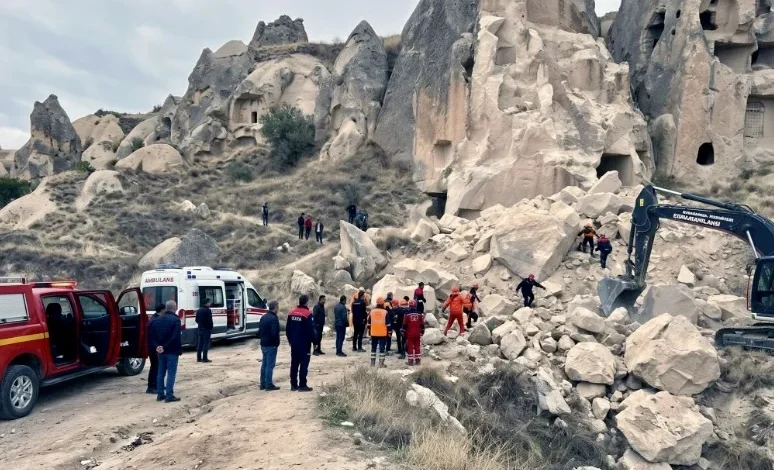
A catastrophic structural failure at one of Turkey’s most revered UNESCO World Heritage sites has left three people dead and five others injured, prompting a national conversation regarding the intersection of tourism, climate change, and the preservation of fragile geological wonders. On October 29, 2026, during the celebration of Turkey’s Republic Day, a massive rock formation known as a "fairy chimney" partially collapsed near the entrance of a high-traffic parking area in Göreme, Cappadocia. The incident, which occurred at approximately 3:15 p.m. local time, turned a day of national celebration into a site of a complex search-and-rescue operation that lasted well into the night.
The collapsed formation, a signature of the Central Anatolian landscape, was composed of soft volcanic tuff capped by more resistant basalt. According to initial reports from the Nevşehir Governor’s Office, the sudden detachment of the rock face was precipitated by heavy rainfall that had battered the region in the days preceding the event. The moisture saturated the porous volcanic rock, exacerbating natural erosion patterns and triggering a landslide that caught visitors by surprise.
A Chronology of the Disaster
The timeline of the tragedy began in the early afternoon of October 29. As Turkey observed its Republic Day, the Göreme region saw a significant influx of domestic tourists, many of whom were visiting the historic area to participate in holiday festivities and enjoy the iconic scenery.
At approximately 3:15 p.m., witnesses reported hearing a thunderous, grinding noise that echoed through the valley. This was followed by the rapid disintegration of the spire, which sent a plume of dust and pulverized rock over the parking lot. Emergency services, including the Disaster and Emergency Management Authority (AFAD), local gendarmerie, and medical response units, were dispatched to the scene within minutes.
Initial reports from the site suggested that several individuals had been pinned beneath the debris. By the evening, search crews had recovered two bodies. However, the operation continued under floodlights through the night as engineers assessed the stability of the remaining structures to ensure the safety of rescuers. By the early hours of October 30, a third body was recovered from the rubble. The victims have been identified as two Turkish nationals and one foreign tourist. Of the five injured, several were treated at nearby hospitals and subsequently discharged, while others remained under medical observation for trauma and fractures.
Geological Context and Vulnerability
The fairy chimneys of Cappadocia are not merely tourist attractions; they are the result of millions of years of complex geological processes. The region’s unique topography—characterized by valleys, canyons, and "hoodoos" or fairy chimneys—was formed by the erosion of thick layers of volcanic ash, or tuff, deposited by ancient eruptions. These deposits were subsequently covered by layers of basalt and andesite, which are harder and more resistant to weathering.
While these formations have defined the landscape for millennia, they are inherently fragile. The porous nature of the volcanic tuff makes it highly susceptible to "piping" and mechanical weathering. When rainfall is significant, water penetrates the fissures in the rock, leading to increased internal pressure and the eventual weakening of the structural foundation.
Geologists have long noted that the climate in Central Anatolia is shifting. Increased frequency of extreme weather events, including heavy, localized rainfall, has accelerated the weathering of these structures. While the government has implemented various monitoring programs, the sheer scale of the landscape—which spans thousands of square kilometers—makes it impossible to reinforce every formation. The collapse serves as a stark reminder that these natural monuments are in a constant state of flux, governed by forces that are increasingly unpredictable.
Official Responses and Regulatory Investigation
In the aftermath of the collapse, the Turkish government moved quickly to secure the site and initiate a formal inquiry. Justice Minister Akin Gürlek announced that the Chief Prosecutor’s Office in Nevşehir has launched a comprehensive investigation into the incident. The inquiry will focus on whether there were missed warning signs regarding the structural integrity of the specific formation and if existing safety protocols at the parking area were sufficient.
"We are conducting a thorough assessment with the help of geological experts to determine if this was an unavoidable natural event or if preventative measures could have been implemented," a spokesperson for the Ministry of Culture and Tourism noted. The site remains cordoned off as geotechnical teams utilize drone surveys and ground-penetrating radar to inspect the surrounding spires for further signs of instability.
The local tourism industry has expressed profound sorrow, acknowledging that the incident is a heavy blow to the region’s reputation. However, tourism operators are also emphasizing the need for continued public education. "Visitors must understand that this is a living, changing landscape," said an official from a local tourism board. "The beauty of Cappadocia is its rawness, but that same rawness comes with inherent, sometimes invisible, risks."
Broader Implications for Heritage Tourism
The collapse in Göreme raises critical questions about the management of UNESCO-listed sites that are both natural landscapes and hubs for mass tourism. With millions of visitors flocking to Cappadocia annually for hot-air ballooning, hiking, and historical exploration, the pressure on the environment is immense.
Previous incidents, including smaller rockfalls in 2024 and 2025, had already prompted the Ministry to initiate restoration and erosion-control projects. These efforts included the application of protective resins on certain formations and the installation of sensors to monitor rock movement. However, the October 2026 tragedy underscores the limitations of human intervention against the sheer scale of geological erosion.
From a policy perspective, the implications are two-fold. First, there is a renewed mandate for stricter zoning laws. Authorities are now evaluating whether parking lots and tourist congregation areas should be moved further away from high-risk, "unstable" zones. Second, the incident highlights the urgent need for a more robust climate-adaptation strategy for cultural heritage sites. As global weather patterns become more volatile, the management of such sites must shift from reactive crisis response to proactive, long-term climate monitoring.
The Human Cost and Moving Forward
The loss of life in Göreme is a grim chapter in the history of a region that has served as a sanctuary for human civilization since the Hittite period. As families mourn the victims, the local community in Nevşehir is grappling with the reality that their iconic landscape is not static.
For the millions who visit Cappadocia, the fairy chimneys represent a timeless connection to the past. However, the events of October 29 serve as a somber lesson in the volatility of nature. The investigation, which is expected to yield preliminary results in the coming weeks, will likely trigger a overhaul of how tourist sites are managed in Turkey. For now, the focus remains on the grieving families and the arduous task of stabilizing a landscape that continues to shift, erode, and evolve under the pressure of time and the elements.
As the site slowly reopens to the public under heightened security and surveillance, the legacy of this tragedy will likely be a more cautious approach to heritage management. The balance between allowing public access to these wonders and ensuring the safety of those who come to admire them has become the central challenge for the Ministry of Culture and Tourism. In the heart of Anatolia, the fairy chimneys stand as silent witnesses to history—both the history written by human hands in the caves and the deeper, more dangerous history of the earth itself.