Tracking the Ancient Steppe: Conservationists Battle Modern Infrastructure to Save Kazakhstan’s Iconic Saiga Antelope

The vast, frozen steppes of western Kazakhstan present an unforgiving landscape where the elements dictate survival and history is written in the tracks of ancient migrations. Across this desolate expanse, a team from the Association for the Conservation of Biodiversity of Kazakhstan (ACBK) navigates treacherous, mud-choked trails to monitor one of the planet’s most resilient and unusual ungulates: the saiga antelope. With their distinctive, trunk-like noses and an evolutionary lineage that dates back to the Pleistocene epoch, saigas have outlived woolly mammoths and saber-toothed cats. Today, however, these prehistoric nomads face a modern crisis. Rapid industrialization, expanding rail lines, and new border fences threaten to fragment their ancestral migratory routes, putting conservationists and government agencies in a race against time to preserve a vanishing way of life across the Eurasian continent.
Main Facts and the Current Landscape
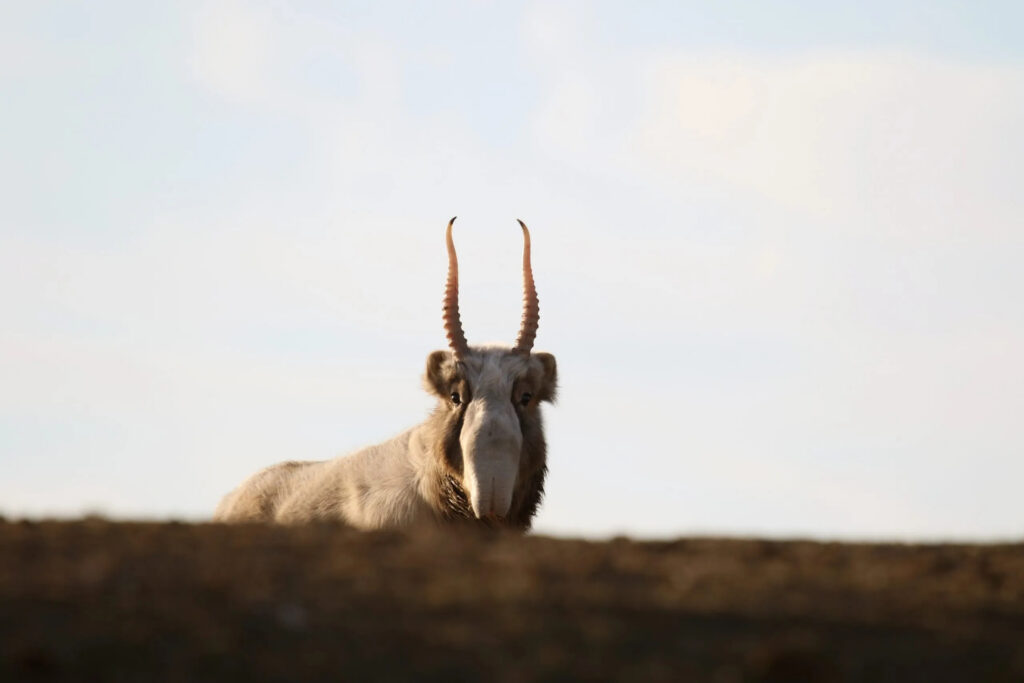
The saiga antelope (Saiga tatarica) is globally recognized for its iconic, floppy snout—a specialized adaptation designed to filter out harsh dust during arid summers and warm freezing winter air before it reaches the animal’s lungs. Historically, millions of these nomadic creatures roamed freely from the Caucasus Mountains to Mongolia. Unlike many species that adapted to sedentary habitats, the saiga relies entirely on perpetual motion, traversing hundreds of miles in massive herds to find seasonal grazing grounds and water sources.
The recent field audit conducted by ACBK researchers Alexandr and Albert highlights the critical nature of the annual rutting season. During this period, male saigas engage in intense physical displays of dominance, relying on their distinctively large noses to signal virility to prospective mates. The sheer physical toll of these rituals often leaves males exhausted, underlining the delicate biological balance required for population sustainability.
However, the natural behavior of these animals is increasingly compromised by human intervention. The landscape they have navigated for millennia is now crisscrossed by roads, railways, and international boundaries that disrupt their traditional corridors.
Chronology of Human and Animal Migration
The history of movement across the Eurasian steppe is deeply rooted in antiquity.
- Prehistoric Era: Saigas share the landscape with Pleistocene megafauna, serving as silent guides for early human hunter-gatherers navigating the treacherous terrain. Cave paintings dating back to 700 BCE depict the antelope with remarkable reverence.
- Early Iron Age and Silk Road Peak: Human nomadic traditions flourish, giving rise to seasonal migrations that ultimately shape the pathways of the historic Silk Road. Western Kazakhstan, bordered by the Ural River, becomes a vital transcontinental crossroads where Asia meets Europe.
- 20th Century (Soviet Era): Mandatory sedentarization policies implemented by the Soviet Union force nomadic human populations to abandon their perpetual motion in favor of state-run agriculture. While human mobility is systematically suppressed, saiga populations fluctuate wildly under varying management regimes.
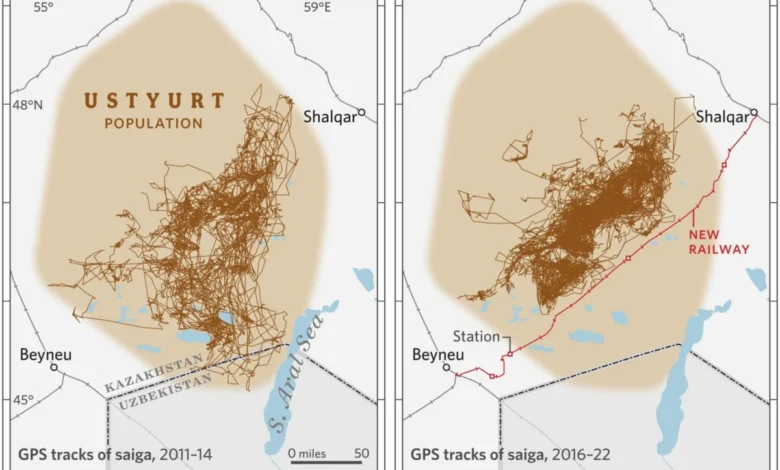
- 2014: The construction of a major new railway line in Central Asia cuts directly across traditional southern migration routes, abruptly halting the movement of GPS-collared saiga herds and trapping populations on the northern side of the tracks.
- Recent Years: Conservation groups establish new protected wildlife sanctuaries informed by telemetry data, while international partnerships emerge to retrofit infrastructure and restore ecological connectivity.
Supporting Data and Ecological Implications
The impact of linear infrastructure on migratory wildlife is a well-documented phenomenon in conservation science. According to tracking data utilized by ACBK, barriers such as unmitigated railway lines and barbed-wire border fences do more than just block physical passage—they induce a profound cognitive loss.
When animals are repeatedly prevented from reaching traditional seasonal ranges, spatial knowledge is broken. Wildlife biologists compare this erasure of navigational memory to the loss of a spoken language. Younger generations of saigas fail to learn the optimal pathways for food and shelter, leading to diminished population resilience.
Furthermore, data from cross-border studies indicate that artificial obstacles severely limit genetic exchange between sub-populations. When herds are penned into restricted zones, they become acutely vulnerable to localized extreme weather events, disease outbreaks, and overgrazing. The 2014 railway barrier in Uzbekistan serves as a prime case study, where historical tracking lines show vibrant seasonal migration suddenly devolving into erratic, despondent circling north of the newly laid steel.
Official Responses and Mitigation Strategies
Recognizing the existential threat posed by poorly planned development, conservation organizations and government bodies in Central Asia have initiated targeted remedial measures. ACBK has collaborated closely with the Kazakh government to design and implement dozens of specialized, saiga-friendly crossing points along railway corridors. These structures feature gently sloping dirt ramps that match the elevation of the tracks, creating the optical illusion of a natural gap. Strategically placed cattle-guard fences ensure that trains and animals remain safely separated, mitigating the risk of fatal collisions while preserving migratory flow.
International cooperation has also yielded tangible results at state boundaries. ACBK successfully partnered with Uzbek authorities to modify traditional border security infrastructure. By replacing standard barbed-wire barriers with innovative, X-shaped barricades, officials have effectively blocked unauthorized vehicular traffic while leaving precisely enough clearance for saigas to slip through safely.
Conservationists remain cautiously optimistic that these engineering solutions will gradually restore the trust of the herds, encouraging them to reoccupy historical plateaus.
Broader Impact and Future Outlook
The plight of the saiga antelope mirrors a broader philosophical and ecological dilemma regarding human progress and the natural world. As Homo sapiens transitioned from mobile foragers to stationary agriculturalists and urban dwellers, humanity largely divorced itself from the migratory rhythms that defined the vast majority of our species’ existence.
Today, the saiga stands as a living reminder of that ancient, mobile heritage. The ongoing efforts to safeguard their journeys through engineering, policy reform, and advanced GPS monitoring represent a critical test for modern conservation. If infrastructure can be successfully retrofitted to accommodate the needs of nonhuman travelers, it may pave the way for a more harmonious coexistence across the steppes of Central Asia.
For now, the field teams in Kazakhstan continue their audits against the backdrop of howling winds and sudden snowstorms, working to ensure that the ancient thunder of saiga hooves continues to echo across the horizon for generations to come.