Tracking the Ghost of the Steppe: Conservationists Battle Modern Fragmentation to Save the Ancient Saiga Antelope

The rugged expanses of the Central Asian steppe offer few concessions to modern travelers, as demonstrated during a recent field audit in western Kazakhstan alongside researchers from the Association for the Conservation of Biodiversity of Kazakhstan (ACBK). Navigating a landscape defined by unpaved tracks and unpredictable weather, conservationists monitor the saiga antelope (Saiga tatarica), an iconic ice-age survivor that has traversed the Eurasian plains for hundreds of thousands of years. As infrastructure expansion accelerates across the region, these prehistoric nomads face unprecedented disruptions to their ancient migratory routes. This report examines the ecological history of the saiga, the threats posed by modern industrialization, and the collaborative international efforts underway to restore connectivity across the steppe.
Main Facts and Ecological Profile
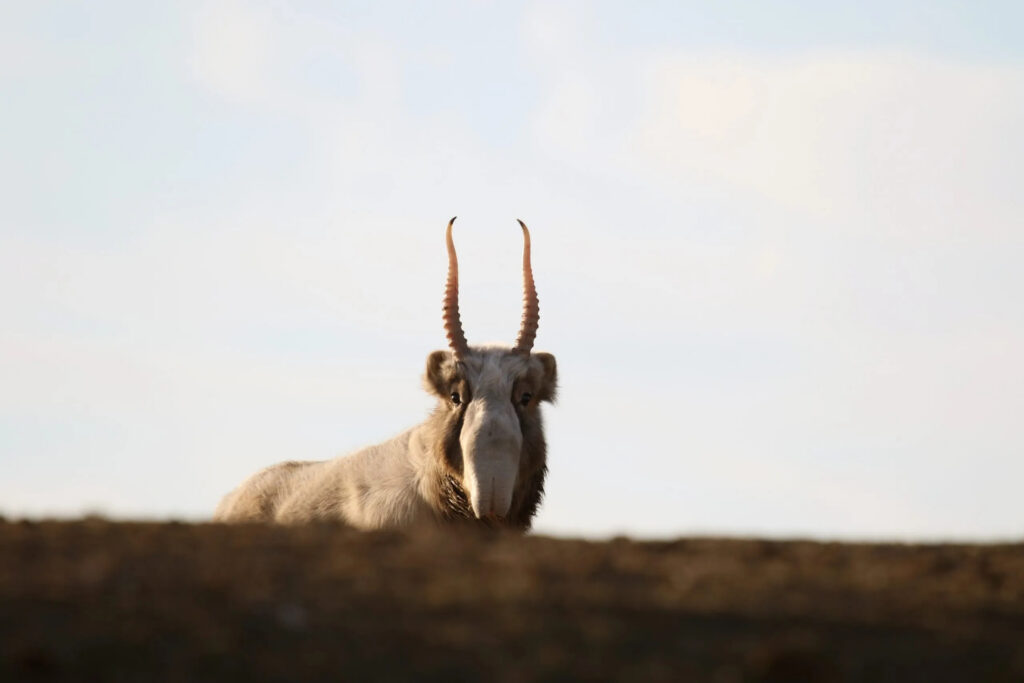
The saiga antelope is instantly recognizable by its signature fleshy, elongated snout, an anatomical adaptation vital for survival in extreme continental climates. This specialized nose filters abrasive dust during the arid summer months and warms sub-zero air before it reaches the animal’s lungs during harsh winters. Historically sharing an ecosystem with woolly mammoths, saber-toothed cats, and giant deer, the saiga is the sole survivor of a Pleistocene megafauna assemblage that once dominated the northern hemisphere.
Despite outliving many of their prehistoric contemporaries, saigas are exceptionally vulnerable to anthropogenic barriers. Driven by evolutionary imperatives, they undertake seasonal migrations across hundreds of miles of treeless terrain. These movements culminate annually in the rutting season, a critical life-cycle phase characterized by large-scale gatherings, intense male competition, and mating rituals. During this period, males engage in aggressive headbutting displays to assert dominance, often exhausting themselves to the point of collapse, while females select mates based on physical vigor and snout prominence.
Chronology of Human and Animal Migration on the Steppe
The history of the Eurasian steppe is inextricably linked to the concept of movement. Archaeological and historical records establish a deep chronology of nomadism in the region:
- Prehistoric Era: Saigas serve as navigational guides for early human hunter-gatherers navigating the featureless grasslands, a dynamic documented in cave paintings dating back to the seventh century BCE.
- Early Iron Age to Medieval Period: Traditional human nomadic practices take root, eventually giving way to the complex network of transit corridors and trade nodes known as the Silk Road. The fertile banks of the Ural River emerge as a major transcontinental crossroads dividing Europe and Asia.
- 20th Century (Soviet Era): Mandatory sedentarization policies enforced by the Soviet Union bring an end to centuries of traditional human nomadism, forcing mobile populations into agricultural settlements and fundamentally altering land-use patterns across the steppe.
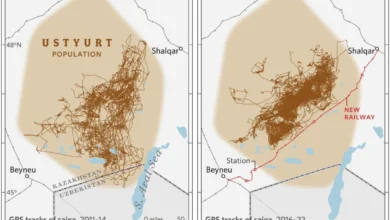
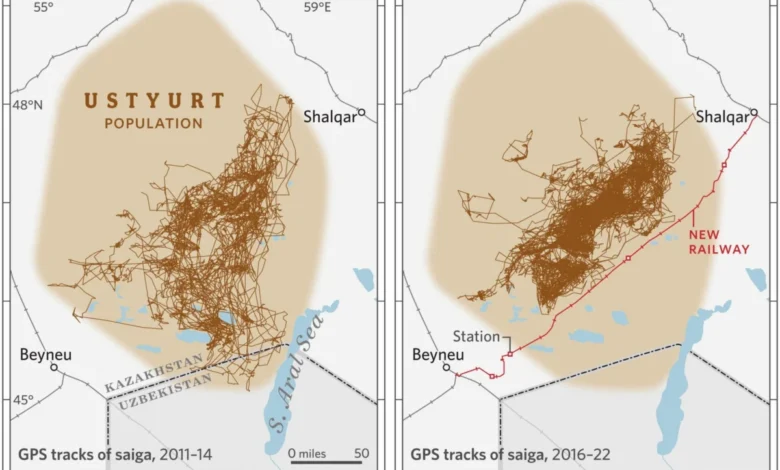
- Post-Soviet Era to 2014: Rapid industrialization, road building, and rail expansion increase. Notably, a new railway constructed in 2014 severs historic migratory paths extending into Uzbekistan, trapping saiga populations north of the tracks and cutting them off from vital seasonal resources.
- Recent Years: ACBK and government partners establish new wildlife sanctuaries informed by GPS tracking data and begin implementing infrastructure modifications, such as saiga-friendly rail crossings and modified border fencing.
Supporting Data and Technological Interventions
Modern conservation strategies rely heavily on telemetry to understand and mitigate habitat fragmentation. Wildlife biologists utilize GPS collars that transmit daily positional data, bypassing the historical difficulties of locating fast-moving herds across boundless terrain. Data gathered by ACBK researchers revealed that linear infrastructure—particularly fenced international borders and elevated railway lines—acts as an absolute barrier to migration.
For instance, telemetry data collected prior to 2014 showed dense clusters of saigas moving freely across the Kazakhstan-Uzbekistan border. Following the completion of a railway barrier in 2014, post-construction data illustrated a dramatic behavioral shift: collared animals repeatedly turned back upon encountering the tracks, abandoning southern feeding grounds and traditional wintering areas. Wildlife experts note that such disruptions cause a catastrophic loss of spatial memory, comparable to the erasure of a language, as younger generations are prevented from learning traditional migration routes from older herd members.
Official Responses and Conservation Initiatives
To counteract these systemic threats, conservation organizations have partnered with regional governments to implement targeted mitigation measures. ACBK, working in coordination with the government of Kazakhstan, has spearheaded the design and construction of specialized crossing points along railway corridors. These interventions feature gently sloping dirt ramps that mirror the elevation of the tracks, creating the illusion of a continuous landscape. Strategic cattle guards placed at a distance prevent direct collisions between trains and wildlife, preserving the illusion of safety.
Similarly, international cooperation has yielded structural modifications at international borders. In collaboration with Uzbek authorities, conservationists redesigned traditional barbed-wire barriers into X-shaped barricades. These structures successfully restrict vehicular traffic while maintaining sufficient ground clearance for saigas to traverse international boundaries freely.
Broader Impact and Implications
The plight of the saiga antelope highlights a fundamental tension between modern infrastructure development and ecological connectivity. As linear developments continue to fragment the Eurasian interior, the loss of migratory corridors threatens not only individual species but the ecological integrity of the steppe as a whole.
Environmental analysts emphasize that preserving nomadic wildlife requires a paradigm shift in regional infrastructure planning. By integrating wildlife-friendly engineering into new transportation projects—such as overpasses, underpasses, and permeable fencing—governments can balance economic development with biodiversity conservation. Ultimately, the survival of the saiga depends on society’s willingness to preserve the vast, uninterrupted spaces that define the Central Asian steppe, ensuring that the ancient rhythms of the natural world are not permanently silenced by the march of progress.