Field Testing the REEL Paper 8: Can You Really Print Large-Format Photographs Anywhere?

The boundaries of traditional darkroom photography have long been dictated by physical infrastructure: running water, permanent dark spaces, flat staging areas, and bulky chemical trays. For decades, practitioners of silver-gelatin and alternative analog printing processes have accepted these spatial requirements as immutable laws of the craft. However, recent hardware innovations are challenging this paradigm. Among the most notable entries into this niche sector is the REEL Paper 8, developed by Vintage Visual. Designed to facilitate large-format photographic printing without the need for traditional trays, this accessory promises to bring darkroom capabilities to unconventional and remote environments.
To evaluate these claims under rigorous conditions, a comprehensive field test was conducted in the remote terrain of the Nantahala National Forest in North Carolina. The assessment sought to determine whether the device could successfully bridge the gap between studio-grade print production and extreme portability, offering a potential lifeline for nomadic photographers, spatial-limited artists, and off-grid darkroom practitioners.
Main Facts and Hardware Overview
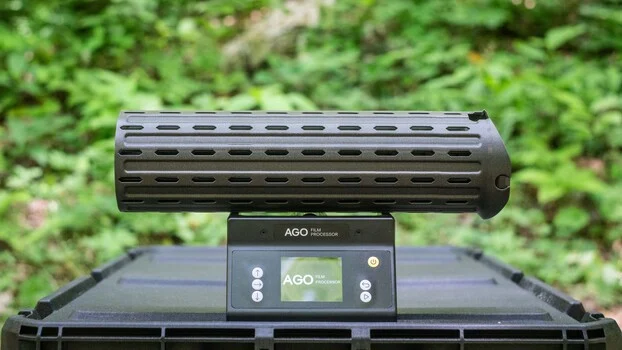
At its core, the REEL Paper 8 is an ABS plastic cylindrical spooling device engineered to fit seamlessly into standard large-format development tanks, specifically the Paterson Multi-Reel 8 Super Tank. Measuring approximately 12.75 inches (32.4 cm) in length and 3.5 inches (8.9 cm) in diameter, the unit is exceptionally lightweight while maintaining a rigid structural integrity. It is designed to accommodate photographic paper up to 12×16 inches in size, effectively translating to standard large-format dimensions such as 8×10 or 11×14 inches.
The manufacturing quality of the REEL Paper 8 demonstrates precision engineering. Molded without noticeable imperfections, the interior tracks and slots guide photographic media—such as Ilford Fiber-Base Gloss paper—through the processing cycle without snagging, folding, or incurring surface gouges. Mechanically, the unit is optimized for integration with motorized processing hardware, most notably the AGO Film Processor. When paired with automated agitation systems, the REEL Paper 8 utilizes pre-programmed rotation intervals, automated timing sequences, and temperature management systems to ensure chemical distribution uniformity across the surface of the paper.
The field test conducted in the Nantahala National Forest encompassed a complete, end-to-end analog workflow. This involved capturing exposures on 4×5 large-format film, developing the exposed negatives in the field, and subsequently printing those negatives using the REEL Paper 8 apparatus housed within a portable darkroom setup.
Chronology and Background Context of Mobile Darkroom Evolution
The pursuit of mobile darkroom photography is not a modern phenomenon, though contemporary digital-to-analog hybrids and lightweight field kits have transformed its feasibility. Historically, landscape photographers from the early era of plate photography carried heavy tents and portable chemical stations to process glass negatives on location. In the late 20th and early 21st centuries, this tradition evolved as practitioners adapted ice fishing huts, modified recreational vehicles, and van conversions into mobile laboratories capable of handling silver-gelatin, cyanotype, and salt-print workflows.
The timeline of the tester’s specific mobile enterprise began in the autumn of 2022, following a lifestyle transition that involved selling a permanent residence and converting a vehicle into a full-time mobile camper. For nearly two years, the operation traversed the continental United States, operating out of temporary, highly improvised darkrooms. These environments ranged from coastal setups near the Gulf of Maine—where silver-gelatin prints were pulled in maritime humidity—to arid landscapes in New Mexico, where cyanotypes were washed using melted snow.
Operating in such diverse climates exposed the severe logistical hurdles of traditional tray processing. High humidity in regions like western Tennessee frequently caused condensation on makeshift darkroom walls, while the physical volume required to transport multiple plastic developing trays, stop baths, fixers, and wash systems placed a heavy burden on vehicle payload capacity. The introduction of the REEL Paper 8 represents a direct technological response to these logistical bottlenecks, aiming to eliminate open trays entirely by moving the development process into a closed tank ecosystem.
Supporting Data and Operational Performance
During the North Carolina field trial, six sheets of 8×10 silver-gelatin Ilford Fiber-Base Gloss paper were processed successfully using the REEL Paper 8. The quantitative and qualitative metrics recorded during this test highlight both the efficiencies and the operational limitations of the hardware.
Space and Equipment Reduction:
In a standard remote printing scenario, a photographer must transport a minimum of three, and ideally five, individual developing trays to accommodate developer, stop bath, fixer, and wash stages. The REEL Paper 8 reduces this requirement to a single Paterson 8-reel tank. This consolidation drastically minimizes the physical footprint of the darkroom kit, allowing for easier transport in cramped mobile living quarters or backpack expeditions.
Chemical Efficiency:
By confining the development process within a cylindrical tank rather than open trays, the system theoretically reduces total chemical volume requirements by approximately one-third. However, operators often choose to maintain standard mixing volumes to ensure consistent chemical saturation during high-density fiber-base printing.
Compatibility and Integration:
The hardware is specifically tailored for the Paterson Multi-Reel 8 Super Tank, requiring users either to own this specific tank or factor its acquisition into their initial setup costs. Furthermore, while manual agitation is possible, optimal performance is achieved when paired with programmable motor bases such as the AGO Film Processor, which standardizes processing times and agitation frequency.
Financial Investment Analysis
A realistic evaluation of the REEL Paper 8 must account for its cost-to-benefit ratio, which heavily influences its viability for different segments of the photographic community.
As a standalone accessory, the REEL Paper 8 retails for approximately $115 USD through major photographic equipment suppliers such as B&H Photo, with direct purchases from Vintage Visual occasionally including accessory items like a quick-pour funnel. However, because the system relies on specific infrastructure, the total financial outlay is higher for photographers who do not already possess the supporting ecosystem.
A complete entry-level setup requires:
- The REEL Paper 8 insert: ~$115 USD
- The Paterson 8-Reel Super Tank: ~$100 USD
- A compatible automated processor (such as the AGO Film Processor system), if manual operation is to be avoided: Variable, representing a substantial investment.
For photographers who already utilize large-format Paterson tanks and motorized processing bases, the marginal cost of adding the REEL Paper 8 is relatively low, yielding an immediate return on investment through time saved and reduced chemical handling. Conversely, for hobbyists operating within a dedicated, stationary home darkroom with ample square footage, the expenditure offers few functional advantages over traditional tray processing.
Broader Industry Implications and Market Impact
The introduction of products like the REEL Paper 8 reflects a broader micro-trend within the analog photography revival: the modernization of legacy workflows to accommodate contemporary mobile lifestyles. As a growing segment of photographers rejects purely digital workflows in favor of tactile, physical printmaking, the demand for portable, efficient analog tools has increased.
Industry analysts note that while alternative processes like cyanotypes and salt prints can be exposed under ultraviolet light and washed without complex light-tight infrastructure, silver-gelatin and RA-4 color printing have historically remained chained to stationary darkrooms. The REEL Paper 8 partially mitigates this restriction, though certain foundational limitations remain. Specifically, while the wet-processing phase is successfully moved into a daylight-safe tank, the initial exposure phase—projecting an image from a negative onto the photographic paper—still requires a light-proof environment and an optical projection light source, meaning the system cannot be operated entirely in ambient daylight for silver-gelatin workflows.
Conclusion and Verdict
The REEL Paper 8 occupies a specialized space in the modern analog photographic market. For nomadic artists, off-grid documentarians, and darkroom operators facing severe spatial constraints, the device successfully delivers on its core promise: eliminating bulky trays, reducing chemical mess, and allowing for consistent large-format print processing in unconventional locations.
While the upfront financial investment requires careful consideration—particularly for those lacking the requisite Paterson tanks and automated processor bases—the engineering execution and operational efficiency of the tool validate its utility. Ultimately, the REEL Paper 8 serves as a bridge between traditional darkroom craftsmanship and contemporary mobility, signaling a shift toward more flexible, adaptable analog workflows in the years ahead.
Related posts: