The Physics of Aperture and Diffraction: Why Your Camera Cannot Escape the Wave Nature of Light

When a photographer mounts a 24mm lens and sets it to f/8, the resulting physical opening measures precisely 3.00 millimeters across. Conversely, a 600mm lens operating at the same f/8 aperture features an opening spanning 75 millimeters—making it twenty-five times wider. While this larger aperture projects a diffraction pattern onto the sky that is twenty-five times finer, both optical systems ultimately land a blur spot on the digital sensor measuring an identical 10.7 microns wide.
In the engineering of photographic optics, every inherent limitation carries a distinct price tag. Aberrations can be mitigated with superior glass formulations; noise can be conquered through larger sensor architectures; and flare can be suppressed with advanced multi-layer coatings. However, diffraction yields to nothing. This is because diffraction is not a mechanical property of the lens itself, but rather an immutable consequence of the wave nature of light interacting with a physical boundary.
The Wave Mechanics of Light and Aperture Restraint
Light propagating from a distant point source arrives at a camera lens as a flat wavefront of essentially infinite spatial extent. According to the Huygens-Fresnel principle, every individual point along that wavefront can be treated as a secondary source emitting its own spherical wavelet, with the cumulative electromagnetic field further along representing the sum of all these wavelets. Within an unobstructed, complete wavefront, wavelets propagating laterally cancel each other out entirely. This precise destructive interference is the fundamental mechanism that allows light to appear to travel in straight lines.
When an aperture is introduced, it disrupts this delicate arrangement. The physical boundary of the diaphragm removes every wavelet falling outside its perimeter. Consequently, the sideways contributions of the surviving wavelets lack corresponding partners to achieve cancellation, causing radiant energy to scatter into angular trajectories that geometric rays would never traverse. The Fresnel-Kirchhoff integral formally describes this phenomenon as a summation restricted solely to the open area of the aperture, dictating that the physical dimensions and geometry of the opening completely determine the resulting diffraction pattern.
Historically, this optical reality has been understood through rigorous mathematical frameworks. In 1835, British astronomer George Biddell Airy published the definitive solution for a circular aperture, deriving what is now universally known as the Airy pattern—a luminous central disc enclosed by concentric, fainter rings. The mathematical derivation relies on a Bessel function of the first kind, yielding an infinite series of zeros. The first of these zeros occurs at an argument of 3.8317, which, when divided by pi, generates the familiar optical constant 1.22. Within this primary dark ring lies approximately 83.8 percent of the total optical energy, while the first and second bright rings capture 7.2 percent and 2.8 percent, respectively.
At a wavelength of 550 nanometers—representing the green portion of the visible spectrum where standard Bayer matrix sensors exhibit peak sensitivity—this formula simplifies into highly predictable dimensions. The diameter of the Airy disc expands by roughly 1.34 microns for every incremental unit of the f-number: yielding 5.4 microns at f/4, 10.7 microns at f/8, 14.8 microns at f/11, 21.5 microns at f/16, and 29.5 microns at f/22.
The Mathematical Origin of the f-Number
The angular spread of diffracted light is governed exclusively by the physical diameter of the aperture. A broader opening diffracts light less severely, which explains why professional astronomers evaluating telescopes prioritize aperture diameter in millimeters rather than focal ratios when assessing resolving power.
However, photographic systems do not record pure angles; they register spatial points upon a silicon focal plane. Converting an angular scale into a linear distance at the sensor requires factoring in the effective focal length. Because the angle of diffraction scales inversely with aperture diameter ($lambda/D$), the resulting blur diameter on the sensor scales proportionally with the product of wavelength, focal length, and inverse aperture ($lambda f / D$), which simplifies directly to the f-number ($lambda N$).
Comparative analysis across diverse focal lengths illustrates this mathematical invariance. Operating four distinct lenses at f/8 yields wildly different physical aperture sizes and angular resolutions, yet uniform sensor results. A 24mm lens features a 3.00mm opening reaching its first dark ring at 46.1 arcseconds. A 50mm lens reaches 22.1 arcseconds, a 200mm lens achieves 5.5 arcseconds, and a 600mm lens records 1.8 arcseconds. Despite a twenty-five-fold variation in physical apertures and angular diffraction, all four lenses project an identical 10.73-micron blur disc onto the sensor plane.
While the longer telephoto lens resolves finer spatial details on the subject by a factor of twenty-five—a critical metric when capturing celestial bodies or distant mountain ridges—this advantage does not translate into a smaller sensor blur spot. The optical magnification required to achieve high angular resolution scales the scene by the exact same proportion. Consequently, astronomers and photographers are merely describing the same fundamental physics through the specific terminology relevant to their respective disciplines.
Modulation Transfer Function and the Absence of an Optical Cliff
The Airy disc serves as an intuitive mental model, but it functions poorly as an empirical measuring tool because real-world photography does not involve isolated point sources. Instead, optical performance is evaluated using the Modulation Transfer Function (MTF), which quantifies the proportion of contrast preserved at varying levels of spatial frequency. For an aberration-free optical system, the diffraction MTF is defined by the fractional overlap area between the pupil and a displaced copy of itself, resulting in a closed-form geometric solution.
This performance curve exhibits a hard termination boundary known as the cutoff frequency ($nu_c$). At a wavelength of 550 nanometers, the finest spatial detail a theoretical perfect lens can transmit is 227 line pairs per millimeter at f/8, dropping to 165 at f/11, 114 at f/16, and 83 at f/22. Beyond this threshold, the MTF drops to absolute zero, meaning no residual high-frequency information remains for software sharpening algorithms to recover.
Crucially, diffraction does not represent a sudden performance cliff encountered exclusively at smaller apertures like f/11; rather, it operates as an ongoing tax paid continuously across every working f-number from f/1.4 onward. A well-designed lens operating at f/16 still delivers approximately 67 percent contrast at 30 line pairs per millimeter—the standard threshold required for a sharp 16×20-inch photographic print viewed from a normal distance—while retaining 18 percent contrast at 80 line pairs per millimeter, where pixel-peeping scrutiny occurs. This dual reality explains why an f/16 landscape photograph may exhibit measurable degradation under 100 percent digital magnification yet still render as an exceptionally crisp exhibition print.
Megapixel Density and Sensor Scaling Realities
The rapid proliferation of ultra-high-resolution image sensors has fundamentally altered how photographers interact with diffraction limits. Modern full-frame sensors, such as the 61-megapixel Sony a7R V, pack 9,504 pixels across a 35.7mm width, yielding a pixel pitch of 3.76 microns and a Nyquist sampling frequency of 133 line pairs per millimeter. Lower-resolution alternatives, such as the 24.5-megapixel Nikon Z6III, feature a coarser pixel pitch of 5.94 microns and a Nyquist limit of 84 line pairs per millimeter.
When evaluating these sensors against diffraction MTF curves, higher-resolution arrays retain measurable contrast deep into small apertures, though their high pixel density exposes optical degradation sooner. At the a7R V’s Nyquist frequency, the sensor retains 74 percent contrast at f/2.8, 49 percent at f/5.6, 30 percent at f/8, and 10 percent at f/11, crossing the diffraction cutoff threshold around f/13.7. By contrast, the coarser pixel pitch of the Nikon Z6III maintains higher relative contrast percentages at corresponding small apertures simply because its sampling grid is less sensitive to high-frequency attenuation.
Crucially, optical physicists and sensor engineers emphasize that high-resolution bodies do not inherently perform worse at small apertures. The physical dimensions of the Airy disc at f/8 remain constant at 10.73 microns regardless of whether the underlying silicon format is Micro Four Thirds, APS-C, full-frame, or 44x33mm medium format. As extensive optical simulations by researchers like Jim Kasson demonstrate, when images are normalized to a fixed print size, finer pixel pitches never exacerbate diffraction-induced softness; instead, they generally yield slightly superior resolving efficiency by capturing more micro-contrast prior to the optical cutoff limit. High-resolution sensors do not create diffraction blur—they merely make visible a physical limitation that was always present in the optical train.
The Optimization Balance: Aberrations Versus Diffraction
Every photographic lens possesses an optimal aperture setting where overall image sharpness reaches its peak. This performance sweet spot is governed by the antagonistic interplay between two distinct physical phenomena: residual optical aberrations and diffraction.
As a photographer stops down a lens from its maximum aperture, residual aberrations—the optical imperfections caused by glass elements failing to focus all incoming light rays to a single point—decline rapidly. A narrower diaphragm utilizes only the central zones of the lens elements, where manufacturing and design tolerances are most easily controlled. Conversely, diffraction blur expands in direct linear proportion to the f-number. Because optical blur components from independent physical sources add in quadrature (the square root of the sum of their squared values), the total system degradation curve forms a gentle U-shape with a distinct minimum.
The precise location of this performance peak offers valuable insight into optical engineering quality. Exceptional, high-end lenses are heavily corrected wide open, leaving minimal residual aberration to be eliminated by stopping down. Consequently, these premium optics reach their peak resolving performance early, typically around f/2.8 or f/4. More modest optical designs require stopping down further into the mid-range to suppress residual aberrations, achieving their peak performance around f/5.6. Regardless of where the performance curve peaks, however, all lenses converge toward identical diffraction-limited performance at extreme settings like f/16, where superior glass formulations can no longer overcome the fundamental wave constraints of light.
Macro Photography and the Working f-Number
The challenges of diffraction multiply exponentially in high-magnification macro photography. The f-number engraved on a lens barrel is strictly defined for objects focused at infinity. As a lens is racked closer to a subject for macro work, the physical image plane extends backward, narrowing the cone of light reaching the sensor and causing the effective working f-number to increase significantly.
For a symmetric optical design operating at life-size (1:1) magnification, the effective f-number increases by a factor of two. A marked aperture of f/8 transforms into a working f/16, expanding the Airy disc to 21.5 microns—spanning roughly 5.7 pixels on a 3.76-micron sensor. At extreme magnifications, such as five times life size (5:1), a marked f/16 aperture can easily become a working f/96, generating an enormous Airy disc measuring 129 microns across.
To combat this severe optical penalty without sacrificing depth of field, advanced macro practitioners frequently abandon traditional single-exposure stopping down in favor of focus stacking. By capturing multiple frames at a lens’s sharpest optical sweet spot and blending them via specialized computational software, photographers can bypass the destructive effects of diffraction while achieving expansive apparent depth of field.
The Optics of Sunstars and Polygonal Aperture Diffraction
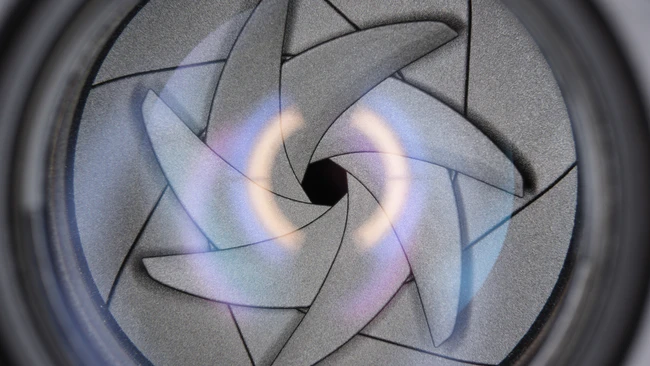
While diffraction is routinely treated as a performance penalty, its underlying physical mechanics can be harnessed deliberately to create artistic effects such as sunstars. When intense point sources of light encounter the straight-edged blades of an iris diaphragm, light is diffracted into linear rays running perpendicular to each blade boundary—effectively forming a one-dimensional variant of the Airy pattern.
The geometry of the resulting starburst pattern is strictly predictable based on the number of blades in the aperture mechanism. For regular polygonal apertures with an even number of blades, parallel opposing blades share normal axes, causing diffraction streaks to overlap and resulting in a starburst with a point count equal to the number of blades ($n$). Conversely, odd-bladed apertures ensure that no two blades are parallel, producing distinct, non-overlapping diffraction rays equal to twice the blade count ($2n$).
While modern lens manufacturers frequently incorporate rounded aperture blades to render out-of-focus background highlights smoothly, stopping the lens down sufficiently forces the iris mechanism into a tightly closed polygonal configuration. This mechanical constraint explains why even modern lenses with curved blades produce well-defined sunstars when stopped down to f/11 or f/16. While achieving this aesthetic effect exacts a measurable toll on overall pixel-level contrast due to increased diffraction, it remains a striking demonstration of wave optics operating in plain sight.
Related posts: