With the November election cycle rapidly approaching its climax, New York Governor Kathy Hochul and New York City Mayor Zohran Mamdani staged a high-profile visit to the Queens Night Market in Flushing Meadows Corona Park this past Halloween. The event, which served as both a strategic campaign stop and a symbolic display of inter-governmental cooperation, saw the two Democratic leaders navigating the bustling aisles of one of the city’s most iconic cultural hubs. Against a backdrop of flickering string lights and the aroma of diverse global cuisines, the pair sought to project a united front, aiming to galvanize the Democratic base just three days before voters head to the polls.
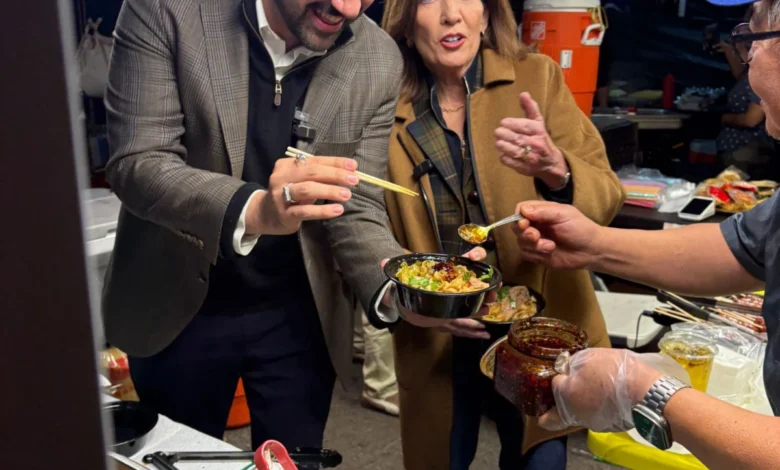
The visit was marked by a series of stops at various food stalls, where the political optics were carefully balanced with personal interactions. At the Taiwanese Yummy tent, the encounter underscored the informal nature of the evening. Cheng Liu, the proprietor, steered the conversation away from the Governor’s offerings, insisting that Mayor Mamdani sample his signature beef noodle soup prepared according to traditional methods. As Liu meticulously arranged slippery, wide noodles beneath a bed of pickled mustard greens, aromatic herbs, and eight-hour braised brisket, the Mayor prepared to eat. The scene shifted briefly from political theater to culinary immersion when Liu personally added a generous dollop of homemade chili oil. “The mayor is not scared of spicy food,” Liu remarked through his son’s translation. “We wanted to give him Taiwanese cuisine.”

The Queens Night Market has become a mandatory stop for political figures seeking to demonstrate their connection to the city’s immigrant communities and working-class constituents. Launched in 2015 by founder John Wang, the market has evolved from a local gathering into a massive, open-air cultural institution that reflects the shifting demographics of the outer boroughs. According to Wang, the presence of high-level politicians is a recurring theme during election cycles. “Every election season, they come out,” Wang noted. “Even if they’ve never been here before, they’re like, ‘Yeahhh! I love the Queens Night Market.’” Historically, the response to these visits has varied; while some figures receive enthusiastic receptions, others encounter a more tempered reaction from the crowd.
A Strategic Alliance Amidst Political Tension
The joint appearance of Governor Hochul and Mayor Mamdani is particularly significant given the current political climate in New York. Hochul is currently locked in a competitive reelection campaign against Nassau County Executive Bruce Blakeman, who has secured the endorsement of former President Donald Trump. For Hochul, the city is a critical battleground; securing the support of the city’s diverse and progressive voting bloc is essential to offsetting potential losses in the suburban counties. Conversely, Mamdani, a figurehead of the city’s democratic socialist movement, has utilized the partnership to secure policy wins that align with his progressive agenda.
The alignment between the two leaders, though viewed by some as an unlikely pairing given their respective positions on the political spectrum, appears to be rooted in pragmatic necessity. Mamdani has successfully lobbied the Governor for support on key initiatives, including the expansion of universal free childcare and the introduction of a “pied-à-terre” tax aimed at non-resident property owners. In exchange, Hochul benefits from the significant grassroots organizing power commanded by the Mayor’s supporters.

During a joint interview, the Mayor framed his support for the Governor as a reciprocal relationship, emphasizing her legislative actions regarding immigrant rights. “The governor has stood up and called for public safety to actually be public safety and not just be an assistance and an accompaniment of ICE,” Mamdani stated, referencing recent legislation signed by Hochul that limits cooperation between local law enforcement and federal immigration authorities.
Economic Policy and the Cost of Living
Beyond the political rhetoric, the visit served as a platform to highlight the ongoing struggle with the cost of living in New York City. The Queens Night Market, which mandates a price cap of $6 per item, serves as a poignant contrast to the inflation-driven challenges facing the average New Yorker. Governor Hochul, who has made affordability a cornerstone of her campaign, pointed to the expansion of free school lunch programs statewide as a tangible example of her administration’s commitment to families. “As a mom, this is personal,” she remarked. “I made a lot of peanut butter and jelly sandwiches over the years for kids.”
However, the economic reality for small business owners remains a point of contention. While the event offered entrepreneurs a moment in the spotlight, the underlying issues of high commercial rent and the barriers to brick-and-mortar success persist. Steve Lahens, owner of Epis by Steve, expressed both gratitude for the high-profile visit and concern for the future. “The rent could be lower so people like me could get a spot,” Lahens explained. “Right now I’m stuck in catering. I love it, but my whole goal is to get a storefront.”

Impact and Implications
The optics of the visit were designed to resonate with a broad demographic. By engaging with vendors like Akera Phillip, who represents Grenadian cuisine through her business Ella Spice, the leaders sought to validate the role of immigrant entrepreneurs in the city’s economy. Phillip, who expressed feeling “blessed” to serve the city’s leadership, noted that the visit made her feel that her contributions were recognized at the highest levels of government.
The event concluded with a lighthearted moment involving a fan dressed in a costume of the Mayor, a gesture that Mamdani jokingly suggested was “Bruce Blakeman’s nightmare.” While the evening provided ample social media content and positive press, the long-term implications of this political alliance remain to be seen. Analysts suggest that the cooperation between the moderate Governor and the socialist Mayor represents a shift in New York politics, where ideological rigidity is increasingly being sidelined in favor of coalition-building to address acute urban challenges.
As the election draws closer, the effectiveness of this partnership will be tested at the ballot box. For Governor Hochul, the ability to maintain the enthusiasm of the Mayor’s base will be a determining factor in the race’s outcome. For Mayor Mamdani, the success of his legislative agenda rests on his ability to continue navigating a productive relationship with the Governor’s office.

Looking Ahead
As of November 2026, the political landscape in New York remains fluid. The data suggests that voter turnout in the outer boroughs—particularly in areas like Queens—is heavily influenced by perceived alignment with local leadership. If the strategy employed at the Queens Night Market succeeds, it may set a new precedent for how state and city leaders collaborate on issues ranging from public safety to economic development.
The event in Flushing Meadows, while seemingly a routine campaign stop, underscored the complex intersection of food, culture, and power. Whether the shared bowls of beef noodle soup and the displays of Caribbean comfort food will translate into concrete policy success or electoral victory is a question for the coming weeks. For now, the image of the Governor and the Mayor, dressed in business casual attire and navigating the crowded stalls of the night market, stands as a testament to the enduring importance of retail politics in one of the world’s most diverse cities.
In summary, the visit was more than a photo opportunity; it was a calibrated performance of unity designed to reassure voters that, despite differences in policy focus, the state and city administrations are capable of working in concert to address the needs of New Yorkers. As the city approaches the final hours of the election cycle, the echoes of this night market visit—the calls for lower rents, the defense of immigrant rights, and the commitment to affordability—will continue to define the closing arguments of the Democratic campaign.
Related posts: