Navigating Wat Phu Tok: Thailand’s Architectural Marvel and High-Altitude Cliffside Sanctuary

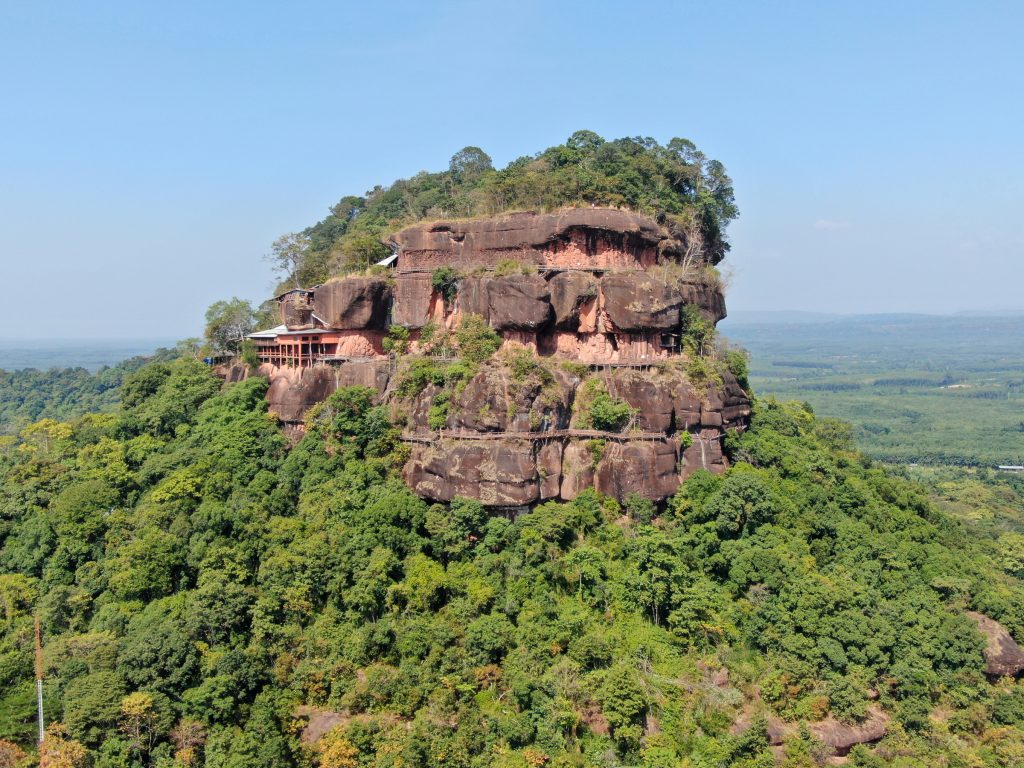
Rising abruptly from the flat agricultural plains of Thailand’s remote northeastern Bueng Kan province, Wat Jetiyakhiri—universally known as Wat Phu Tok—stands as one of Southeast Asia’s most extraordinary architectural and spiritual achievements. Translating locally from the Isan dialect as the "lonely mountain," this solitary sandstone monolith reaches an elevation of 359 meters, dominating the surrounding landscape with a striking physical presence often compared to a scaled-down version of Sri Lanka’s ancient Sigiriya rock fortress. For travelers and pilgrims willing to venture far off the beaten path, the site offers a rare convergence of raw nature, deep Buddhist heritage, and a spine-tingling vertical climb that tests the limits of human equilibrium.
Main Facts and Geographic Overview
Located approximately 30 minutes from Bueng Kan city, the temple grounds encompass a sprawling base featuring a serene lake, verdant parklands, and comprehensive visitor facilities. However, the defining feature of Wat Phu Tok is its intricate system of wooden walkways, staircases, and ladders engineered directly into the sheer vertical faces of the red rock mountain.

Constructed meticulously by hand over decades, the network of pathways spans seven distinct tiers. These levels are not merely functional access routes; they were conceptually designed to mirror the seven stages of spiritual enlightenment in Buddhist philosophy. As visitors ascend from the relatively gentle lower slopes to the precipitous heights of the upper tiers, the terrain transforms from conventional earthen trails into suspension-style wooden planks anchored securely into the cliffside. The sixth level, in particular, features a suspended pathway that wraps halfway around the mountain’s circumference, offering sweeping, panoramic views of the Mekong River basin and the dense, unbroken canopy of the Isan region.
Chronology and Historical Development

The history of Wat Phu Tok is deeply intertwined with the ascetic traditions of Thai Buddhism and the visionary dedication of its founder, the revered forest monk Luang Pu Juan. Historically, the rugged terrain, dense surrounding forests, and isolated location of the sandstone massif made it a natural habitat for abundant wildlife, most notably numerous species of venomous snakes. Rather than deterring spiritual seekers, these challenging environmental factors made the mountain an ideal sanctuary for meditation, symbolizing the isolation and adversity required to overcome earthly attachments.
In the mid-20th century, Luang Pu Juan established the site as a permanent meditation retreat. Recognizing the need to connect the various natural caves, rock shelters, and shrines scattered across the upper elevations, the monk spearheaded the monumental task of building vertical infrastructure. Monks, novices, and local volunteers hauled timber and construction materials up the sheer rock faces, painstakingly fastening wooden staircases, ladders, and cantilevered walkways into the stone.

Through decades of continuous labor, the seven tiers were fully realized, creating a vertical labyrinth dedicated to quiet introspection and monastic study. Tragedy struck the monastic community when Luang Pu Juan tragically lost his life in a commercial aviation accident. Despite the loss of its visionary founder, the temple has been meticulously maintained by succeeding generations of monks and local administrative bodies, preserving its structural integrity and its status as an active place of worship.
Architectural Engineering and Structural Safety

The engineering behind Wat Phu Tok remains a subject of fascination for structural analysts and adventurous travelers alike. Constructing a multi-tiered pathway system onto vertical sandstone without modern heavy machinery required traditional craftsmanship and an intimate understanding of the rock’s geology.
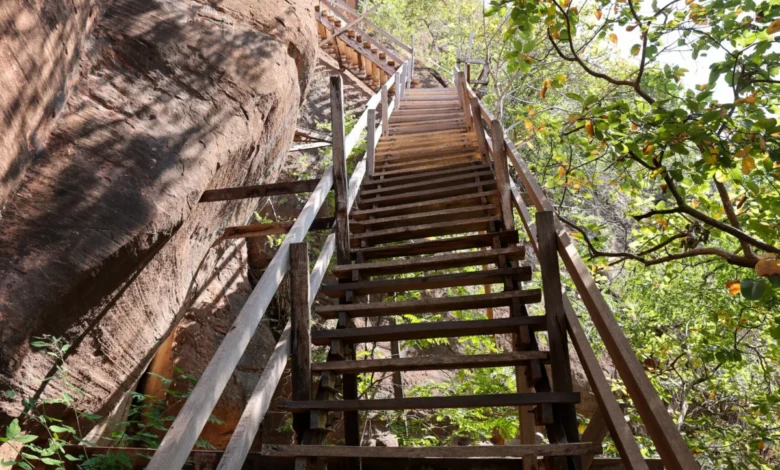
The ascent begins modestly enough, passing through a formal entrance gate before the trail rapidly transitions into steep wooden staircases. As climbers progress toward the higher levels, particularly the fifth and sixth tiers, the staircases approach near-vertical angles, resembling wooden ladders. The walkways on the sixth level are constructed from heavy wooden planks anchored via iron brackets driven directly into the cliff walls.

While travelers frequently report psychological apprehension—often exacerbated by the optical illusion of the planks flexing slightly underfoot—structural assessments and ongoing maintenance protocols confirm the pathway’s stability. Local authorities and temple caretakers conduct routine inspections to replace weathered timber and reinforce anchor points. Nevertheless, safety guidelines emphasize that the infrastructure requires complete focus from visitors, as the sheer drop-offs demand absolute vigilance.
Spiritual Significance and the Seven Levels of Ascent

Each of the seven tiers at Wat Phu Tok holds distinct architectural and symbolic importance within the Buddhist framework of the temple:
Levels One through Four: These initial tiers serve as the transition from the mundane world into the sacred precincts of the mountain. Featuring gradually steepening wooden stairs and occasional rock-cut shrines, these levels guide climbers through dense patches of forest and lower rock formations.

Level Five: Serving as the primary administrative and ceremonial hub of the mountain, the fifth level features the largest ordination hall, numerous smaller shrines, and extensive ground-level walking paths. It is also the access point for notable architectural detours, including an elevated rock walkway that leads across a small wooden bridge to an isolated rock temple nestled against the far side of the mountain.
Level Six: Widely regarded as the psychological and visual climax of the journey, the sixth level features the famous cliff-hanging wooden walkways. Encircling approximately half of the mountain’s perimeter, this tier provides unobstructed views of the surrounding Mekong basin while challenging visitors with its exposed heights and narrow footpaths.

Level Seven: Representing the summit of the mountain, the seventh level is reached via an exhausting final vertical climb. Historically noted for its high population of venomous snakes, access to this tier carries explicit warnings for visitors. The summit itself lacks shrines or constructed walkways, offering instead a wild, undisturbed plateau that provides additional vantage points for those who complete the ascent.
Broader Impact and Regional Tourism Implications

The presence of Wat Phu Tok has significantly influenced the socio-economic profile of Bueng Kan, one of Thailand’s youngest provinces, established officially in 2011 after separating from Nong Khai. Historically reliant on rubber agriculture and cross-border trade with Laos, the province has leveraged its unique ecological and cultural assets to promote sustainable, low-impact tourism.
Tourism board analyses indicate that while mainstream international travelers frequently concentrate on Thailand’s southern beaches or northern cultural hubs like Chiang Mai, remote attractions such as Wat Phu Tok draw a dedicated demographic of ecotourists, cultural historians, and domestic travelers seeking authentic, crowd-free experiences. The influx of visitors provides vital economic support to local hospitality providers, family-run guesthouses, and regional transport networks in Bueng Kan city and its surrounding rural districts.

Furthermore, environmental conservationists praise the temple administration’s commitment to preserving the surrounding natural ecosystem. By maintaining the mountain primarily as a monastic sanctuary rather than a heavily commercialized amusement destination, the site safeguards local biodiversity, including the forest canopy and native wildlife populations that originally attracted forest monks to the region decades ago.
Visitor Guidelines and Practical Information

For those planning an excursion to Wat Phu Tok, regional tourism authorities and experienced travelers emphasize adherence to standard cultural and safety protocols:
- Attire: As an active Buddhist temple, visitors must dress respectfully, ensuring that shoulders and knees are covered.
- Physical Fitness: The climb requires moderate to high cardiovascular endurance and a strong tolerance for heights; individuals with severe vertigo should exercise extreme caution, particularly beyond the fifth level.
- Safety Precautions: Footwear with reliable traction is essential due to occasional moisture on wooden planks and stone surfaces. Visitors are strictly advised to remain on designated pathways and avoid disturbing local wildlife, particularly on the upper tiers.
- Timing: Early morning visits are widely recommended to avoid high afternoon temperatures and to experience the morning mist rising across the Mekong River basin from the upper viewpoints.
As Thailand continues to diversify its tourism offerings toward sustainable regional exploration, Wat Phu Tok remains an enduring testament to human ingenuity, spiritual devotion, and the breathtaking intersection of architecture and the natural world.