Delta Air Lines versus KLM Royal Dutch Airlines: A Transatlantic Premium Economy Showdown

The transatlantic travel market has undergone a fundamental transformation over the past decade, shifting away from a strict two-class model toward a multi-tiered cabin structure that increasingly emphasizes intermediate comfort. For decades, international passengers faced a stark dichotomy: the spacious luxury of lie-flat business class seats or the cramped quarters of standard economy. Today, premium economy has emerged as the fastest-growing segment in commercial aviation, offering dedicated cabins, wider seats, enhanced dining, and priority services at a price point significantly lower than business class.
To evaluate whether this middle-tier product truly justifies the substantial financial investment over economy—and whether it successfully deters travelers from splurging on lie-flat seats—aviation analysts Gunnar and a colleague from Thrifty Traveler recently put two of the SkyTeam alliance’s most prominent transatlantic offerings to the test. Boarding separate aircraft across the Atlantic, the reviewers compared Delta Air Lines’ Premium Select and KLM Royal Dutch Airlines’ Premium Comfort. Operating as close joint-venture partners across the Atlantic, Delta and KLM share revenue, coordinate schedules, and align many of their service standards. However, subtle yet significant differences remain in their hard products, soft products, and overall passenger experience.
The investigative journey pitted Delta’s Airbus A330-900neo against KLM’s Boeing 777-200. By scrutinizing every touchpoint—ranging from the efficiency of the check-in process and ergonomic seat comfort to meal quality, cabin service, and actual sleep hygiene—the reviewers sought to answer a pressing question for modern travelers: When crossing the Atlantic on an overnight flight, does premium economy strike the ideal balance between cost and comfort, or will passengers ultimately regret bypassing the front of the plane?
The Rise of Premium Economy on Transatlantic Routes
The commercial aviation landscape has been reshaped by consumer demand for incremental upgrades without the exorbitant price tags typically associated with business class, which frequently costs three to five times the price of an economy ticket. Major legacy carriers—including American Airlines, Delta Air Lines, United Airlines, British Airways, Air France, and KLM—have retrofitted their widebody fleets or taken delivery of new aircraft featuring dedicated premium economy cabins.
Unlike economy class, which has seen seat pitch shrink to an average of 30 to 31 inches on many long-haul aircraft, premium economy cabins generally offer a more generous 38 inches of pitch, alongside greater width, deeper recline angles, adjustable footrests, and larger entertainment screens. Furthermore, the physical cabin separation ensures a more intimate environment, typically housing between 24 and 48 seats, which translates to higher ratios of flight attendants to passengers.
For corporate travelers facing tighter travel budgets and leisure travelers seeking enhanced physical well-being on long-haul flights, premium economy has quickly become the sweet spot. Industry metrics indicate that premium cabins generate disproportionately high revenues for legacy airlines, helping offset fluctuating fuel costs and volatile corporate travel demand. Consequently, evaluating how competing alliance partners implement this product provides valuable insights for consumers navigating loyalty programs, cash purchases, and cash-plus-miles redemption strategies.
Aircraft Configurations and Hard Product Comparison
The transatlantic test deployed two distinct widebody aircraft utilized heavily on European routes: Delta’s modern Airbus A330-900neo and KLM’s workhorse Boeing 777-200. While both carriers belong to the SkyTeam alliance and frequently operate under codeshare agreements, their interior designs and passenger experiences reflect distinct brand philosophies.
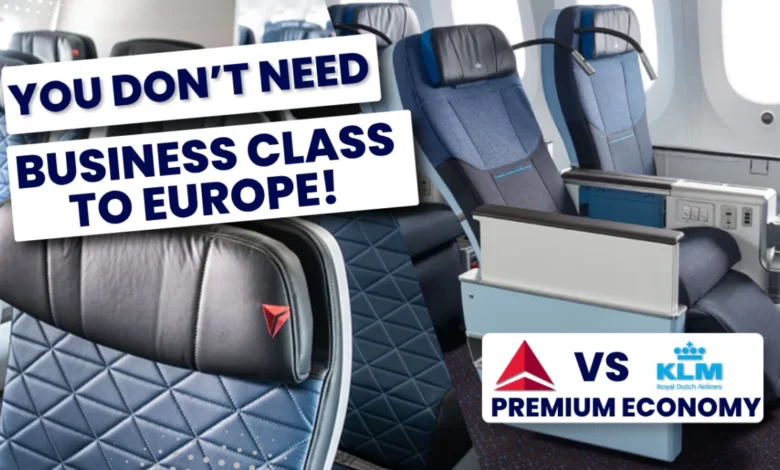
Delta Air Lines has made significant investments in upgrading its long-haul fleet, and its Airbus A330-900neo represents one of the crown jewels of its widebody operations. The Delta Premium Select cabin on this aircraft is arranged in a comfortable 2-3-2 configuration, which minimizes the number of middle seats compared to standard economy’s typical 2-4-2 or 3-3-3 layouts. The seat itself features a rigid shell design, meaning that reclining does not encroach upon the personal space of the passenger seated directly behind. Additional amenities include adjustable leg rests, fold-out footrests, enhanced lumbar support, a larger high-definition touchscreen monitor, and noise-canceling headphones.
Conversely, KLM’s Boeing 777-200 features the Dutch carrier’s relatively newer Premium Comfort cabin. KLM has adopted a 2-4-2 configuration for its premium economy offering on the Boeing 777, a layout dictated by the narrower cabin cross-section of the iconic twin-jet compared to the wider Airbus fuselage. Despite the four-abreast center section, KLM has engineered its seat to provide competitive personal space, featuring a deep recline, a dedicated footrest, a sturdy tray table, and ample storage compartments for personal electronics.
Evaluating the physical comfort of these two products involves weighing trade-offs. The 2-3-2 layout on Delta’s A330neo offers a statistical advantage in reducing the likelihood of drawing a middle seat, whereas KLM’s design focuses heavily on upholstery comfort, tactile materials, and intuitive hard-product ergonomics. Both seats successfully deliver on the primary promise of premium economy: significantly more room to stretch out and alter posture during a six-to-nine-hour overnight journey.
Check-In, Ground Experience, and Priority Services
A crucial component of the premium economy value proposition extends beyond the physical aircraft cabin to the ground experience. For both Delta and KLM, purchasing a premium economy ticket grants passengers various priority benefits designed to streamline the airport journey.
Delta Premium Select passengers typically enjoy Sky Priority benefits, which include expedited check-in lines, priority security lane access where available, and priority baggage handling. This ensures that checked luggage arrives promptly at the destination carousel, minimizing wait times upon arrival in Europe. However, it is important to note that standard lounge access is generally not included with a Delta Premium Select ticket unless the traveler holds elite status within the SkyTeam alliance or an eligible co-branded credit card.
Similarly, KLM’s Premium Comfort offering includes SkyPriority elements, permitting passengers to utilize dedicated check-in counters and board the aircraft ahead of standard economy passengers. Like its transatlantic partner, KLM does not automatically bundle complimentary SkyTeam Crown Lounge access into the base price of a Premium Comfort ticket, though both airlines frequently market paid lounge access upgrades or leverage frequent flyer status privileges.
During the comparative evaluation, both reviewers noted that the ground processes operated efficiently, allowing them to bypass lengthy economy queues. The seamless transition from curbside check-in to the boarding gate underscores how airlines utilize premium economy to appeal to time-sensitive passengers who value operational efficiency.
In-Flight Dining, Service Standards, and Amenity Kits
Once airborne, the soft product separates premium economy from standard economy. While business class features multi-course gourmet dining, fine wines, and custom-plated service, premium economy bridges the gap by offering elevated meal options served on upgraded dinnerware, accompanied by complimentary beer, wine, and spirits.
Delta Premium Select passengers receive enhanced dining inspired by regional and seasonal ingredients. Meals are typically served on upgraded tableware with cloth napkins and stainless-steel cutlery. Throughout the flight, cabin crew members provide attentive service, regularly offering beverages and snacks. Additionally, Delta provides an amenity kit containing travel essentials such as an eye mask, earplugs, and dental care items, alongside a plush blanket and pillow designed to enhance sleep quality.
KLM’s Premium Comfort elevates the Dutch carrier’s historically strong catering standards. The meal service often features distinct choices presented with sustainable tableware, accompanied by specialty beverages. KLM also provides a dedicated amenity kit produced with recycled materials, reflecting the airline’s broader corporate sustainability initiatives. The pillow and blanket provided in KLM’s cabin mirror the ergonomic focus of the seat, offering adequate warmth and support for overnight rest.
Sleep Quality and Ergonomic Assessment
The ultimate test for any overnight transatlantic flight is sleep quality. Crossing multiple time zones rapidly can induce severe fatigue, making the ability to achieve restorative sleep paramount for travelers who need to function immediately upon arrival.
Neither Delta Premium Select nor KLM Premium Comfort offers a fully lie-flat experience; recline angles typically range between 7 and 8 inches, supported by footrests and leg rests. Consequently, passengers cannot sleep flat on their backs or stomachs as they would in business class. However, the combination of a deeper recline, wider armrests, and enhanced leg support allows travelers to achieve a semi-recumbent posture that facilitates light-to-moderate sleep.
Gunnar and his colleague evaluated sleep continuity, postural strain, and cabin noise levels on their respective flights. Both reviewers reported that while premium economy cannot fully replicate the restorative sleep afforded by a lie-flat bed, the physical upgrades provided a vastly superior rest experience compared to standard economy. The absence of the cramped knee-to-seatback contact characteristic of economy cabins significantly reduced physical restlessness, enabling travelers to arrive in Europe feeling adequately rested rather than entirely exhausted.
Financial Implications and Value Proposition Analysis
The central dilemma for transatlantic travelers centers on cost-benefit analysis. With business class fares frequently exceeding $3,000 to $6,000—or requiring upwards of 100,000 to 200,000 airline miles each way—many flyers are priced out of the front cabin. Premium economy typically commands a more moderate premium over standard economy, often priced at an additional $300 to $800 per direction, or a reasonable step-up in mileage redemptions.
A rigorous evaluation of Delta Premium Select and KLM Premium Comfort demonstrates that both products successfully occupy the middle ground. For travelers who find economy physically punishing due to height, back issues, or inability to sleep upright, premium economy represents a cost-effective compromise. It delivers roughly 70 to 80 percent of the physical comfort of business class at approximately 40 to 50 percent of the cost.
Furthermore, for frequent flyer program members utilizing miles, redeeming through programs like Delta SkyMiles or Air France-KLM Flying Blue for premium economy can yield high cent-per-mile value, particularly during promotional award sales. As airlines continue to fine-tune their cabin architectures, the data suggests that consumer demand for premium economy will remain robust, driven by travelers who refuse to endure standard economy but view business class as an unnecessary extravagance.
Editorial Transparency and Rigorous Testing Standards
To maintain journalistic integrity and provide objective consumer advice, publications and travel review platforms emphasize independent evaluation. In the case of this transatlantic comparison, the review team explicitly noted that no complimentary tickets, media rates, or promotional sponsorships were accepted from Delta Air Lines, KLM, or the SkyTeam alliance. Every flight, seat selection, and ancillary expense was funded entirely out of pocket using personal cash, points, or miles. This uncompromising approach ensures that consumers receive unbiased, fact-based assessments free from commercial bias or corporate influence.
Broader Industry Trends and Future Outlook
The performance and consumer reception of Delta Premium Select and KLM Premium Comfort highlight a permanent structural shift in commercial aviation. As airlines phase out older aircraft and configure new widebody deliveries, the footprint of standard economy is slowly contracting to make room for larger premium economy and business class sections.
Industry analysts project that premium economy will continue to capture market share from both economy and business classes. Corporate travel policy adjustments, which increasingly restrict employees to premium economy rather than business class for mid-haul and long-haul international routes, further cement the cabin’s financial viability for carriers.
For travelers planning future itineraries across the Atlantic, understanding the nuances between alliance partners like Delta and KLM ensures informed decision-making. Whether opting for Delta’s Airbus A330neo with its spacious 2-3-2 layout or KLM’s Boeing 777-200 with its refined Dutch hospitality and ergonomic seating, the modern premium economy passenger is better equipped than ever to navigate the skies in comfort without breaking the bank.