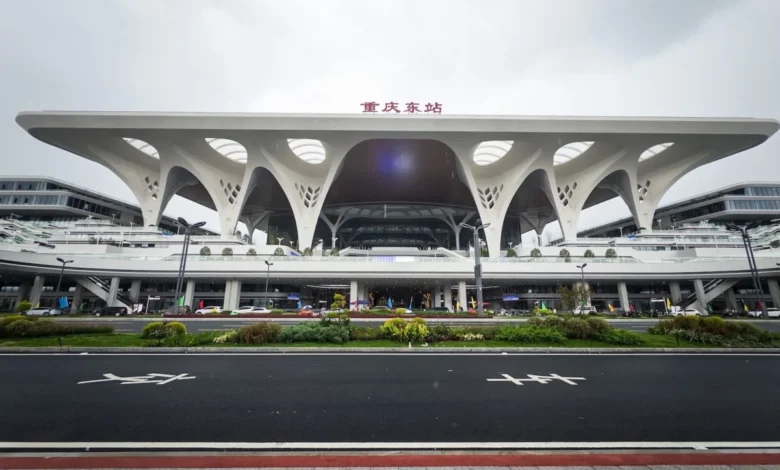
China’s burgeoning high-speed rail network has reached a new zenith with the opening of Chongqing East Railway Station, a colossal transportation hub that redefines the scale of modern travel. Inaugurated on June 27, 2025, in the Nan’an district of Chongqing, this architectural marvel sprawls across an astounding 13.1 million square feet, a footprint that renders New York’s iconic Grand Central Terminal, with its 3 million square feet, comparatively diminutive. Chongqing East Railway Station is not merely a station; it is a testament to China’s ambitious infrastructure development and its vision for future mobility.
The sheer immensity of Chongqing East Railway Station is a deliberate design choice, catering to the burgeoning demand for efficient and extensive travel within China. With the nation’s high-speed rail network now approaching an impressive 30,000 miles, the station is strategically positioned to serve as a critical nexus for connectivity across the country. Its expansive facilities are engineered to accommodate the millions of passengers who will traverse its concourses annually, facilitating journeys to major urban centers such as Chengdu, Guiyang, Kunming, Wuhan, Xi’an, Shanghai, Shenzhen, Beijing, Guangzhou, and Changsha. Beyond these cross-country routes, Chongqing East also significantly enhances access to a wealth of regional tourist destinations. These include the breathtaking natural wonders of Wulong, the historic Qianjiang, the dramatic landscapes of Zhangjiajie, and the ancient charm of Fenghuang. This dual function—serving as both a gateway for long-haul travel and a convenient access point for exploring Chongqing’s surrounding mountainous terrain and iconic karst landscapes—underscores the station’s multifaceted importance.
The construction of Chongqing East Railway Station itself is a narrative of technological innovation and forward-thinking engineering. Faced with the challenges posed by the project’s immense scale, the demanding terrain, and the region’s often-extreme heat, China Railway 11th Bureau embraced advanced construction methodologies, prominently featuring robotics and artificial intelligence. This was not a mere adoption of novel technology but a pragmatic response to logistical and efficiency imperatives. Specialized robotic systems were deployed for critical tasks, including four-head screed robots for precise floor leveling, automated tile-laying robots ensuring uniformity and speed, and sophisticated robots for the intricate installation of glass curtain walls. According to statements from China Railway 11th Bureau, this AI-driven approach resulted in a threefold increase in average work efficiency and a reduction in labor costs by nearly half. The outcome was not a fully automated, unmanned construction site, but rather a highly efficient hybrid model. Here, skilled technicians, engineers, and builders worked in concert with these specialized machines, orchestrating one of the most significant rail infrastructure projects in western China. This innovative construction paradigm offers a compelling glimpse into the future of large-scale infrastructure development, where human expertise is augmented by intelligent automation.
A New Era of High-Speed Rail Connectivity
China’s commitment to developing a world-class high-speed rail (HSR) system has been a defining feature of its infrastructure policy over the past two decades. The initial phase of HSR development in China began in the late 1990s, with the first high-speed line, the Beijing–Tianjin Intercity Railway, opening in 2008. Since then, the pace of expansion has been extraordinary. The network has grown exponentially, connecting major cities and facilitating rapid intercity travel, significantly reducing transit times and fostering economic integration. The opening of Chongqing East Railway Station signifies a pivotal moment in this ongoing expansion, establishing a new benchmark for the size and capacity of HSR hubs within the country.
The station’s strategic location in Chongqing, a major metropolis in southwestern China and a key economic center along the Yangtze River, is also significant. Chongqing serves as a vital gateway to the western regions of China, a historically less developed area that is now a focal point for national development initiatives. By integrating Chongqing more seamlessly into the national HSR network, Chongqing East Railway Station is poised to stimulate economic growth, boost tourism, and improve the quality of life for millions of residents in the region and beyond.
A Monumental Undertaking: Scale and Design
The sheer scale of Chongqing East Railway Station is difficult to overstate. Its 13.1 million square feet of total area is not just a number; it represents a vast expanse of interconnected spaces designed for the efficient flow of people and services. To put this into perspective, the station’s footprint is equivalent to approximately 227 American football fields or, as previously noted, over four times the size of Grand Central Terminal. This colossal size allows for numerous platforms, extensive waiting areas, retail outlets, dining facilities, and administrative offices, all integrated into a cohesive and functional design.
The architectural design of Chongqing East Railway Station emphasizes both grandeur and functionality. While specific details on its aesthetic might vary, such large-scale modern stations in China often incorporate elements that reflect local culture and national pride, alongside contemporary design principles that prioritize passenger experience and sustainability. The station’s design likely addresses the need for intuitive navigation within its immense structure, employing clear signage, advanced wayfinding systems, and efficient passenger flow management to mitigate the potential disorientation that could arise from its sheer size.
The Role of Automation in Construction
The integration of AI and robotics in the construction of Chongqing East Railway Station represents a significant advancement in the field of civil engineering. The decision to employ automated systems was driven by several critical factors:
- Efficiency and Speed: The sheer scale of the project demanded an accelerated construction timeline. Robots can perform repetitive tasks with greater speed and consistency than human workers, thereby shortening the overall construction period.
- Safety: Construction sites, especially those of this magnitude, can be hazardous environments. Utilizing robots for tasks such as working at heights or handling heavy materials can significantly reduce the risk of accidents and injuries to human workers.
- Precision and Quality: Automated systems are capable of performing tasks with a high degree of precision, ensuring consistent quality in the finished product. This is particularly important for elements like floor leveling and tile installation, where accuracy is crucial for both aesthetics and long-term durability.
- Cost-Effectiveness: While the initial investment in robotic technology can be substantial, the long-term savings in labor costs, reduced waste, and increased efficiency can make it a more cost-effective solution for mega-projects. The reported halving of labor costs and tripling of efficiency by China Railway 11th Bureau exemplifies this benefit.
- Addressing Labor Shortages and Skill Gaps: In some regions, there can be a shortage of skilled labor for large-scale construction projects. Automation can help bridge this gap, allowing projects to proceed without being hampered by a lack of qualified personnel.
The hybrid model, where human oversight and direction are combined with robotic execution, is likely to become a standard for future mega-infrastructure projects. It leverages the strengths of both human intelligence and machine capability, creating a more robust and adaptable construction process.
Implications for Future Travel and Development
The opening of Chongqing East Railway Station has profound implications for China’s transportation landscape and its broader economic development:
- Enhanced Regional Connectivity: The station’s role as a hub connecting southwestern China with major economic centers across the country will foster greater integration and collaboration. This will facilitate business travel, boost trade, and encourage investment in the western regions.
- Tourism Boost: Improved accessibility to both major cities and regional attractions is expected to significantly boost tourism. Visitors will find it easier to explore diverse landscapes and cultural heritage sites, contributing to local economies and job creation.
- Economic Growth: The station is a catalyst for economic development in Chongqing and the surrounding areas. It will create jobs during its operational phase, support related industries such as logistics and hospitality, and enhance the city’s attractiveness as a business and investment destination.
- Technological Advancement: The successful implementation of AI and robotics in its construction signals China’s growing prowess in advanced manufacturing and infrastructure technology. This can lead to further innovation and adoption of similar technologies in other sectors.
- Model for Future Infrastructure: Chongqing East Railway Station serves as a model for future large-scale infrastructure projects, demonstrating how advanced technology and innovative construction methods can be employed to meet the demands of a rapidly developing nation.
A Glimpse into China’s Ambitious Future
Chongqing East Railway Station is more than just a transportation hub; it is a symbol of China’s relentless drive for progress and its commitment to building a modern, interconnected nation. Its colossal scale and technologically advanced construction underscore a forward-looking approach to infrastructure development, one that prioritizes efficiency, sustainability, and the seamless integration of people and places. As China continues to expand its high-speed rail network and invest in cutting-edge technologies, stations like Chongqing East will play an increasingly vital role in shaping the future of travel and economic growth, not only within China but on a global scale. The station’s sheer size and advanced capabilities are set to redefine passenger expectations and set new benchmarks for transportation infrastructure worldwide. The project’s successful completion is a testament to China’s engineering prowess and its vision for a connected and prosperous future.
Related posts: