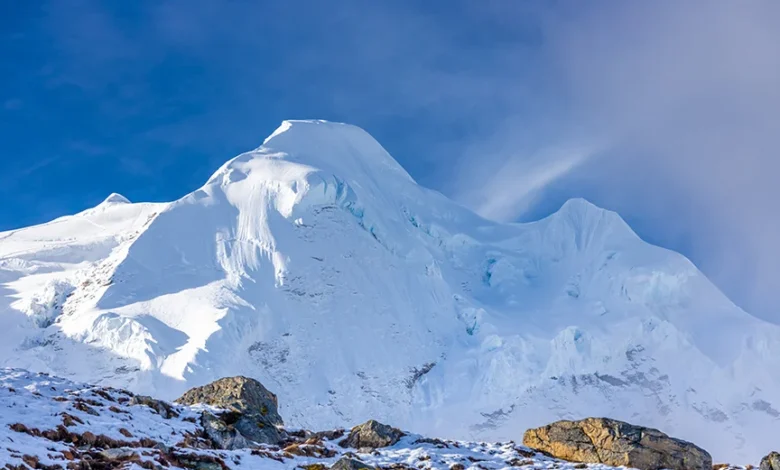
Richard Carlos Skidmore, a 66-year-old mountaineer from the United States, has died while on an expedition to the 6,476-meter Mera Peak in the Solukhumbu district of Nepal. The tragedy occurred on Sunday, November 22, just one day after Skidmore successfully reached the summit of one of Nepal’s most popular trekking peaks. His death has prompted discussions among the international climbing community regarding high-altitude safety protocols, expedition logistics, and the inherent risks associated with Himalayan mountaineering, even on peaks categorized as non-technical.
According to preliminary reports from the Solukhumbu district police, Skidmore reached the summit of Mera Peak at approximately 10:00 a.m. local time on Saturday, November 21. Following the successful ascent, he began his descent back toward the high camp, located at an elevation of approximately 5,800 meters. While it is standard practice for climbers to descend to lower camps after a summit bid, Skidmore opted to remain at the high camp to spend the night. It was there that he was found unresponsive by members of his expedition team the following morning.
Chronology of the Expedition
The timeline of the event highlights the rapid nature of the incident. Skidmore’s expedition was part of a broader climbing season in the Himalayas, which typically sees favorable weather windows for summit attempts in late autumn.
- Saturday, November 21: Skidmore successfully reached the summit of Mera Peak at 10:00 a.m. Following the summit, he completed the descent to the high camp at 5,800m, arriving later that afternoon.
- Sunday, November 22: Expedition staff discovered that Skidmore had passed away in his tent. Local authorities were notified immediately to initiate recovery efforts.
- Monday, November 23 (approximate): A helicopter was dispatched to the high camp to retrieve Skidmore’s body, which was then transported to a medical facility in Kathmandu for a post-mortem examination.
Medical Context and Investigation
As of the current reporting, the official cause of death remains undetermined. While local law enforcement and medical professionals have cited the possibility of altitude-related complications or a sudden cardiac event, neither has been confirmed through the autopsy process.
High-altitude environments, particularly those above 5,000 meters, impose extreme physiological stress on the human body. The thin air, characterized by significantly reduced partial pressure of oxygen, can exacerbate underlying health conditions. Mountaineering medical experts often point to the risks of High Altitude Pulmonary Edema (HAPE) or High Altitude Cerebral Edema (HACE), which can develop rapidly, sometimes even in individuals with previous high-altitude experience.
Skidmore was not an novice climber; records from the Everest Chronicle and the Italian Alpine Club’s Lo Scarpone indicate that he successfully summited Lobuche Peak in 2024. His previous experience above 6,000 meters suggests that he was familiar with the physical demands of Himalayan climbing. This makes the circumstances of his death particularly distressing to those who knew him and to the broader mountaineering community, as he had demonstrated the necessary capability to navigate such environments in the recent past.
Logistics and High-Camp Protocols
The decision to remain at the high camp after a summit attempt has become a point of scrutiny. On social media platforms and in climbing forums, veteran Himalayan mountaineers have noted that staying at 5,800 meters for an additional night after a summit push is unconventional, provided that weather conditions allow for a descent to lower, more oxygen-rich elevations.
Typically, expedition leaders encourage climbers to move to lower camps as soon as possible after summiting to allow for recovery and to minimize the time spent at extreme altitude. While the specific reasons for Skidmore’s choice to remain at high camp are not fully detailed, such decisions are often influenced by physical exhaustion, weather shifts, or logistical constraints imposed by the expedition’s support staff. Experts suggest that further investigation into the expedition’s operational plan may be necessary to understand if there were procedural lapses or if the decision was a result of unforeseen circumstances on the mountain.
Statistical Context: Mera Peak Safety
Mera Peak is frequently marketed as a "trekking peak" because it does not require the same technical rock or ice climbing proficiency as an 8,000-meter giant. However, its altitude alone renders it a serious undertaking. The Himalayan Database, which acts as the primary repository for mountaineering statistics in Nepal, keeps records of climbs in the region.
While the database coverage of "trekking peaks" is selective compared to the major summits like Everest or Annapurna, its records indicate that four climbers have lost their lives on Mera Peak since 2018. When accounting for Skidmore’s death, that number rises to five. This data serves as a sobering reminder that the term "trekking peak" is often a misnomer in the context of the Himalayas, where the environment remains volatile and unforgiving.
Implications for Himalayan Tourism
The death of Richard Skidmore serves as a stark reminder of the risks involved in commercial mountaineering. Nepal’s tourism sector relies heavily on the influx of international climbers, and the local economy in the Solukhumbu district is deeply intertwined with the climbing industry.
Following such incidents, local authorities and the Nepal Mountaineering Association (NMA) often review safety protocols. There is an ongoing debate regarding the necessity of stricter medical screenings for climbers over the age of 60 and the requirement for more stringent oversight of independent expedition agencies. The incident has also reignited the conversation regarding the importance of acclimatization schedules and the need for medical oxygen and emergency communication devices to be readily available even on lower-altitude peaks.
Broader Impact and Official Response
The recovery of a body from 5,800 meters is a complex and dangerous operation, requiring skilled pilots and favorable weather. The successful evacuation of Skidmore’s remains to Kathmandu allowed for the proper legal and medical procedures to be followed, providing a measure of closure for his family.
At this stage, neither the Nepali government nor the relevant climbing agencies have issued a definitive statement on the findings of the autopsy. The case remains open, and the lack of a clear medical cause continues to fuel speculation among the public. However, the climbing community emphasizes that the priority remains the respect for the deceased and the safety of future expeditions.
As the Himalayan climbing season winds down, this tragedy serves as a solemn conclusion for many in the region. It highlights the reality that mountaineering is never entirely predictable. For those who follow in Skidmore’s footsteps, the event serves as a warning that even with prior experience, the mountains command respect, and the margin for error at high altitude remains razor-thin.
The international climbing community continues to extend its condolences to the family of Richard Carlos Skidmore, reflecting on the life of a man who sought the challenges of the world’s highest peaks. As investigations continue, the lessons learned from this incident will likely be integrated into future safety briefings and training programs, ensuring that the legacy of those who have passed is honored through a continued commitment to minimizing risks in the world’s most extreme environments.