Tracing the Ancient Steppe: Conservation Efforts for Kazakhstan’s Resilient Saiga Antelope

The open plains of the Eurasian steppe present a landscape where horizons stretch indefinitely and the boundaries between earth and sky dissolve into a seamless grey. Traversing this remote terrain requires navigating a complex network of mud tracks and tire ruts, carved into the earth by decades of seasonal movement. In the distance, silhouetted against howling Siberian winds, a phenomenon unfolds that has remained largely unchanged since the Pleistocene epoch: hundreds of saiga antelope surging across the frozen expanse, their distinctive, bulbous snouts filtering the frigid air as they move in synchronized unison.
Long before human caravans forged the early trade routes that would eventually evolve into the Silk Road, saigas crossed these vast plains. Having outlived woolly mammoths, saber-toothed cats, and giant deer, the saiga stands as a living relic of an ancient world. Today, however, this resilient ungulate faces a modern crisis. Rapid industrialization, expanding infrastructure, and human development have fractured their historic migration routes, threatening to sever an ancient ecological legacy.
The Dynamics of the Rut and the Steppe Ecosystem
The field expedition, conducted alongside researchers from the Association for the Conservation of Biodiversity of Kazakhstan (ACBK), was timed to coincide with the saiga’s annual rutting season. This critical period of the biological calendar involves massive congregations of antelope following intricate, single-file migration corridors before splitting into competitive groups for mating rituals.
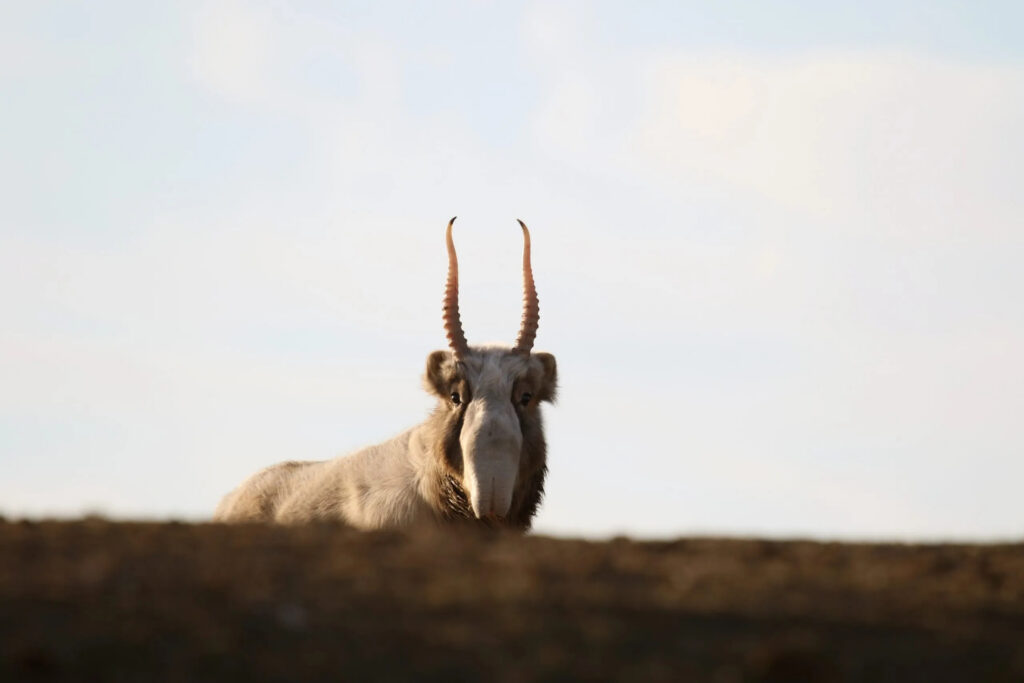
During the rut, male saigas engage in intense displays of physical prowess, including aggressive headbutting and territorial patrolling. These behaviors demand such high levels of energy that many males succumb to exhaustion. For females, mate selection is heavily influenced by specific physiological traits, most notably the saiga’s elongated, floppy nose. This specialized snout is vital for survival, serving to warm freezing winter air before it reaches the lungs and filtering out dust during dry summer months. Consequently, a pronounced snout signals high genetic fitness.
The open, treeless nature of the steppe has historically made the species an ideal candidate for wildlife tracking. Modern GPS telemetry has revolutionized conservation efforts, allowing researchers to monitor herd movements in real time across expanses devoid of visual obstructions. Data gathered from these collars informs the establishment of new wildlife sanctuaries, ensuring that protected boundaries align with actual animal movement patterns.
Historical Context and the Shadow of Sedentarization
The nomadic tradition in Kazakhstan is deeply embedded in the region’s history, dating back to the Early Iron Age. The etymology of the word "Kazakh" itself stems from Turkic roots signifying a wanderer or vagabond. For millennia, human populations moved seasonally between higher altitudes during the summer and sheltered river valleys in the winter, establishing a rhythm of life synchronized with the natural world.
These traditional migration corridors eventually laid the foundation for the Silk Road, transforming the fertile banks of the Ural River into a vital transcontinental crossroads where Asia met Europe. Strategic settlements along this route provided essential waypoints for weary travelers, fostering cultural and economic exchange.
However, this traditional lifestyle underwent a radical transformation during the 20th century. With the rise of the Soviet Union, mandatory sedentarization policies forced nomadic human populations into agricultural settlements. While framed as modernization, these policies largely ignored the ecological reality of the steppe, much of which is fundamentally unsuited for crop cultivation. The disruption of human nomadism mirrored a broader philosophical and ecological departure from mobility—a shift that many historians and naturalists view as a critical turning point in humanity’s relationship with the natural environment.
Infrastructure Fragmentation and Ecological Implications
While human populations largely transitioned to settled urban centers, the saiga antelope maintained its ancient migratory imperatives. This persistence has placed the species on a collision course with modern infrastructure.
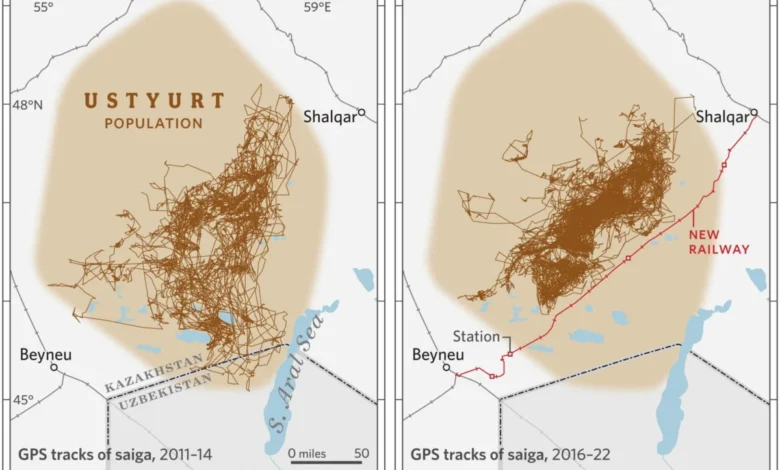
Over the past century, the rapid expansion of railways, paved highways, and border fences has sliced through the Eurasian steppe. Conservation data highlights the severe consequences of these barriers. For instance, tracking maps analyzed by ACBK researchers revealed that a population of saigas historically migrated deep into Uzbekistan each year. The construction of a major railway line in 2014 abruptly severed this route. Post-construction data showed herds pacing despondently on the northern side of the tracks, unable to reach traditional grazing grounds and water sources that withered on the southern side.
This artificial fragmentation induces a catastrophic loss of spatial knowledge. Similar to how forced sedentarization erased navigational traditions among human populations, young saigas learn migration routes, water sources, and shelter locations through active participation and observation within the herd. When physical barriers block these pathways, entire stretches of ecological knowledge fade from memory, threatening the species’ long-term viability.
Mitigation Strategies and Cross-Border Collaboration
To combat the fragmentation of the steppe, conservation organizations and government bodies are implementing targeted engineering and policy solutions. ACBK has partnered with the Kazakh government to construct dozens of specialized, saiga-friendly crossing points along railway lines. These structures feature gently sloping dirt ramps that match the height of the tracks, creating the illusion of a natural gap in the barrier. Additionally, strategically placed cattle-guard fences keep trains and wildlife separated, preventing collisions and preserving the safety of the crossings.
International cooperation has also proven essential. ACBK has collaborated with Uzbek authorities to modify rigid border security infrastructure. Traditional barbed-wire walls have been re-engineered into X-shaped barricades that successfully deter unauthorized vehicular traffic while leaving sufficient clearance for migrating saigas to pass underneath.
These interventions aim to restore ecological connectivity across the transcontinental plateau. As field researchers and conservationists continue to monitor the herds through shifting weather patterns—from the treacherous mud of autumn rains to the stark, frozen crust of Siberian winters—the imperative remains clear. Preserving the saiga antelope requires safeguarding not just the animals themselves, but the vast, uninterrupted pathways that sustain their ancient journey across the Eurasian steppe.
Related posts: