Hunting the Devil’s Cigar: Inside the Search for Texas’s Rarest and Most Elusive Mushroom

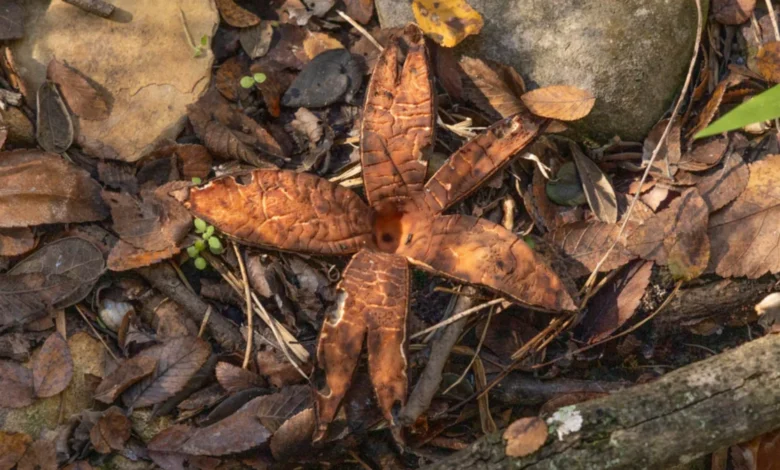
The forest floor along Austin’s Shoal Creek Trail hides secrets that entirely escape the casual observer, but for trained mycologists, the damp autumn earth can reveal specimens of international scientific fascination. Guided by Angel Schatz, executive director of the Central Texas Mycological Society, a group of nature enthusiasts recently tracked down one of the botanical world’s most elusive organisms: Chorioactis geaster, globally known as the Devil’s Cigar and designated officially as the state mushroom of Texas.
Buried beneath a thick blanket of decaying leaf litter right beside a blackened tree stump, the unassuming dark brown lump would have remained completely unnoticed by anyone lacking a trained eye. Yet, finding this organism—historically referred to in Japan by the common name kirinomitake—represents a major milestone for amateur and professional foragers alike. Because of its extraordinarily narrow ecological niche, highly specific climatic requirements, and bizarre reproductive cycle, the Texas Star mushroom remains one of the most sought-after and rarely observed fungi on Earth.
A Geographic Paradox: From the Lone Star State to East Asia
The scientific mystery of the Devil’s Cigar extends far beyond the borders of Texas. First discovered and formally described in the late 19th century near Austin, Chorioactis geaster is famously recognized for a phenomenon known as disjunct distribution. For decades, mycologists were baffled by the fact that this specific fungus was documented exclusively in a handful of counties across Texas—ranging from Lubbock down to the Hill Country and east toward Dallas—and occasionally across the Red River in Oklahoma.
For a long time, botanical science assumed the species was entirely endemic to the Lone Star State. However, in the latter half of the 20th century, researchers identified the exact same species thousands of miles away in mountainous regions of Japan, and later in Taiwan. Despite decades of global mycological research, scientists have yet to definitively explain why Chorioactis geaster grows natively only in these two widely separated regions of the Northern Hemisphere, sharing virtually identical environmental parameters despite an ocean between them.
Within Central Texas, the life cycle of the Devil’s Cigar is inextricably linked to a specific arboreal host: the cedar elm (Ulmus crassifolia). The fungus behaves as a saprotrophic and semi-parasitic organism, relying heavily on the decaying wood of dead or dying cedar elms. Mycologists often target what they call "black crowns"—the distinct, multi-pointed remnants of old, blackened cedar elm stumps left behind in wooded floodplains and limestone-rich creek beds.
Anatomy and Reproduction: The Hissing Star
Understanding the Devil’s Cigar requires looking at its two distinct developmental phases, each presenting unique challenges for identification and documentation.
In its juvenile stage, the mushroom closely resembles its namesake. It appears as a dark brown, leathery, bulbous cylinder or cigar-shaped structure, typically measuring just one to four inches in length. Often partially submerged in soil or hidden beneath heavy leaf litter, these closed capsules feature a characteristic apical nipple at the top. During this closed phase, the fungus is exceptionally well-camouflaged, blending seamlessly with decaying bark, damp soil, and rotted wood.
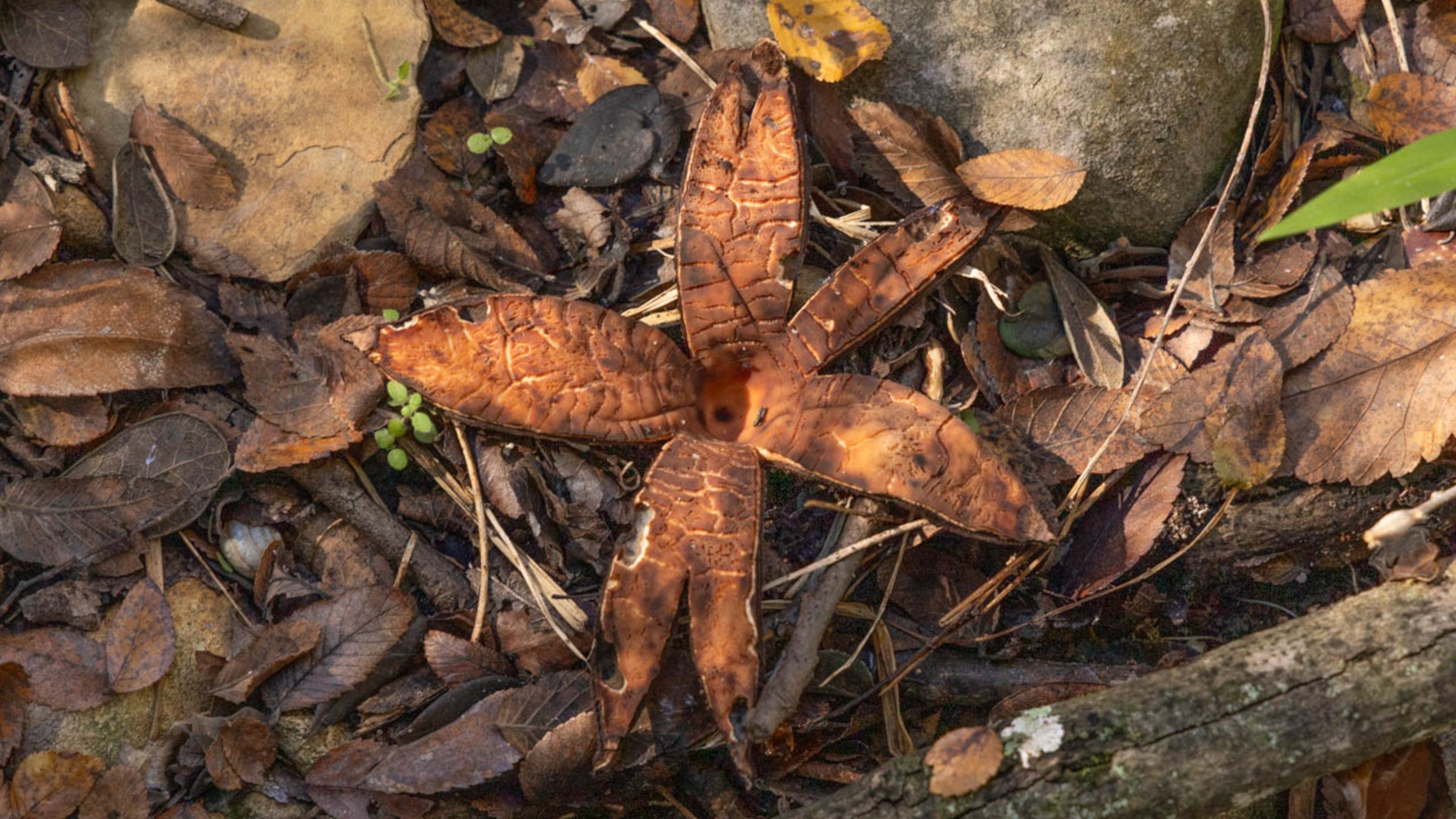
The true spectacle occurs during the mature reproductive phase. When internal pressure builds and moisture levels peak, the leathery brown casing splits open radially into four to seven rays, transforming the cigar shape into a striking, tan-colored star that can measure several inches across.
This transformation is accompanied by a dramatic mechanical action. As the inner spore-bearing surface dries and flexes, the mushroom releases its microscopic spores into the atmosphere accompanied by a distinct, audible hissing sound—a rare example of an audible fungal spore dispersal mechanism, known as ballistospory. Once the star opens, researchers estimate that observers have a very narrow window, typically lasting roughly a week, to spot the specimen before environmental decomposition sets in or local insects consume it. Despite its striking appearance and intriguing behavior, the Devil’s Cigar is entirely inedible, possessing a tough, woody texture lacking any culinary value.
Optimal Conditions and the Foraging Window
For those hoping to catch a glimpse of the Texas Star, timing and weather are everything. The emergence of Chorioactis geaster is heavily dependent on seasonal shifts, typically occurring from the late fall through the early spring.
During the warmer months of the year, the organism remains dormant underground or within the heartwood of rotting stumps. However, as regional temperatures begin to drop—with overnight lows consistently falling below 50 degrees Fahrenheit—and autumn rains saturate the soil, metabolic activity within the mycelium accelerates.
Mycological experts advise prospective spotters to head out into wooded creek bottoms and limestone trails immediately following significant rainfall events. The combination of high relative humidity, consistently moist soil, and cooler ambient temperatures creates the ideal physical pressure needed to force the closed cigar-shaped capsules to burst into their characteristic star formations.
Because the mushroom requires undisturbed habitats with mature populations of cedar elms, urban expansion, land clearing, and habitat fragmentation pose ongoing challenges to its local survival. Conservation groups and amateur mycology societies emphasize the importance of ethical foraging practices, which strictly prohibit disturbing the underlying root systems or removing rare specimens from public lands.
Prime Texas Trails for Spotting the Texas Star
While the Devil’s Cigar can theoretically appear anywhere in Central Texas where cedar elms thrive in moist, shaded environments, certain regional parks and greenbelts offer a statistically higher probability of successful observation due to their protected status and dense native tree populations.
Devils Backbone Trail, Inks Lake State Park, Burnet
Located in the heart of the Texas Hill Country, this 3.5-mile out-and-back trail guides hikers through rugged terrain characterized by rocky limestone outcrops, upland forests, and dense stands of cedar elm. The trail meanders alongside creeks feeding into Inks Lake, providing the damp microclimates and decaying organic matter that Chorioactis geaster requires. In addition to offering prime mycological exploration, the area features rich birdwatching opportunities, making it a popular destination for naturalists.
Barton Creek Greenbelt, Austin
Stretching nearly four miles out-and-back from the trailhead near Barton Springs Pool in Zilker Park, the Barton Creek Greenbelt serves as an accessible urban oasis for wildlife enthusiasts. Hiking south toward the 360 Trailhead takes visitors through shaded riparian zones lined with mature hardwood trees, including numerous cedar elms. The heavy foot traffic combined with protected natural corridors makes this an ideal location for guided educational forays led by organizations like the Central Texas Mycological Society.
Purgatory Creek Natural Area, San Marcos
For those seeking a more secluded excursion, Purgatory Creek offers a 7.7-mile lollipop loop trail on the southern edge of San Marcos. Meandering through a diverse canopy of live oaks and cedar elms, Dante’s Trail and the connecting Paraiso Trail take hikers across quiet limestone creek beds and shaded ravines. The dense leaf litter and undisturbed soil composition along this route create an optimal habitat for elusive fungi, rewarding hikers who take the time to scan the ground near decaying black crowns.
Broader Implications for Conservation and Science
The continued documentation of Chorioactis geaster along Texas trails highlights the vital importance of urban green spaces, state parks, and protected natural areas in preserving regional biodiversity. While the mushroom holds no commercial or culinary value, its status as an ecological indicator makes it a subject of ongoing interest for academic researchers studying fungal biogeography and climate adaptation.
As local mycology groups continue public outreach and educational hikes, awareness of the Texas Star is steadily growing among outdoor recreationists. By transforming routine hikes into educational opportunities, organizations like the Central Texas Mycological Society ensure that the fragile ecosystems supporting rare organisms like the Devil’s Cigar remain protected for future generations of scientists and nature lovers to study and appreciate.