When Elvis Met Nixon: The Untold Story Behind the National Archives Most-Requested Image

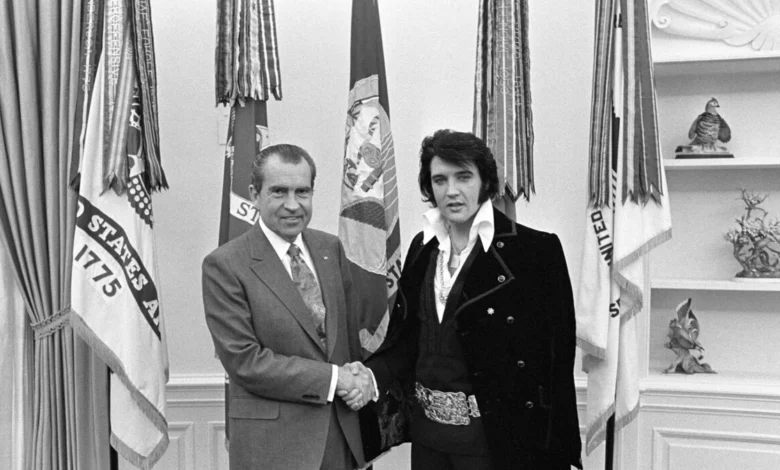
The White House Photo Office contact sheet for roll 5364 carries a typed label that misspells the legendary singer’s name: "Elvis Presly with President Nixon," dated December 21, 1970, with a single heavy-capitalized word stamped along the right margin: ATKINS. Spanning twenty-two frames of Kodak Tri-X film arranged neatly across five rows, this historical artifact documents one of the most culturally surreal encounters of the 20th century. In frame 18, President Richard Nixon and Elvis Presley clasp hands firmly in front of the Oval Office flags, staring directly into the camera lens with distinct intensity.
While the National Archives has frequently described this specific frame as either the most requested image or one of the most requested images in its massive 15-million-item holding, the photograph captures neither the exact moment the two men met nor the entirety of their clandestine 15-minute interaction. Ollie Atkins, Nixon’s chief White House photographer, had captured their initial handshake sixteen frames earlier, which featured Presley wearing oversized, tinted sunglasses and gripping a stack of personal photographs. Frame 18 represents a second, deliberately posed handshake, executed midway through a meeting that Presley had explicitly requested the administration keep strictly confidential.
The paper trail surrounding Atkins’ twenty-eight frames offers a fascinating window into late-20th-century presidential operations. Preserved primarily within the holdings of the Richard Nixon Presidential Library and Museum, the archive includes Presley’s handwritten, multi-page letter, internal staff memoranda, the president’s Daily Diary, contact sheets, and press guidance drafted over a year later when the meeting finally leaked to the press. Despite institutional debates regarding whether this image definitively outstrips foundational documents like the Constitution in public requests, its enduring cultural footprint remains undisputed.
A Handwritten Plea at the Northwest Gate
The chronology of the encounter began in the early morning hours of Monday, December 21, 1970. Presley, then 35 years old and at a distinct crossroads in his legendary music and film career, had flown overnight from Los Angeles to Washington, D.C. At approximately 6:30 a.m., the King of Rock ‘n’ Roll arrived at the White House northwest gate and handed a bewildered guard an unusual missive written on American Airlines in-flight stationery.
The document comprised five handwritten pages, accompanied by a sixth sheet detailing private telephone numbers for Presley’s residences in Memphis, Beverly Hills, and Palm Springs, as well as his manager’s direct line. Marked private and confidential, the letter was addressed to the president via California Senator George Murphy, who had coincidentally shared Presley’s overnight flight.
"First, I would like to introduce myself. I am Elvis Presley and admire you and have great respect for your office," the singer wrote. Presley articulated a deep concern over the shifting social and cultural landscapes of the era, specifically citing hippies, the anti-war drug culture, the Students for a Democratic Society, and the Black Panthers. He asserted that these groups did not view him as an ally or part of the traditional establishment, positioning himself instead as a uniquely influential cultural asset willing to travel the country to combat drug abuse and anti-American sentiment. In exchange for his clandestine assistance, Presley requested a specific official credential: to be made a "Federal Agent at Large."
Providing his alias, Jon Burrows, and his room number at the Washington Hotel, Presley assured officials, "I will be here for as long as it takes to get the credentials of a Federal Agent." He attached a singular, absolute condition: "I am glad to help just so long as it is kept very private." Researchers at the George Washington University-based National Security Archive have long made scans of these primary source documents publicly available, preserving the raw, unvarnished nature of Presley’s administrative ambitions.
Inside the West Wing: Bureaucratic Maneuvering
Upon receiving the letter that morning, Dwight Chapin, the president’s special assistant, promptly forwarded the missive to White House Chief of Staff H.R. Haldeman. Noting that Presley had physically appeared at the gate, Chapin proposed that Egil "Bud" Krogh—a deputy assistant whose portfolio included addressing drug abuse—meet with Presley first to assess whether any honorary law enforcement credentials could appropriately be issued. Chapin suggested that Krogh could then seamlessly introduce Presley to President Nixon during the "Open Hour," a scheduled block for brief courtesy visits. "He wants to keep everything private and I think we should honor his request," Chapin added, noting that engaging with Presley might offer a valuable avenue for connecting with young Americans outside traditional government channels.
H.R. Haldeman’s initialed approval was swift, though historically marked by skepticism. Beside Chapin’s pitch, Haldeman famously scrawled the margin note, "You must be kidding," a sentiment later highlighted by both White House historians and archival publications. Nevertheless, executive machinery moved forward. Talking points prepared for the president scheduled the meeting for 12:30 p.m., designating Presley and Krogh as the sole participants, and floated the suggestion that Presley record an anti-drug album themed "Get High on Life" at the federal drug rehabilitation and research center in Lexington, Kentucky.
The official White House Daily Diary for that Monday chronicles the execution of these plans. It lists "Elvis Presley, entertainer" meeting with Krogh from 12:45 to 1 p.m., concluding a sequence of brief appointments that had commenced with White House telephone operators. A subsequent entry logs Presley again from 1:09 to 1:11 p.m., accompanied by his two close associates, Jerry Schilling and Sonny West. Notably absent from the official diary entries is Ollie Atkins, whose camera preserved the visual evidence of both sequential visits.
Anatomy of Roll 5364: Capturing the King
Ollie Atkins brought two decades of photojournalism experience—including extensive work for the Saturday Evening Post covering Washington politics—to his role as Nixon’s personal photographer. The White House Photo Office meticulously logged every roll of film by photographer, date, format, and processor. On December 5364, Atkins utilized Kodak Tri-X Pan black-and-white film, resulting in a visual sequence that aligns precisely with the chronological progression of the meeting.
According to Bud Krogh’s internal memorandum for the presidential file, the encounter commenced immediately with photographic documentation. Frames 02 through 04 of roll 5364 depict the initial greeting: a handshake beside an Oval Office door, with Presley wearing his signature oversized tinted glasses and a high-collared shirt, clutching a stack of photographs and a leather case in his left hand. Frames 05 through 09 transition to the Resolute Desk, where Presley laid out various law enforcement badges and signed photographs of his wife, Priscilla, and daughter, Lisa Marie, while President Nixon examined a print.
Krogh’s notes document that Presley wasted no time showcasing his extensive collection of law enforcement memorabilia, which included badges from police departments in California, Colorado, and Tennessee. Frames 10 through 13 widen the perspective, showing Krogh positioned to the right of the desk. Frames 14 through 19 capture the pivotal, staged handshakes in front of the executive flags. By frames 18 and 19, Presley had removed his dark glasses, and both men locked their gaze directly onto Atkins’ camera lens. The final frames, 20 through 23, return to the desk, culminating in frame 21, where President Nixon appears to lean in to inspect Presley’s ornate cuff links.
A Second Roll and the Missing Audio Record
Atkins was simultaneously managing a second roll of film, roll 5369, which captured prior and subsequent administrative traffic, including Deputy Assistant Edward Morgan and his mother, alongside Presley’s associates, Jerry Schilling and Sonny West.
Crucially, no audio recording of the conversation exists within the historical record. The Secret Service did not officially install Nixon’s voice-activated taping system in the Oval Office until February 16, 1971—fifty-seven days after the meeting took place. Consequently, historians must rely entirely on Krogh’s written memoranda, subsequent memoirs, and participant recollections. According to Krogh’s contemporary notes, the meeting featured Presley passionately denouncing the Beatles as "a real force for anti-American spirit," declaring his unwavering loyalty to the commander-in-chief, and concluding the encounter by impulsively wrapping his left arm around the president in a warm embrace.
The Badge, the Gun, and the Public Leak
While Krogh’s contemporaneous file memo makes no explicit mention of Presley demanding a federal narcotics bureau badge, subsequent retellings and official guidance clarify the resolution of the request. On January 27, 1972—thirteen months after the meeting—journalist Jack Anderson broke the story in the Washington Post under the headline "Presley Gets Narcotics Bureau Badge," forcing the White House to draft defensive press guidance.
Evidence indicates that John Finlator, deputy director of the Bureau of Narcotics and Dangerous Drugs, had initially rebuffed Presley’s request that morning, only to relent later that afternoon at the urging of White House staff, presenting the singer with a specially commissioned honorary badge. Graceland archives later prominently displayed this artifact, alongside the purple velvet ensemble Presley wore to the White House, during the 50th-anniversary exhibitions.
Conversely, Presley’s reciprocal gift to the president—a commemorative World War II Colt .45 pistol encased in a bespoke wooden presentation chest—was intercepted by security personnel due to strict White House protocols, preventing Presley from handing it directly to the chief executive. Today, that firearm is permanently housed in the collection of the Nixon Presidential Library.
Legacy and Archival Permanence
When the Nixon administration collapsed in the wake of the Watergate scandal, Atkins’ photographic negatives transferred to the National Archives under the Presidential Recordings and Materials Preservation Act of 1974. Opened for public research in the early 1980s, the images experienced a massive surge in public interest following syndicated media features and late-night television appearances in the late 1980s and 1990s.
In July 1997, to coincide with the 20th anniversary of Presley’s death, the National Archives published all twenty-eight frames online in a specialized digital exhibit titled "When Nixon Met Elvis." Over the subsequent decades, as institutional blogging and digital outreach expanded, the Archives repeatedly cited frame 18 as its single most requested photograph. Although internal archivists have occasionally noted the inherent difficulties in tracking exact download frequencies across decentralized regional branches and digital portals, the cultural resonance of the image remains unmatched.
Ultimately, roll 5364 stands as an extraordinary historical touchstone—a fleeting intersection between the conservative political establishment of Cold War America and the undisputed King of Rock ‘n’ Culture, preserved forever in twenty-two frames of silver gelatin emulsion.
Related posts: