Bold, bustling, and culturally rich, Belgrade stands as one of southeastern Europe’s most compelling urban destinations. Positioned strategically at the confluence of the Sava and Danube rivers, the Serbian capital bridges Central European architecture with Balkan resilience. As the city continues to emerge as a prominent economic and cultural hub in the region, international tourism figures have steadily climbed, drawing travelers eager to explore its centuries-old fortresses, expansive green spaces, and world-renowned nightlife.

For decades, Belgrade has been defined by its turbulent geopolitical history, having served as a strategic crossroad for Roman, Byzantine, Austro-Hungarian, and Ottoman empires. Today, however, municipal authorities and cultural institutions are successfully shifting the global narrative toward contemporary art, progressive culinary scenes, and accessible urban tourism. With significant investments in infrastructure, restored historical districts, and a booming digital nomad community, Belgrade offers an intricate blend of ancient heritage and modern vitality.
Historical Foundations and Architectural Landmarks
Belgrade Fortress and Kalemegdan Park
At the heart of the capital’s historical identity lies the Belgrade Fortress, locally known as Kalemegdan Fortress. Overlooking the panoramic expanse where the Sava meets the Danube, this archaeological and architectural complex has witnessed more than a hundred battles across antiquity and the medieval era. Originally established as a Roman castrum in the 1st century AD, the site evolved through Byzantine fortification, medieval Serbian expansion, and extensive Ottoman and Austro-Hungarian reconstruction.

Adjacent to the fortifications is Kalemegdan Park, functioning as the city’s primary green sanctuary. Spanning across the upper and lower towns, the park integrates Roman ruins, military open-air exhibitions, and shaded promenades. Tourism analysts note that Kalemegdan remains the single most visited landmark in Serbia, drawing millions of domestic and international visitors annually.
The Architectural Contrast of Stari Dvor and Novi Dvor
Representing the city’s royal and political evolution, the Old Palace (Stari Dvor) and the New Palace (Novi Dvor) showcase the capital’s 19th- and early 20th-century grandeur. Completed in 1884 under the Obrenović dynasty, Stari Dvor exhibits refined academic and neoclassical design elements, currently serving as the seat of the Belgrade City Assembly. Directly opposite stands Novi Dvor, constructed in the early 20th century as a royal residence and presently functioning as the official office of the President of Serbia. These structures underscore the architectural transition from regional monarchy to modern republican governance.

The Temple of Saint Sava
Dominating the Vračar plateau, the Temple of Saint Sava stands as one of the largest Eastern Orthodox church buildings in the world. Dedicated to the foundational figure of the Serbian Orthodox Church, construction on the monumental structure began in the 1930s, though it faced decades of political delays before its primary exterior was completed. Built in a neo-Byzantine architectural style, the church’s massive copper dome reaches a height of 79 meters, crowned by a 10-meter-high gold-plated cross. The interior decoration, executed in collaboration with leading mosaic artists, represents a major milestone in contemporary religious art and engineering.
Cultural Institutions and Intellectual Heritage
The National Theatre and Performing Arts
Established by a decree of Prince Michael III in 1868, the National Theatre in Belgrade is the cornerstone of Serbian performing arts. Located on Republic Square, the institution houses resident ensembles for opera, ballet, and drama. Throughout its history, the theatre has operated as a cultural anchor, maintaining operations even through periods of severe geopolitical instability. Today, it stages hundreds of classical and contemporary productions annually, attracting high-profile international directors, vocalists, and choreographers.

Comprehensive Museum Offerings
Belgrade’s museum sector offers deep insights into national and European history, science, and fine arts:
- The National Museum of Serbia: Reopened after a multi-year comprehensive renovation, the institution houses over 400,000 archaeological artifacts, numismatic collections, and masterpieces of European and Yugoslav painting.
- The Military Museum: Situated within the Belgrade Fortress grounds, it displays an extensive chronology of Balkan warfare, featuring over 3,000 artifacts ranging from medieval weaponry to modern armor.
- The Nikola Tesla Museum: Dedicated to the life, inventions, and personal archives of the world-renowned electrical engineer and physicist, this institution holds thousands of original documents, patent blueprints, and functional replicas of Tesla’s alternating current innovations.
- The Museum of Yugoslavia and the House of Flowers: Chronicling the rise, zenith, and dissolution of the Socialist Federal Republic of Yugoslavia, the complex preserves the legacy of former president Josip Broz Tito, serving as a vital site for contemporary historical research.
Distinct Neighborhoods and Urban Enclave Exploration
Skadarlija: The Bohemian Quarter
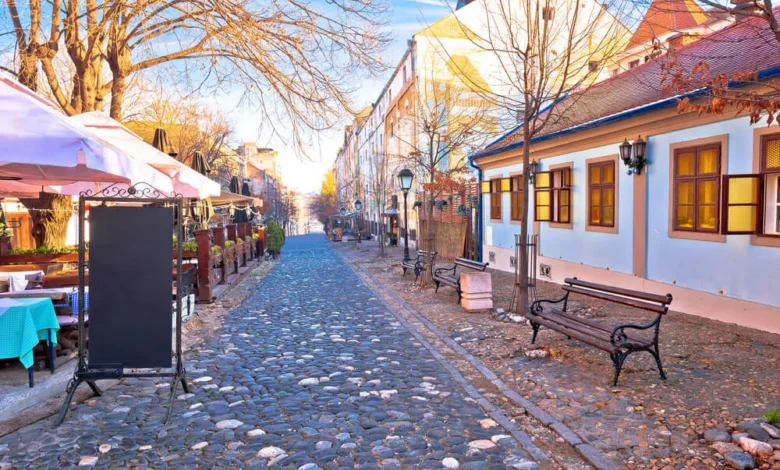
Often compared to Montmartre in Paris, Skadarlija is a cobblestone pedestrian zone that preserves the artistic spirit of late 19th- and early 20th-century Belgrade. Historically inhabited by poets, painters, and actors, the street maintains its bohemian ambiance through preserved traditional taverns (kafanas), vintage streetlamps, and live acoustic music. Local economic studies highlight Skadarlija as a critical hub for cultural tourism, preserving traditional gastronomy and folklore performance arts.

Zemun and Gardoš Tower
Located north of the city center along the right bank of the Danube, Zemun retains a distinct Central European character, reflecting its centuries-long status as a frontier town of the Austro-Hungarian Empire. Visitors can explore the maze of narrow streets leading up to the Gardoš hill, crowned by the Millennium Tower (Gardoš Tower). Built in 1896 to mark a millennium of Hungarian settlement in the Pannonian Basin, the structure now operates as a cultural viewpoint and art gallery, offering expansive vistas across the river plains toward Belgrade proper.
Natural Escapes and Recreational Tourism
Ada Ciganlija
Referred to locally as "Belgrade’s Sea," Ada Ciganlija is a former river island converted into an expansive peninsular lake and recreational park on the Sava River. Spanning several kilometers of shoreline, the complex features pebble beaches, sports facilities, cycling paths, and rowing courses. During the summer months, the area accommodates hundreds of thousands of visitors daily, playing a vital role in the city’s urban ecology and public health infrastructure.

Mount Avala and the Avala Tower
Rising 511 meters above sea level on the southern fringes of the city, Mount Avala offers forested walking trails, historical monuments, and panoramic views. The mountain is dominated by the Avala Tower, a telecommunications skyscraper standing at over 204 meters. Originally destroyed during the 1999 NATO bombings, the tower was meticulously rebuilt using domestic materials and reopened in 2010, cementing its status as an engineering landmark in the Balkans.
Gastronomy and Culinary Traditions
Serbian cuisine reflects a dynamic synthesis of Mediterranean, Central European, and Ottoman influences. Traditional dining centers around meat dishes, slow-cooked stews, and dairy products. Key culinary items include mešano meso (mixed meat grills featuring ćevapi and pljeskavica), along with regional specialties such as podvarak (baked sauerkraut with meat) and seasonal winter preserves.

Culinary tourism has expanded significantly in recent years, with the city’s restaurant sector gaining recognition in international culinary guides. Alongside traditional taverns in Skadarlija, central shopping zones and open-air green markets like Kalenić Market provide insight into local agricultural supply chains, artisanal cheeses, and regionally produced brandies, notably rakija.
Nightlife and Entertainment Economy
Belgrade has cultivated a global reputation for its vibrant and diverse nightlife, frequently cited by travel economists as a major driver of youth tourism in southeastern Europe. The city’s nightlife infrastructure operates across multiple vectors, from electronic music clubs housed in floating river barges (splavovi) along the Sava and Danube banks to alternative indie venues in the Savamala district.

Cultural event programming is active throughout the year, featuring international festivals such as:
- FEST: The Belgrade International Film Festival, established in 1971.
- Belgrade Beer Fest: One of the largest open-air music and brewing festivals in Southeast Europe.
- Belgrade Fashion Week and Guitar Art Festival: Annual celebrations of contemporary design and performance.
Regional Connectivity and Strategic Economic Implications
As an emerging hub for international business and tourism, Belgrade is accessible via Nikola Tesla Airport (BEG), which serves as the primary operational base for the national carrier, Air Serbia. Ongoing infrastructure modernization, including expanded highway links and high-speed rail development connecting the capital to regional centers like Novi Sad, has substantially improved transit times and passenger volumes.

Municipal tourism boards project continued growth through strategic investments in green urban spaces, digital infrastructure, and heritage preservation. By leveraging its unique geopolitical crossroads and multicultural heritage, Belgrade remains a vital cultural and economic anchor in the broader Balkan region, offering travelers an authentic window into European history and contemporary dynamism.