The modern corporate landscape is currently defined by a paradox: as artificial intelligence tools promise to streamline efficiency and automate mundane tasks, the average professional reports an increasing sense of digital fatigue and "meeting bloat." In a bold, culturally rooted response to this phenomenon, Visit Iceland has launched its latest tourism campaign, the "AI Knittaker" initiative. The project, which operates from October 29 through November 20, 2026, invites busy professionals to swap their presence in repetitive, unproductive meetings for an Icelandic knitter. These human artisans do not merely record transcripts; they observe the nuance of the conversation, analyze the emotional temperature of the room, and distill the essence of the meeting into a single word, which is then hand-stitched into a traditional Icelandic wool creation.
This campaign arrives at a moment of significant workplace frustration. According to a recent survey conducted by Visit Iceland, residents in the United States and the United Kingdom estimate they lose approximately eight hours per month to meetings deemed entirely unnecessary. By providing a tangible, artisanal alternative to the sterile automation of AI meeting summaries, Iceland is attempting to reframe the conversation around what constitutes "valuable" time and authentic connection in an increasingly digitized work environment.
The Mechanism of the Knittaker
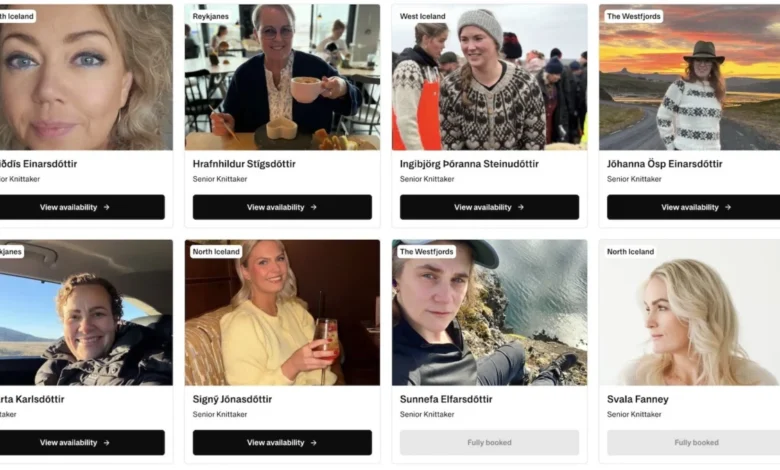
The booking process for the service is designed to be as straightforward as it is whimsical. Participants can select a specific knitter from a roster of Icelandic residents, each bringing their own distinct history and craft experience. The pool ranges from 30-year-old residents of Kópavogur to 68-year-old master crafters from the remote town of Seyðisfjörður, many of whom have been honing their skills since childhood.
The highlight of the initiative is the participation of Salka Sól Eyfeld, the celebrated Icelandic singer and actor known for her role in the crime drama "Trapped." Eyfeld, who also serves as a published author on the subject of knitting, brings a high-profile, creative sensibility to the role of Chief Knittaker. Once a meeting is "attended" by a chosen artisan, they evaluate the dynamics—noting the loaded pauses, the subtle disagreements, and the breakthrough ideas—before selecting a summary word. Whether the meeting resulted in a "PIVOT," a "RESET," or perhaps a more exasperated "WTF?", the final product is a physical piece of Icelandic wool that serves as a permanent, tactile record of the meeting’s outcome.
A History of Subversive Tourism
The "AI Knittaker" campaign is the latest in a decade-long string of unconventional marketing strategies from Iceland, a country that has consistently used its national identity to subvert global trends. The strategy began in earnest in 2015 with the "Ask Guðmundur" project. By framing seven real-life Icelanders named Guðmundur or Guðmunda as a "human search engine," the tourism board challenged the reliance on digital algorithms to solve human problems.
This history of disruption includes the 2020 "OutHorse Your Stress" campaign, where visitors were encouraged to record their frustrations to be blasted into the Icelandic wilderness, and the 2021 "Icelandverse" campaign. Released only 13 days after Meta’s rebrand, the latter featured a Zuckerberg lookalike in a parody of the metaverse, offering viewers "actual reality" instead. Perhaps most successful was the 2022 "OutHorse Your Email" initiative, where Icelandic horses were trained to walk across oversized keyboards to generate out-of-office replies. That specific campaign yielded $6.8 million in earned media and contributed to a 16.8 percent increase in travel interest among American tourists.
Cultural Significance of the Lopapeysa
The choice of knitting as the centerpiece for this campaign is deeply rooted in Icelandic history. Since the country’s settlement in the ninth century, sheep farming and wool production have served as the backbone of the domestic economy. While fishing eventually overtook farming in the early 20th century, the cultural significance of the lopapeysa—the iconic Icelandic wool sweater—remains unparalleled.
The lopapeysa, characterized by its distinctive patterned color stripe around the neckline and shoulders, is more than a fashion statement; it is a protected cultural product. Following a 2020 law, the term is legally restricted to sweaters hand-knit in Iceland using virgin wool from Icelandic sheep. By centering the campaign on this craft, Visit Iceland is not just mocking AI; it is asserting the value of protected, geographic, and manual authenticity against the backdrop of mass-produced, globalized digital output.
The "Workslop" Crisis and AI Fatigue
The resonance of this campaign is likely due to the growing "AI backlash" in the professional sphere. Recent data from the Pew Research Center indicates a shift in public sentiment; as of March 2026, half of all Americans report being more concerned than excited by the rapid integration of AI into their daily lives—a sharp increase from 37 percent in 2021.
The workplace environment reflects this trend with even greater intensity. Mentions of AI in employer reviews on platforms like Glassdoor surged by 240 percent between May 2025 and May 2026. Significantly, 53 percent of these reviews categorized the implementation of AI as a negative factor, citing it as an impediment to genuine productivity. The phenomenon of "workslop"—AI-generated content that appears professional but lacks substance—has become a common point of contention. Data suggests that 57 percent of employees now engage with AI-generated meeting summaries, yet many report that these summaries fail to capture the critical human elements of a discussion, such as intent, hesitation, or consensus.
Implications for the Future of Work
The "AI Knittaker" project is not merely a marketing gimmick; it is an economic and social critique. By highlighting the contrast between the fleeting, data-heavy output of an AI bot and the slow, deliberate, and high-quality output of an Icelandic knitter, the campaign invites a reflection on the nature of productivity.
Economically, the campaign functions as a high-visibility, low-cost investment. By targeting the pain points of the global workforce, Visit Iceland successfully captures international attention, leveraging the desire for "slow travel" and authentic experiences. The campaign positions Iceland as the antithesis of the hyper-connected, AI-driven burnout culture currently pervasive in major financial and tech hubs.
From a sociological perspective, the initiative challenges the assumption that every process must be optimized for speed. When the "summary" of a board meeting is a hand-knit piece of wool, the metrics of the meeting change. The physical object demands time, patience, and a recognition of the human labor behind it. In a world where AI is increasingly being used to "unmute" productivity, the Icelandic approach suggests that sometimes, the most productive thing one can do is to slow down, disconnect from the screen, and engage with something tactile.
Conclusion
As the November 20, 2026 deadline for the project approaches, the success of the "AI Knittaker" will likely be measured not just in the number of sweaters sent to international offices, but in the sustained conversation it generates regarding human autonomy. By effectively positioning itself as the "anti-AI" destination, Iceland continues to differentiate itself in a crowded global tourism market.
While AI will undoubtedly continue to evolve, the cultural message delivered by this campaign remains static: the human element—characterized by nuance, creativity, and the ability to "read the room"—is a commodity that no amount of machine learning can truly replicate. As professionals return to their offices, they may find themselves looking at their AI-generated summaries with a renewed skepticism, perhaps wondering what a traditional Icelandic knitter would have made of the same conversation. In the final analysis, the project serves as a reminder that the value of human connection, however inefficient it may appear in a spreadsheet, remains the most essential component of our collective work.
Related posts: