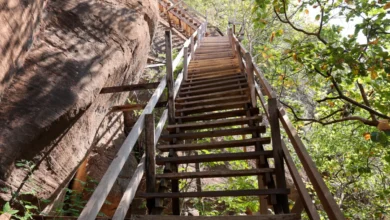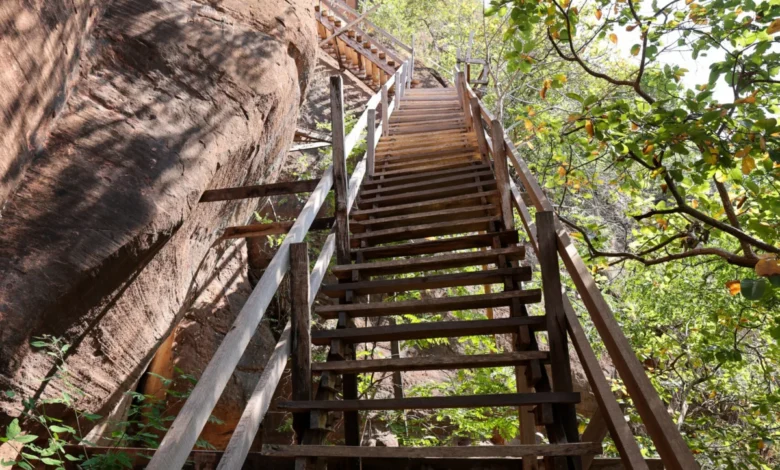
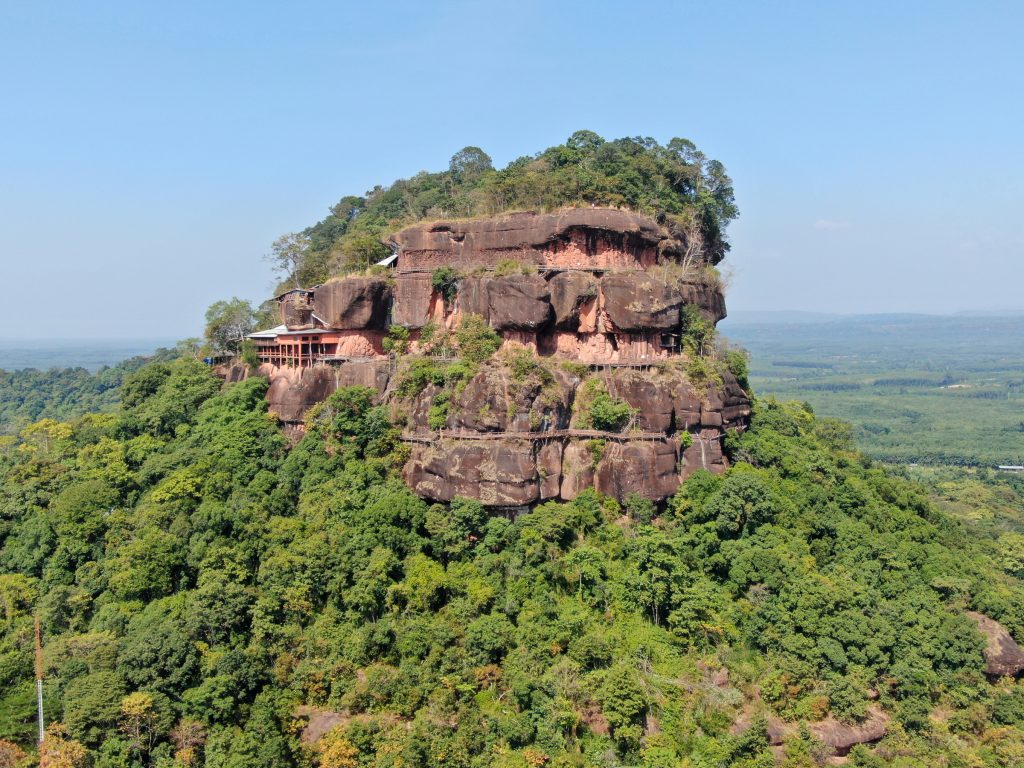
Nestled in the remote, verdant landscapes of Bueng Kan province in northeastern Thailand’s Isan region lies Wat Jetiyakhiri, more universally known as Wat Phu Tok. Translating locally to the "lonely mountain," this 359-meter-high isolated sandstone monolith rises dramatically from the surrounding flat plains. It offers travelers an experience that blends architectural ingenuity, spiritual pilgrimage, and high-altitude adrenaline. Visually reminiscent of Sri Lanka’s famed Sigiriya fortress on a smaller scale, the temple complex is celebrated not only for its breathtaking panoramic views of the Mekong River basin but also for its intricate system of wooden staircases and cliff-hugging walkways designed to test the limits of both faith and balance.
Main Facts and Architectural Overview
Wat Phu Tok functions as both an active Buddhist monastery and an architectural marvel. The defining characteristic of the site is its seven-tiered wooden scaffolding system, painstakingly constructed to encircle the vertical sandstone rock face. These elevated pathways, ladders, and staircases allow monks, pilgrims, and tourists to navigate the sheer cliffs and access various meditation cells, shrines, and ordination halls distributed across the mountain’s elevations.

The structure is divided into seven distinct levels, a deliberate design choice that mirrors the seven stages of spiritual enlightenment in Buddhist philosophy. While the lower tiers feature relatively gentle slopes and dense forestation, the upper levels transition into narrow, suspended wooden planks anchored directly into the rock. The sixth level, in particular, features a continuous suspended walkway spanning the circumference of the cliff, offering unobstructed views of the surrounding countryside while evoking a profound sense of exposure and thrill.
Chronology and Historical Development

The history of Wat Phu Tok is deeply intertwined with the region’s ascetic monastic traditions. Due to its rugged terrain, dense jungle canopy, and isolation, the mountain historically served as a natural habitat for diverse wildlife, notably including populations of venomous snakes. These very environmental challenges made the site an ideal location for forest monks seeking solitude, seclusion, and a rigorous environment for meditation.
The transformation of the lonely mountain into a sacred pilgrimage site was spearheaded by the revered monk Luang Pu Juan. Recognizing the spiritual potential of the rugged topography, Luang Pu Juan initiated the ambitious project to construct a vertical transit network. Monks, novices, and local volunteers labored to build the intricate web of wooden stairs, ladders, and cantilevered walkways, connecting isolated caves and rocky outcrops where monks could practice mindfulness undisturbed.

Following the tragic passing of Luang Pu Juan in an aircraft accident, the maintenance of the complex fell to succeeding generations of monastics and local authorities. Despite the logistical challenges of preserving wooden structures in a tropical, high-altitude environment, the temple continues to be meticulously maintained as a functioning place of worship and a monument to human perseverance.
Supporting Data and Geographical Context

Bueng Kan province, officially established as Thailand’s 77th province in 2011 after separating from Nong Khai, remains one of the country’s least commercialized and most sparsely populated administrative regions. Located approximately a 30-minute drive from Bueng Kan city, Wat Phu Tok serves as a primary economic and cultural anchor for tourism in an otherwise off-the-beaten-path destination.
The mountain itself reaches an elevation of 359 meters above sea level. The architectural ascent is characterized by strict vertical zoning:

- Levels 1 through 4: Serve as the transitional zones, featuring dense vegetation, initial staircases, and minor shrines, gradually increasing in steepness until the stairs resemble vertical ladders.
- Level 5: Functions as the primary administrative and ceremonial hub of the monastery. This tier features ground-level pathways, numerous shrines, and the main ordination hall (Ubosot), alongside secondary detours leading to isolated rock-carved sanctuaries.
- Level 6: The architectural highlight of the complex. Approximately half of this level consists of wooden plank walkways anchored securely into the sheer rock face, providing a complete 360-degree traverse of the mountain and sweeping vistas of the Mekong River basin.
- Level 7: The summit of the mountain. Accessible via steep vertical ladders, this final tier lacks man-made walkways or architectural structures. Historically known for high populations of venomous snakes, access to this level is designated as "at your own risk" for visitors.
Safety Protocols and Official Guidelines
Given the extreme topography of Wat Phu Tok, local administrative bodies and temple management enforce safety guidelines to mitigate risks associated with high-altitude tourism. While the structural integrity of the wooden scaffolding—constructed from heavy timber anchored with steel bolts into the sandstone—is inspected regularly, authorities emphasize that visitors must exercise personal responsibility.

The shifting of wooden planks underfoot, combined with steep gradients and exposure to sheer drops, requires constant vigilance. Signage and local guides advise visitors to wear appropriate footwear, refrain from carrying bulky equipment that could impede balance, and avoid ascending during severe weather events such as heavy monsoon rains or high winds, which can render the wooden surfaces slick and hazardous. Access to the seventh level is monitored closely during peak rainy seasons when snake activity increases significantly.
Broader Impact and Implications for Regional Tourism

The prominence of Wat Phu Tok has played a critical role in the economic development of Bueng Kan province. As the Tourism Authority of Thailand (TAT) continues to promote secondary destinations to alleviate overcrowding in major urban hubs like Bangkok, Chiang Mai, and Phuket, sites like Wat Phu Tok offer a sustainable blueprint for adventure and eco-tourism.
By distributing tourist traffic to Thailand’s northeastern Isan region, the temple contributes to local hospitality, transport, and guide economies without subjecting the natural landscape to mass commercialization. Furthermore, the site preserves the intangible cultural heritage of the Isan forest monk tradition, offering international and domestic visitors an authentic encounter with Theravada Buddhist practices embedded within a pristine natural environment.

As infrastructural investments improve connectivity to Bueng Kan, Wat Phu Tok remains a prime example of how remote heritage sites can balance public accessibility with the preservation of historical integrity, ecological mindfulness, and inherent architectural daring.